
History
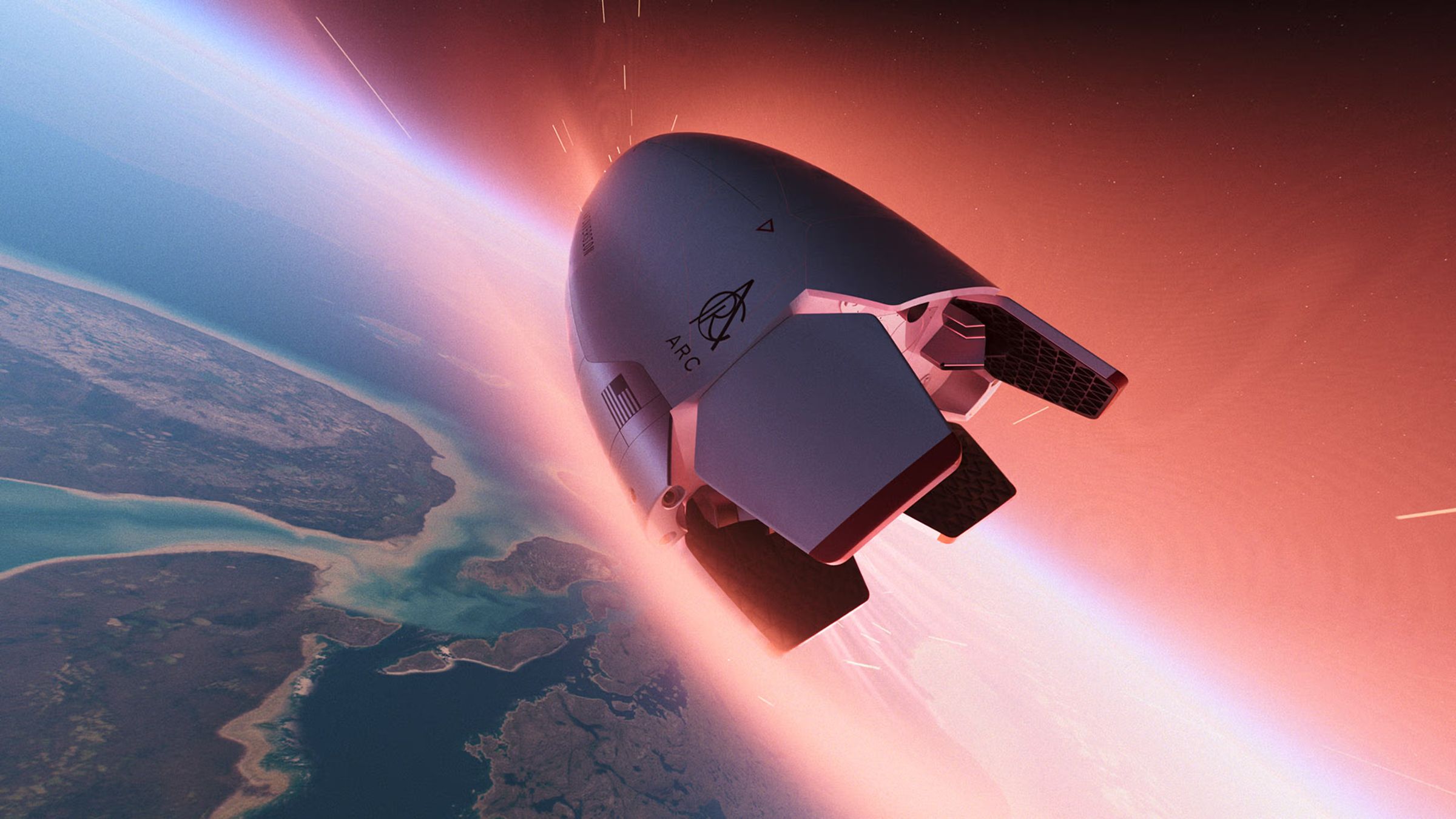
Inversion Arc is a maneuverable reentry spacecraft under development in the United States for rapid cargo delivery from space, hypersonic testing, and national-security missions. The vehicle is intended to descend from low-Earth orbit, conduct controlled hypersonic atmospheric flight, and land autonomously under parachutes.
Inversion publicly unveiled Arc in October 2025 as its flagship space-based delivery vehicle. The program builds on technology tested by the company's smaller Ray spacecraft, which reached orbit in January 2025 and validated subsystems including avionics, solar panels, propulsion, and an internally developed separation system.
Arc is also being examined as a possible platform for an Earth-based aerocapture demonstration with NASA. The study is intended to determine how the spacecraft's maneuverable atmospheric-flight capability could contribute to technology needed for future planetary missions.
Development
At the 2025 unveiling, Inversion presented a full-scale mockup of Arc and reported that it had built a full-scale manufacturing development unit of the primary structure. The company also said it had completed its first mission profile, conducted dozens of drop tests intended to improve landing accuracy, performed advanced aerodynamic modeling, and completed detailed component design. Inversion also reported work with NASA on a next-generation thermal protection system for severe reentry environments. Further details were published in the official Arc announcement.
Inversion initially stated that Arc's first mission was scheduled for 2026. By September 2026, reporting on the program described the first in-space demonstration as planned for no earlier than 2027, indicating that the flight schedule had moved beyond the original target. The updated schedule was reported by Payload.
NASA aerocapture study
In September 2026, Inversion announced that NASA had awarded the company a contract to study the use of Arc for an aerocapture demonstration. Aerocapture uses aerodynamic forces during a controlled atmospheric pass to reduce a spacecraft's velocity and achieve orbital capture while reducing dependence on propulsive braking.
The $350,000 firm-fixed-price purchase order was awarded through NASA's Shared Services Center. The study is scheduled to continue through June 30, 2027, and NASA Ames Research Center was identified as the location supporting performance of the effort. The work covers mission design, aerodynamics, trajectory analysis, and vehicle definition.
NASA has studied aerocapture as a possible method for reducing propulsion requirements on planetary missions, but the technique has not yet been demonstrated in flight. Inversion's study examines whether Arc could reproduce relevant aerocapture trajectories in Earth's atmosphere and provide flight data before the technique is considered for destinations such as Mars, Venus, Titan, Uranus, or Neptune. Inversion described the study in its NASA contract announcement.
Design
Arc is described as a lifting-body reentry spacecraft designed for controlled flight from orbit through the atmosphere at hypersonic velocity. Inversion intends the vehicle to combine substantial cross-range capability with maneuverability throughout reentry, allowing it to alter its flight path before recovery.
The spacecraft is designed to operate from low-Earth orbit. In the company's proposed logistics concept, multiple Arc vehicles could be placed in orbit and commanded to return cargo or other payloads to selected locations. The vehicle is intended to perform descent and atmospheric maneuvering autonomously before landing under parachutes.
Arc incorporates a payload bay intended for different types of cargo and mission equipment. Inversion has presented rapid global logistics, hypersonic testing, national-security missions, and advanced on-orbit operations as planned applications. The company states that the vehicle is intended to be reusable and recoverable after landing.
Hypersonic flight
For hypersonic testing, Inversion describes Arc as capable of flight above Mach 20, sustained high-g loading, and prolonged time under relevant test conditions. These characteristics are intended to reproduce demanding trajectories for test payloads and experimental systems. Arc has been selected for participation in the Kratos-led MACH-TB 2.0 program.
Thermal protection and control
The program requires the spacecraft to survive high-energy atmospheric reentry while maintaining controlled maneuvering. Inversion reported advanced aerodynamic modeling and collaboration with NASA on a next-generation thermal protection system. Detailed material composition, control-surface arrangement, and thermal limits have not been publicly specified in the available sources.
Program status
As of September 2026, Arc remained under development and had not yet completed its first in-space demonstration. A full-scale mockup and a manufacturing development unit of the primary structure had been completed, and the company had conducted drop testing and aerodynamic development. The first in-space demonstration was reported as planned for no earlier than 2027.
The NASA aerocapture contract is a study rather than an operational aerocapture mission. Its purpose is to determine how Arc could support a future Earth demonstration through mission design, aerodynamic analysis, trajectory analysis, and vehicle definition. Contemporary coverage of the spacecraft and its development is available from Military & Aerospace Electronics.
Specifications (Arc)
General characteristics
- Type: maneuverable lifting-body reentry spacecraft
- Developer: Inversion
- Primary planned roles: rapid cargo delivery from space, hypersonic testing, and national-security missions
- Operating concept: deployment in low-Earth orbit followed by autonomous commanded reentry
- Recovery: autonomous parachute landing
- Payload arrangement: versatile internal payload bay
- Reusability: designed for recovery and reuse
Performance
- Hypersonic test velocity: designed for speeds above Mach 20
- Atmospheric flight: maneuverable controlled hypersonic reentry with substantial cross-range capability
- Global delivery objective: intended to deliver payloads from orbit to locations on Earth in under one hour
 Argentina
 Armenia
 Australia
 Austria
 Austria-Hungary
 Belgium
 Brazil
 United Kingdom
 Brunei
 Bulgaria
 Canada
 Chile
Chile China
China Colonial America
 Colombia
 Confederate States
 Croatia
 Czech
Czech Denmark
 Egypt
Egypt Finland
 France
 Georgia
 Germany
 German Imperial
 Greece
 Holland
 Hungary
 India
India Indonesia
 Iran
Iran Iraq
Iraq Ireland
 Israel
 Italy
Italy Japan
Japan Japan (1940)
 Jordan
 Kingdom of Italy
 Malaysia
 Mexico
 Myanmar
 Nazi Germany
 Netherlands
 New Zealand
 North Korea
 Norway
 Pakistan
 Peru
Peru Philippines
 Poland
 Portugal
 Prussia
 Romania
 Russia
 Saudi Arabia
 Serbia
 Singapore
 Slovakia
 Slovenia
 South Africa
 South Korea
 Soviet Union
 Spain
Spain Sweden
 Switzerland
 Syria
Syria Taiwan
 Thailand
 Turkey
 UAE
UAE Ukraine
 Vietnam
 Yugoslavia