
History
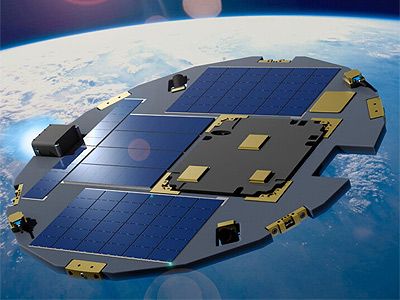
DiskSat is a plate-shaped small spacecraft platform developed by The Aerospace Corporation with NASA funding as an alternative to the conventional CubeSat form factor. The design preserves a standardized launch interface while providing a much larger exposed surface area for power generation, antennas, sensors, and other spacecraft equipment.
The first DiskSat technology demonstration consists of four spacecraft intended to validate the platform, its deployment system, maneuverability, and operation at low and very low Earth orbit altitudes. The four spacecraft were launched on a Rocket Lab Electron from Launch Complex 2 at Wallops Island, Virginia, on December 18, 2025.
NASA's Small Spacecraft & Distributed Systems program funds and manages the technology demonstration, while The Aerospace Corporation leads development of the DiskSat concept and spacecraft. The mission is intended to establish whether the unusual flat geometry can provide a practical standardized platform for future small spacecraft.
Development
CubeSats provide standardized dimensions and launch interfaces that simplify rideshare missions, but their compact cuboid geometry limits available surface area, electrical power generation, and aperture space for antennas or scientific instruments. DiskSat was developed to retain the containerized launch concept while replacing the box-shaped spacecraft with a broad, thin disk.
According to NASA's DiskSat overview, the demonstration spacecraft use standard CubeSat subsystems where practical. Their larger internal volume and flat arrangement provide additional payload space and make internal components more accessible during assembly and testing. The overall diameter can also be adapted to launch-vehicle dimensions without requiring a fundamentally different deployment concept.
For launch, multiple DiskSats can be stacked closely inside a launch vehicle fairing. A custom dispenser then releases the spacecraft individually so that they do not recontact after separation. The dispenser itself formed an important part of the first technology demonstration because successful deployment was required before the spacecraft could begin their orbital tests.
Demonstration mission
The inaugural four-spacecraft mission launched aboard a Rocket Lab Electron on December 18, 2025. After launch from Wallops Island, the four DiskSats were deployed from The Aerospace Corporation's custom dispenser at an altitude of about 550 km.
The demonstration is intended to verify the structural and operational characteristics of the platform and demonstrate its power, communications, attitude-control, deployment, and maneuvering systems. The spacecraft carry electric propulsion for orbit changes and station keeping. One objective is to lower one or more spacecraft into very low Earth orbit below 300 km and evaluate operations in that environment.
By August 2026, The Aerospace Corporation was continuing orbital commissioning. SpaceNews reported that the satellites were descending from their initial orbit through atmospheric drag while engineers commissioned their Enpulsion Nano Field Emission Electric Propulsion systems for later powered lowering and low-altitude sustainment.
Early orbital lessons
The unusual spacecraft geometry required new or modified approaches to power management, communications, attitude control, and thermal management. Components including thrusters, payloads, and star trackers are mounted on the exterior, creating thermal-control requirements that differ from those of conventional small satellites.
During early orbital operations, engineers encountered stray light reaching the star trackers. The mission team addressed the problem by revising the spacecraft concept of operations. A more serious issue involved battery heaters that drew power unequally. Engineers developed a software mitigation, but before it was fully uploaded both batteries on DiskSat C and one battery on DiskSat A had been permanently disabled. Mission personnel nevertheless reported in August 2026 that the demonstration remained on track to pursue its objectives.
During the demonstration program, The Aerospace Corporation also began transferring the technology to industry. SpaceNews reported that Neumann Space, Orbotic Systems, and Satlyt had signed commercial licensing agreements covering DiskSat technology.
Design
Structure and configuration
The demonstration DiskSat is approximately 1 m in diameter and 2.5 cm thick. Its bus structure uses carbon-fiber composite face sheets bonded to an aluminum honeycomb core. The resulting disk is substantially wider and thinner than a conventional CubeSat.
The large flat surfaces can accommodate solar cells, antennas, sensors, and other externally mounted systems. Most electronics and conventional spacecraft subsystems are arranged within the internal volume, although oversized components may protrude beyond the disk surface when required.
NASA describes the platform as adaptable in size. Its diameter can be increased or decreased to match available launch-vehicle dimensions while retaining the general deployment approach. This makes the disk geometry a standardized spacecraft concept rather than a single fixed-size satellite design.
Power, payload area and communications
The broad surface area is intended to provide greater electrical power and aperture area than is practical on compact CubeSat structures. This can support missions requiring larger antennas, multiple radio-frequency systems, or instruments that need substantial exposed area.
Potential applications identified by NASA include communications, radar, and other missions that benefit from high power and large apertures. These are applications of the platform rather than confirmed operational roles of the four-spacecraft demonstration mission.
Propulsion and low-altitude operation
The four demonstration spacecraft use Enpulsion Nano Field Emission Electric Propulsion systems. Electric propulsion is intended to support orbit changing, orbit maintenance, controlled lowering, and other precise maneuvers.
The DiskSat geometry can also be oriented with one face toward Earth to reduce drag. NASA identifies this characteristic as potentially useful for missions below 300 km, where atmospheric drag becomes increasingly significant. The demonstration mission is intended to test maneuverability and operation in this very low Earth orbit environment.
Program status
The first four DiskSats have been in orbit since December 18, 2025. As of August 2026, The Aerospace Corporation was continuing commissioning and preparing for propulsive lowering toward very low Earth orbit. The mission had already generated operational lessons involving thermal control, star trackers, battery management, communications, and the custom deployment system.
NASA lists DiskSat as an active mission on its mission page. The demonstration remains focused on validating the spacecraft architecture and collecting operational data that can support future applications of the platform.
Variants
- DiskSat demonstration spacecraft: Four spacecraft launched in December 2025 to validate the DiskSat bus, custom dispenser, electric propulsion, and operations in low and very low Earth orbit.
- Adapted DiskSat configurations: NASA states that the basic disk dimensions can be increased or decreased to suit launch-vehicle dimensions without changing the fundamental deployment concept. These represent adaptable platform configurations rather than confirmed production variants.
Specifications (DiskSat demonstration spacecraft)
General characteristics
- Type: Plate-shaped small spacecraft technology demonstrator
- Diameter: Approximately 1 m (40 in)
- Thickness: Approximately 2.5 cm (1 in)
- Primary structure: Aluminum honeycomb core with carbon-fiber composite face sheets
- Demonstration quantity: Four spacecraft
- Initial deployment altitude: Approximately 550 km
Propulsion
- Propulsion system: Enpulsion Nano Field Emission Electric Propulsion
- Functions: Orbit changing, orbit maintenance, and planned lowering into very low Earth orbit
Mission profile
- Launch vehicle: Rocket Lab Electron
- Launch date: December 18, 2025
- Launch site: Launch Complex 2, Wallops Island, Virginia, United States
- Target low-altitude regime: Very low Earth orbit below 300 km during the demonstration program
 Argentina
 Armenia
 Australia
 Austria
 Austria-Hungary
 Belgium
 Brazil
 United Kingdom
 Brunei
 Bulgaria
 Canada
 Chile
Chile China
China Colonial America
 Colombia
 Confederate States
 Croatia
 Czech
Czech Denmark
 Egypt
Egypt Finland
 France
 Georgia
 Germany
 German Imperial
 Greece
 Holland
 Hungary
 India
India Indonesia
 Iran
Iran Iraq
Iraq Ireland
 Israel
 Italy
Italy Japan
Japan Japan (1940)
 Jordan
 Kingdom of Italy
 Malaysia
 Mexico
 Myanmar
 Nazi Germany
 Netherlands
 New Zealand
 North Korea
 Norway
 Pakistan
 Peru
Peru Philippines
 Poland
 Portugal
 Prussia
 Romania
 Russia
 Saudi Arabia
 Serbia
 Singapore
 Slovakia
 Slovenia
 South Africa
 South Korea
 Soviet Union
 Spain
Spain Sweden
 Switzerland
 Syria
Syria Taiwan
 Thailand
 Turkey
 UAE
UAE Ukraine
 Vietnam
 Yugoslavia