
History
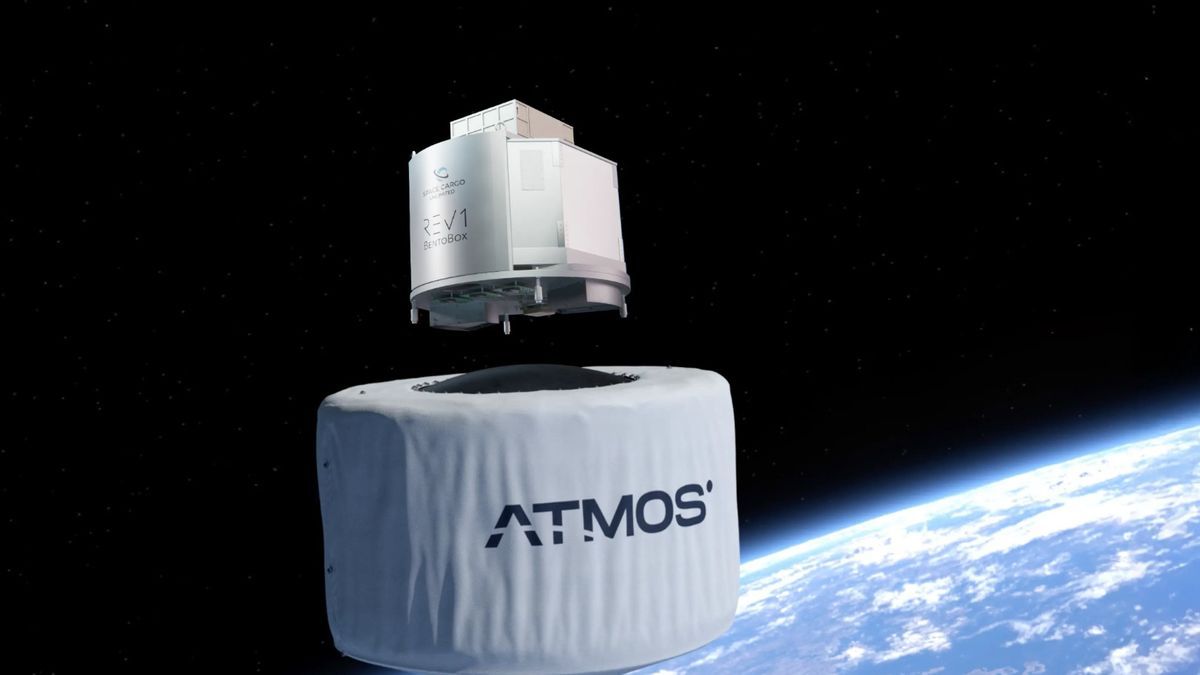
ATMOS Space Cargo PHOENIX is a German family of reentry spacecraft developed for returning payloads from low Earth orbit. The design centers on an inflatable heat-shield system intended to decelerate the vehicle during atmospheric reentry while supporting commercial microgravity research, in-space manufacturing, and cargo-return missions.
The first vehicle, PHOENIX 1, was a 250 kg technology demonstrator built to collect orbital flight data, operate customer payloads, and test deployment of the inflatable heat shield during reentry. It flew in April 2025 as part of SpaceX's Bandwagon-3 rideshare mission.
ATMOS is developing larger and more capable PHOENIX vehicles for recoverable orbital missions. The program also includes a planned 2027 demonstration of a satellite-to-spacecraft optical communications link during orbital flight and reentry.
PHOENIX 1 development and first flight
PHOENIX 1 was developed and qualified for flight in less than 12 months as an early prototype for ATMOS' reentry technology. According to ATMOS Space Cargo, the mission was intended to qualify the capsule and its subsystems for the orbital environment, validate its ground-control and telemetry architecture, collect spacecraft data in orbit, operate customer experiments, and deploy the company's inflatable heat shield before atmospheric entry.
The vehicle launched aboard a Falcon 9 from Cape Canaveral Space Force Station on 21 April 2025. Exolaunch deployed PHOENIX using its CarboNIX 24-inch separation system. The capsule entered a 45-degree-inclination orbit and completed one full orbit before a Falcon 9 upper-stage deorbit burn placed it on its return trajectory.
PHOENIX 1 did not have its own propulsion system. It therefore depended on the launch vehicle's upper stage for the deorbit maneuver before separating for reentry. Independent spacecraft data compiled by Gunter's Space Page lists the demonstrator with a mass of 250 kg, battery power, and no propulsion system.
The mission originally involved preparations for a recovery near Réunion in the Indian Ocean. A late trajectory change shifted the predicted splashdown point to the South Atlantic about 2,000 km off the Brazilian coast. The greater distance prevented recovery of the capsule and made communications and observation during the final phase of reentry more difficult.
SpaceNews reported that the spacecraft returned substantial flight data and that all four onboard payloads activated and transmitted data. ATMOS also received indications that the inflatable heat shield deployed, although limited communications coverage prevented the company from fully determining its performance during the final stages of reentry. ATMOS therefore described the heat-shield objective as achieved while acknowledging that detailed final-descent data was unavailable.
Development beyond PHOENIX 1
PHOENIX 2 is intended to move the program from a technology demonstrator toward a recoverable in-orbit research and cargo-return service. ATMOS stated after the first mission that PHOENIX 2 would include its own propulsion system, allowing it to establish its own return trajectory and select a splashdown area suitable for recovery.
In April 2026, European Spaceflight reported that PHOENIX 2 was being developed to carry payloads of up to 100 kg on missions lasting as long as three months. ATMOS planned an initial fleet of three PHOENIX 2 capsules as part of its move toward routine orbital-return operations. The same report stated that development funding would also support PHOENIX 3, a larger vehicle planned with payload capacity increased to 1,000 kg and capabilities as an orbital transfer vehicle with Earth-return capability.
Planned optical communications demonstration
In 2026, ATMOS Space Cargo and Lithuanian laser communications company Astrolight signed a memorandum of understanding for a planned 2027 optical communications demonstration involving a PHOENIX reentry vehicle and an orbiting satellite. The proposed test will use Astrolight ATLAS-X optical terminals and is intended to demonstrate a direct spacecraft-to-satellite laser link during orbital operations and reentry.
The system is designed for data rates of up to 2.5 gigabits per second. The companies intend the link to carry spacecraft and mission data while PHOENIX is in orbit and during its return through the atmosphere. The demonstration is planned as an in-flight test; it has not yet occurred.
Design
Reentry system
The defining feature of PHOENIX is ATMOS' inflatable heat-shield technology. The system is intended to deploy before atmospheric entry and provide both thermal protection and aerodynamic deceleration. For later PHOENIX vehicles, the inflatable atmospheric decelerator is intended to perform functions that would otherwise require separate heat-shield and parachute systems.
PHOENIX 1 was built primarily to validate this technology under realistic orbital and reentry conditions. Data from the prototype mission was intended to support development of PHOENIX 2 and subsequent vehicles.
Payload and mission architecture
PHOENIX is intended to support payloads that operate in low Earth orbit before being returned to Earth. The first prototype carried four payloads combining biological experiments and technology demonstrations. Identified participants included the German Aerospace Center DLR, Japan's IDDK, and Frontier Space with Imperial College London.
PHOENIX 2 is planned for missions lasting up to three months and payloads of up to 100 kg. PHOENIX 3 is planned as a larger platform with payload capacity up to 1,000 kg and an orbital-transfer role in addition to Earth return.
Propulsion
PHOENIX 1 had no independent propulsion system and relied on the Falcon 9 upper stage to initiate its return trajectory. PHOENIX 2 is planned with its own propulsion capability so that the spacecraft can determine its return trajectory and target a recoverable splashdown zone.
Communications
The PHOENIX 1 mission used ground stations in South America to receive spacecraft and payload telemetry during the approach to reentry. The mission demonstrated the difficulty of maintaining communications when a reentry trajectory passes beyond suitable ground infrastructure.
The planned 2027 Astrolight demonstration addresses this limitation with an optical link between PHOENIX and another spacecraft. The proposed system uses tightly focused laser beams rather than conventional radio-frequency communications and is designed for throughput up to 2.5 Gbit/s. Maintaining sufficiently accurate pointing between two moving spacecraft, particularly while the reentry vehicle's trajectory and environment change rapidly, is a central technical challenge of the test.
Operational history
PHOENIX 1 made the program's first orbital flight in April 2025. The spacecraft reached orbit, operated its payloads, transmitted spacecraft and experiment data, separated for reentry, and initiated deployment of its inflatable heat shield. The capsule was not recovered because the revised mission trajectory placed the splashdown point about 2,000 km off the Brazilian coast.
ATMOS reported that the flight met its principal objectives, but independent reporting noted uncertainty over the heat shield's complete performance because data from the final stage of reentry was limited. The mission therefore provided operational and engineering data for PHOENIX 2 without demonstrating a recovered spacecraft.
Variants
- PHOENIX 1: 250 kg technology demonstrator flown in April 2025. It had no independent propulsion and was used to collect orbital data, operate customer payloads, and test deployment of the inflatable heat shield during reentry.
- PHOENIX 2: Recoverable in-orbit research and cargo-return capsule under development. It is planned to carry up to 100 kg of payload for missions lasting up to three months and to include its own propulsion system for selecting its return trajectory and splashdown area.
- PHOENIX 3: Larger planned development with payload capacity of up to 1,000 kg. ATMOS has described it as a multi-use orbital transfer vehicle with an Earth-return capability.
Specifications (PHOENIX 1)
General characteristics
- Type: Reentry technology demonstrator
- Manufacturer: ATMOS Space Cargo GmbH
- Mass: 250 kg
- Power: Batteries
- Propulsion: None
Mission profile
- Operational environment: Low Earth orbit and atmospheric reentry
- Launch mission: SpaceX Bandwagon-3
- Launch vehicle: Falcon 9
- Launch date: 21 April 2025
- Orbit inclination: 45 degrees
- Primary reentry technology: Inflatable heat shield
Related equipment
PHOENIX forms part of a wider European effort to develop commercial orbital-return systems for microgravity research, in-space manufacturing, and payload recovery. Other European projects are pursuing separate spacecraft designs, while ATMOS is concentrating on a scalable family of vehicles using its inflatable atmospheric deceleration technology.
 Argentina
 Armenia
 Australia
 Austria
 Austria-Hungary
 Belgium
 Brazil
 United Kingdom
 United States
 Brunei
 Bulgaria
 Canada
 Chile
Chile China
China Colonial America
 Colombia
 Confederate States
 Croatia
 Czech
Czech Denmark
 Egypt
Egypt Finland
 France
 Georgia
 German Imperial
 Greece
 Holland
 Hungary
 India
India Indonesia
 Iran
Iran Iraq
Iraq Ireland
 Israel
 Italy
Italy Japan
Japan Japan (1940)
 Jordan
 Kingdom of Italy
 Malaysia
 Mexico
 Myanmar
 Nazi Germany
 Netherlands
 New Zealand
 North Korea
 Norway
 Pakistan
 Peru
Peru Philippines
 Poland
 Portugal
 Prussia
 Romania
 Russia
 Saudi Arabia
 Serbia
 Singapore
 Slovakia
 Slovenia
 South Africa
 South Korea
 Soviet Union
 Spain
Spain Sweden
 Switzerland
 Syria
Syria Taiwan
 Thailand
 Turkey
 UAE
UAE Ukraine
 Vietnam
 Yugoslavia