
History
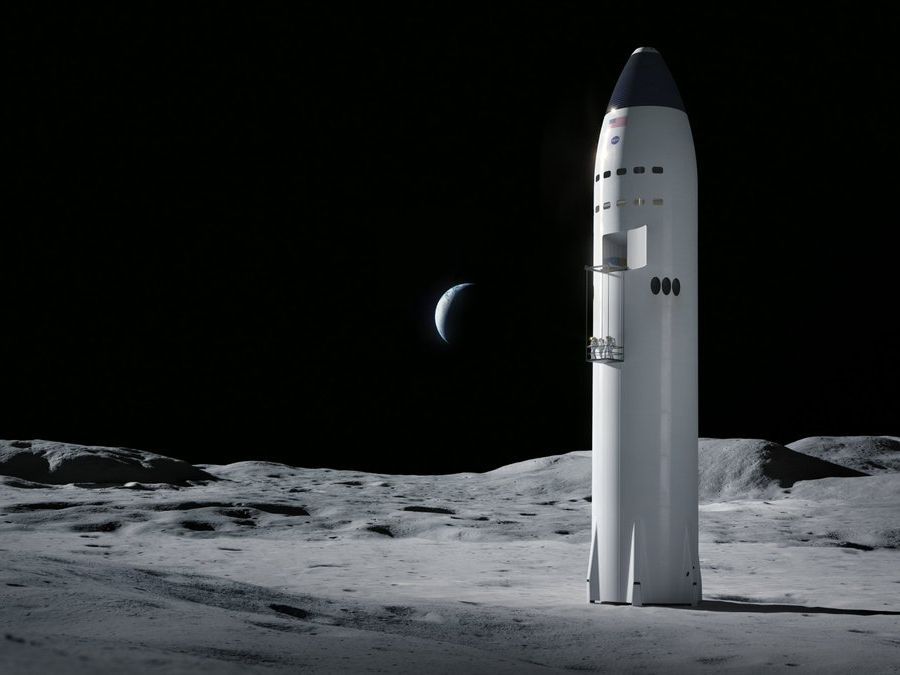
The Artemis III lunar lander designation covers the test vehicles selected for NASA's restructured third Artemis mission. In February 2026, NASA converted Artemis III from a planned crewed lunar landing into a low Earth orbit (LEO) rendezvous and docking test, moving the first crewed landing to the subsequent Artemis IV mission, targeted for 2028. Two commercial landers will participate in the test: Blue Origin's Blue Moon Mark 2 pathfinder and a test version of SpaceX's Starship Human Landing System (HLS).
On 23 October 2026, NASA presented the detailed concept of operations at Kennedy Space Center. Under the plan, New Glenn will launch first, carrying the Blue Moon lander to LEO. The Space Launch System will then launch four astronauts — Randy Bresnik, Andre Douglas, and Frank Rubio from NASA, and Luca Parmitano from the European Space Agency — aboard Orion. Instead of a functional upper stage, the rocket will carry a non-propulsive structural spacer that preserves the upper stage's external interfaces. Orion will deploy into a highly elliptical orbit (29 km perigee, 1,806 km apogee) and then circularise to an altitude of approximately 555 km. After two days of Orion systems checkout, the crew will dock with Blue Moon on Flight Day 3 at an altitude of 439 km.
Over the following two days docked with Blue Moon, the crew will enter the lander through its hatch and evaluate environmental controls, life support, and atmospheric pressure systems, as well as rehearse emergency scenarios and dual-vehicle control procedures. After undocking from Blue Moon, Starship will launch with a specially built docking adapter on its nose. The 52-metre Starship upper stage will rendezvous with Orion on Flight Day 8 at 381 km. The Starship docking demonstration lasts approximately two hours; unlike the Blue Moon encounter, the crew will not enter the Starship vehicle. The nominal mission duration is 14 days, extendable to 17 days, ending with a parachute-aided ocean splashdown.
Artemis program manager Jeremy Parsons stated the mission is designed to reduce risk for future lunar landing missions by allowing crews and ground teams to practise in the lower-risk environment of LEO. Parsons also confirmed that the Blue Moon prototype will not fly with cryogenic propellant, and the Starship test vehicle will not carry life support systems. In an internal memo, NASA Administrator Jared Isaacman indicated the mission was about 90 days behind schedule at the time of reporting. A firm launch date had not been announced; the agency was targeting the summer of 2027. It remained undetermined which of the two landers would fly the Artemis IV crewed landing, with NASA stating it was preserving optionality for both providers.
 Argentina
 Armenia
 Australia
 Austria
 Austria-Hungary
 Belgium
 Brazil
 United Kingdom
 Brunei
 Bulgaria
 Canada
 Chile
 China
 Colonial America
 Colombia
 Confederate States
 Croatia
 Czech
 Denmark
 Egypt
 Finland
 France
 Georgia
 Germany
 German Imperial
 Greece
 Holland
 Hungary
 India
 Indonesia
 Iran
 Iraq
 Ireland
 Israel
 Italy
 Japan
 Japan (1940)
 Jordan
 Kingdom of Italy
 Malaysia
 Mexico
 Myanmar
 Nazi Germany
 Netherlands
 New Zealand
 North Korea
 Norway
 Pakistan
 Peru
 Philippines
 Poland
 Portugal
 Prussia
 Romania

 Russia
 Saudi Arabia
 Serbia
 Singapore
 Slovakia
 Slovenia
 South Africa
 South Korea
 Soviet Union
 Spain
 Sweden
 Switzerland
 Syria
 Taiwan
 Thailand
 Turkey
 UAE
 Ukraine
 Vietnam
 Yugoslavia