
History
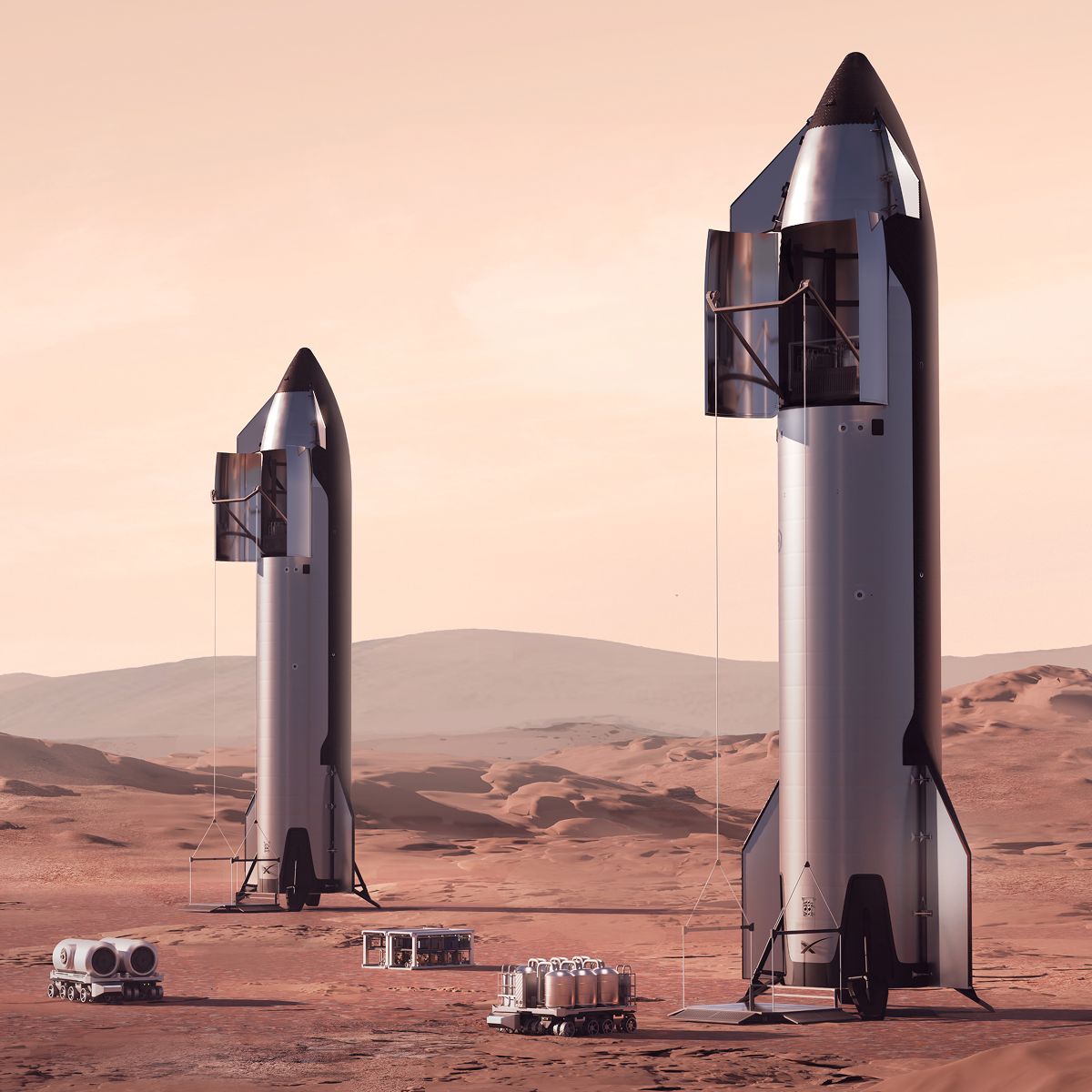
SpaceX Starship is a two-stage heavy-lift launch system under development as a fully reusable transportation system for satellites, cargo, and crew. The complete vehicle consists of the Super Heavy first-stage booster and the Starship spacecraft, which also serves as the second stage.
The program evolved through several earlier SpaceX concepts, including the Mars Colonial Transporter, Interplanetary Transport System, and BFR. The modern Starship configuration emerged after SpaceX changed the vehicle structure from carbon composites to stainless steel in 2018 and adopted the Starship name for the complete launch system in 2019.
Starship has been developed through an iterative flight-test program. By 24 July 2026, the integrated vehicle had flown 13 times, progressing from early ascent tests to controlled booster and ship recoveries, payload deployment, in-space engine relight tests, and deployment of Starlink V3 satellites.
Early concepts
SpaceX's long-term heavy-launch concepts predated Starship by more than a decade. In 2005, Elon Musk discussed a high-capacity launch vehicle capable of carrying about 100 t to low Earth orbit. SpaceX later presented the Falcon XX heavy-lift concept in 2010 and publicly discussed the Mars Colonial Transporter in 2012. The latter was intended to use methane-fueled Raptor engines and support transportation of people and cargo to Mars.
In 2016, the Mars Colonial Transporter concept became the Interplanetary Transport System. The proposed system used a reusable booster and spacecraft, with liquid methane and liquid oxygen as propellants. The design also incorporated autogenous tank pressurization. SpaceX conducted the first test firing of a Raptor engine in September 2016.
The architecture changed again in 2017, when SpaceX presented the BFR. This design reduced the overall scale of the earlier ITS concept and was intended to support Earth-orbit, lunar, interplanetary, and proposed point-to-point missions. SpaceX began construction work on prototype hardware and manufacturing facilities during this period.
Transition to Starship
In December 2018, SpaceX changed the planned structure from carbon composites to stainless steel. The company cited manufacturing cost, ease of fabrication, strength at cryogenic temperatures, and high-temperature performance as reasons for the change. During 2019, SpaceX adopted Starship as the name of the complete vehicle, while the first-stage booster became known as Super Heavy and the spacecraft retained the Starship name.
By 2019, the Starship upper-stage design used three sea-level Raptor engines and three vacuum-optimized Raptor engines. SpaceX also reduced the number of aft aerodynamic flaps and adopted reusable thermal-protection tiles for atmospheric reentry. A 2020 Starship Users Guide described the system as a fully reusable vehicle intended for Earth orbit as well as missions to the Moon and Mars, with a baseline capability exceeding 100 metric tons to low Earth orbit.
Integrated flight testing
The first integrated Starship and Super Heavy flight took place on 20 April 2023. The vehicle cleared the launch site but lost thrust-vector control and was destroyed by the flight termination system before completing stage separation. The second flight on 18 November 2023 demonstrated hot-staging between the booster and ship, although both stages were subsequently lost.
Flight 3 on 14 March 2024 included a full-duration upper-stage burn, an internal propellant-transfer demonstration, and a test of the Starlink dispenser door. The ship was lost during reentry. On Flight 4, conducted on 6 June 2024, Super Heavy completed a controlled splashdown in the Gulf of Mexico and Starship survived reentry before making a controlled splashdown in the Indian Ocean.
Flight 5 on 13 October 2024 achieved the first successful recovery of a Super Heavy booster by the launch tower arms. The Starship upper stage completed its trajectory, reentered, and performed a controlled Indian Ocean splashdown. Flight 6 in November 2024 included an in-space Raptor relight and another controlled ship splashdown.
Block 2 Starship vehicles began flying with Flight 7 in January 2025. Flights 7 and 8 ended with loss of their upper stages after propulsion problems, although their Super Heavy boosters were successfully caught by the launch tower. Flight 9 in May 2025 was the first Starship mission to reuse a Super Heavy booster, but both stages were ultimately lost.
Flights 10 and 11, conducted in August and October 2025, successfully completed controlled booster and ship splashdowns. Both missions deployed Starlink simulator payloads and demonstrated in-space Raptor relights. Flight 11 was the final flight of the Block 2 configuration.
Block 3 debuted on Flight 12 on 22 May 2026. Ship 39 reached its scheduled engine cutoff despite losing one vacuum Raptor, deployed 20 Starlink mass simulators and two modified functional Starlink satellites, and completed a controlled reentry and landing maneuver. The booster was lost during its recovery attempt.
Flight 13 launched on 24 July 2026 with Block 3 Booster 20 and Ship 40. The mission deployed 20 Starlink V3 satellites on a transatmospheric trajectory. The booster was lost during its landing burn, while Ship 40 completed atmospheric entry, performed its simulated landing maneuver, splashed down in the Indian Ocean, and remained intact after tipping over. SpaceX subsequently worked to tow the upper stage toward shore, although the recovery effort was described as unlikely to succeed.
Design
Starship is a two-stage launch system consisting of the Super Heavy booster and the Starship upper-stage spacecraft. Both stages are intended to be reusable. The complete vehicle has been described with a height of about 120 to 121 m and a diameter of 9 m.
Structure and propellants
The modern Starship vehicle uses stainless-steel construction. Both stages use liquid methane and liquid oxygen propellants. The system was designed with autogenous pressurization, in which gaseous propellant is used to pressurize the tanks instead of relying on a separate high-pressure helium system.
Propulsion
Super Heavy uses 33 Raptor engines in the configurations described for recent vehicles. The Starship upper stage uses six Raptor engines, consisting of three sea-level engines and three vacuum-optimized engines. The sea-level engines support powered descent and landing maneuvers, while the vacuum engines are optimized for operation during ascent and spaceflight.
Atmospheric control and recovery
The Starship spacecraft uses aerodynamic flaps to control its attitude during atmospheric descent. Its windward surface uses reusable heat-shield tiles to protect the stainless-steel structure during reentry. Flight testing has repeatedly examined flap durability, tile performance, controlled reentry, the landing flip, and powered descent.
Super Heavy uses grid fins during its return. SpaceX intends both stages to return for rapid reuse, with the launch tower's mechanical arms serving as the planned recovery system. The tower successfully caught a Super Heavy booster for the first time during Flight 5 in October 2024. Recovery of an upper stage by the tower remained a planned capability as of the supplied 2026 program information.
Payload system
The Starship payload section has a 9 m outer diameter, with an approximately 8 m usable dynamic envelope. SpaceX documentation described a standard payload section about 18 m high and approximately 1,100 m3 in volume, with an extended configuration available for payloads requiring additional height.
The payload section is designed to accommodate single spacecraft, multiple spacecraft, constellation deployments, and payloads that remain attached to Starship for in-space demonstrations before returning to Earth. SpaceX documentation also describes compatibility with several Falcon-derived clampband interface sizes and the possibility of side-by-side payload mounting.
Orbital refueling
Orbital propellant transfer is a central part of the planned Starship architecture for missions beyond low Earth orbit. SpaceX documentation states that the reusable system can deliver more than 100 metric tons to low Earth orbit in a single launch and can use propellant transfer in a parking orbit to support substantially larger payloads to geostationary-transfer, lunar, and interplanetary destinations.
Program status
Starship remained in development after Flight 13 in July 2026. The integrated test program had demonstrated hot staging, controlled booster and ship splashdowns, launch-tower booster catches, upper-stage engine relights in space, payload-door operations, deployment of simulated payloads, deployment of Starlink V3 satellites, and repeated atmospheric reentries.
Block 1 was retired after the early integrated flight campaign, and Block 2 was retired after Flight 11. Block 3 first flew in May 2026 and continued with Flight 13 in July 2026. Block 4 was described as being in development.
Future plans in the supplied program record included an attempt to place Starship into low Earth orbit and attempt recovery of the upper stage by the launch tower. Additional planned flights included demonstrations of in-orbit propellant transfer using target and tanker vehicles.
NASA selected a modified Starship as a Human Landing System for the Artemis lunar program. Planned development work includes orbital refueling, rendezvous and docking demonstrations, and an uncrewed lunar landing demonstration before crewed lunar use.
Variants
- Block 1: Initial integrated-flight configuration. Six Block 1 vehicles were reported as flown before the configuration was retired.
- Block 2: Upgraded Starship configuration introduced on Flight 7 in January 2025. Five Block 2 vehicles were reported as flown before retirement after Flight 11.
- Block 3: Configuration introduced with Flight 12 in May 2026. Two Block 3 vehicles had flown by 24 July 2026.
- Block 4: Later configuration described as under development.
- Starship Human Landing System: Lunar landing variant selected by NASA for the Artemis program. Its planned missions require orbital propellant transfer before lunar operations.
- Propellant tanker and depot concepts: Planned Starship-derived vehicles intended to transfer and store propellant in orbit for missions requiring refueling.
Operators
- SpaceX: Developer and operator of the Starship flight-test program.
- NASA: Customer for the planned Starship Human Landing System and associated propellant-transfer, docking, and lunar demonstration activities.
Specifications (Starship system, baseline reusable design)
General characteristics
- Configuration: Two-stage reusable launch vehicle consisting of Super Heavy and Starship.
- Height: Approximately 120–121 m.
- Diameter: 9 m.
- Propellants: Liquid methane and liquid oxygen.
- Super Heavy engines: 33 Raptor engines.
- Starship engines: Six Raptor engines, comprising three sea-level and three vacuum-optimized engines.
- Construction: Stainless steel.
- Payload section outer diameter: 9 m.
- Payload dynamic envelope diameter: Approximately 8 m.
- Standard payload section height: Approximately 18 m.
- Payload volume: Approximately 1,100 m3.
Performance
- Low Earth orbit payload: More than 100 metric tons in the baseline reusable configuration.
- Geostationary transfer orbit payload: 21 metric tons for a single launch in the performance data provided by the Starship Users Guide.
- Propellant-transfer capability: Planned orbital refueling allows payloads exceeding 100 metric tons to be supported on some higher-energy trajectories according to SpaceX performance documentation.
Related equipment
- Mars Colonial Transporter: Earlier SpaceX concept that preceded the Interplanetary Transport System and Starship.
- Interplanetary Transport System: 2016 reusable booster-and-spacecraft architecture that directly preceded the BFR program.
- BFR: 2017 redesign that evolved into the stainless-steel Starship and Super Heavy system.
 Argentina
 Armenia
 Australia
 Austria
 Austria-Hungary
 Belgium
 Brazil
 United Kingdom
 Brunei
 Bulgaria
 Canada
 Chile
Chile China
China Colonial America
 Colombia
 Confederate States
 Croatia
 Czech
Czech Denmark
 Egypt
Egypt Finland
 France
 Georgia
 Germany
 German Imperial
 Greece
 Holland
 Hungary
 India
India Indonesia
 Iran
Iran Iraq
Iraq Ireland
 Israel
 Italy
Italy Japan
Japan Japan (1940)
 Jordan
 Kingdom of Italy
 Malaysia
 Mexico
 Myanmar
 Nazi Germany
 Netherlands
 New Zealand
 North Korea
 Norway
 Pakistan
 Peru
Peru Philippines
 Poland
 Portugal
 Prussia
 Romania
 Russia
 Saudi Arabia
 Serbia
 Singapore
 Slovakia
 Slovenia
 South Africa
 South Korea
 Soviet Union
 Spain
Spain Sweden
 Switzerland
 Syria
Syria Taiwan
 Thailand
 Turkey
 UAE
UAE Ukraine
 Vietnam
 Yugoslavia