
History
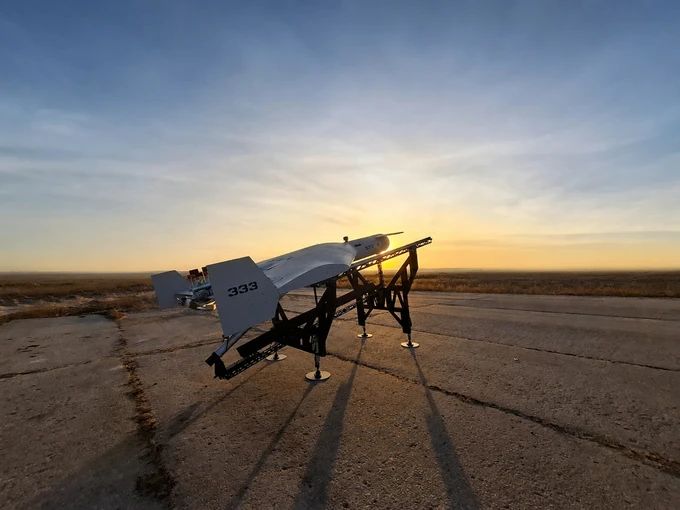
The MICH 2000 is a Ukrainian long-range one-way attack unmanned aerial vehicle developed from a Chinese civilian airframe lineage and adapted for deep-strike missions. Public reporting identifies the Security Service of Ukraine's Special Operations Centre Alpha as its sole operator. The manufacturer states that the MICH 2000 can reach up to 2,000 km and carry a combat section weighing 25 to 60 kg.
The aircraft became publicly identifiable as the MICH 2000 only in August 2026, although the programme had been active since 2024 and an unidentified canard-equipped delta-wing UAV had appeared in strike footage earlier. The most detailed public account came from a factory visit reported by Ukrainian outlet Oboronka and was later summarized by Defence Blog and Militarnyi.
Most published performance, production, pricing, and strike claims originate with the manufacturer. A technical profile by Drone Warfare notes that these figures have not been independently verified, so they are presented here as stated claims rather than independently confirmed specifications.
Origins in Chinese civilian airframes
Ukraine had already used Chinese-sourced civilian UAVs for long-range attacks by 2022. After China restricted direct exports of civilian drones in 2023, a Ukrainian development team traveled to China in late 2023 to obtain aircraft. The team encountered the ZTK-150, a canard-equipped delta-wing design that visually resembled the Iranian Shahed family.
According to the development account, Ukrainian representatives initially explored acquiring production technology, but the Chinese factory declined the sale. Intermediaries then proposed assembly outside the restricted export channel and pilot training. The Ukrainian team returned with eight Chinese-built aircraft and trained pilots, while the experience of observing the manufacturing process encouraged development of a domestic version.
Testing and transition to Ukrainian production
Flight testing began in summer 2024. The first reported test covered about 1 km before the aircraft crashed because of incorrect weight balance. A second test lasted roughly one hour before vibration caused the propeller to detach. A third aircraft was lost after electronic warfare disrupted its communications, demonstrating that the imported configuration was not suitable for contested electromagnetic conditions.
By the end of summer 2024, the team had moved toward producing its own airframes and installing different electronics. The manufacturer later described repeated aerodynamic and structural failures during roughly six to eight weeks of range testing. These failures were followed by a first combat sortie in October 2024. Three aircraft were launched; one was shot down and two reportedly fell about 10 m short of their targets. The operator accepted the result and approved production. The 10 m figure refers only to that early mission and is not a published accuracy specification.
Domestic supply chain and production
The producer subsequently organized a Ukrainian supply chain involving dozens of facilities. Reported domestically produced items include engines, combat sections, fuselages, initiation boards, rocket boosters, and booster fuel. The company also developed its own booster after problems with third-party units reportedly caused extensive equipment losses during testing.
Assembly starts with the structural frame and fuel tank. Tanks are pressure-checked for leaks. Finished bodies are painted, apertures for equipment are cut by a robotic cell, and the airframes are sanded, repainted, and weighed before final assembly. Electronics, the engine, and the combat section are then installed.
In 2026, the manufacturer said annual output was about 6,000 aircraft and that it intended to increase production to 10,000 per year. It also reported reinvesting about US$1 million per month in research and development and exploring joint production with Baltic partners. These are manufacturer statements and not independently audited production figures.
Design
Airframe and launch system
The MICH 2000 uses a flying-wing configuration in which the main body provides the lifting surface. Small canards are fitted ahead of the main wing. The aircraft is propeller-driven and uses rocket-assisted launch. Public sources do not provide reliable dimensions, weight, speed, endurance, ceiling, or a detailed engine designation for the Ukrainian version.
The programme originated from the Chinese ZTK-150 airframe, but published figures for the Chinese aircraft should not be treated as MICH 2000 specifications. Ukrainian development included new airframe production, electronics changes, and a domestic launch-booster supply chain.
Guidance, communications, and navigation
The manufacturer describes the MICH 2000 as a configurable family rather than a single fixed configuration. Available options reportedly include analog, digital, or Starlink communications, different guidance packages, and terminal-guidance equipment. Optional CRPA antenna systems are offered to improve navigation resilience against jamming.
CRPA antennas remain imported and were reported to cost about US$20,000 to US$25,000 depending on the number of channels. The company stated that localization by cost is about 85 percent without a CRPA antenna and about 55 percent when the imported antenna is installed.
Combat section and cost
The manufacturer states that the MICH 2000 can carry combat sections weighing from 25 to 60 kg. The basic aircraft is quoted at about US$48,000, with higher prices for options such as terminal guidance and multi-channel CRPA navigation equipment. These figures vary with configuration and remain manufacturer-provided data.
Operational history
The first reported combat sortie occurred in October 2024. Three MICH aircraft were launched; one was shot down, while the other two reportedly missed their targets by about 10 m. The result nevertheless led the SBU Alpha unit to approve the system for production and operational use.
The earliest documented public appearance of the previously unidentified type occurred on 4 July 2025 during an attack on the Azov Optical-Mechanical Plant in Rostov Oblast. Analysts noted a delta-wing UAV with small forward canards, but the aircraft remained unnamed in open-source recognition material until August 2026.
The Ukrainian outlet Oboronka publicly identified the aircraft as the MICH 2000 on 12 August 2026. The manufacturer has attributed numerous subsequent or previously recorded deep-strike missions to the type, including attacks on targets in occupied Ukrainian territory and inside Russia. It has also claimed that thousands of aircraft were launched and hundreds of targets were hit. Independent reporting confirms that several of the cited strikes occurred, but it does not independently establish that MICH 2000 aircraft carried out every claimed attack.
Reporting on the August 2026 attack on the cargo ship Nadezhda near Novorossiysk illustrates this attribution problem. Defence Blog described the strike as involving the MICH 2000, while the Drone Warfare profile noted that the underlying Oboronka report used footage of the ship attack as the prompt for identifying the UAV but did not include Nadezhda in its own list of confirmed MICH 2000 targets. The ship strike therefore should not be treated as independently verified MICH 2000 employment.
Variants
- MICH 2000: Configurable long-range one-way attack UAV family. The manufacturer's catalogue reportedly includes eight versions spanning deep-strike and middle-strike roles, but public sources do not provide individual designations or complete specifications for all eight.
- MICH+: Developmental middle-strike derivative reported without the MICH 2000's forward canards. The manufacturer states a planned range of up to 600 km, a 70 kg combat section, terminal guidance, and a price of about US$40,000. It was still described as under development in August 2026.
Operators
- Security Service of Ukraine Special Operations Centre Alpha: Reported sole operator of the MICH 2000. The system is used for long-range one-way attack and deep-strike missions.
Specifications (MICH 2000 deep-strike configuration)
General characteristics
- Type: Long-range one-way attack unmanned aerial vehicle
- Configuration: Flying wing with small forward canards
- Propulsion: Propeller-driven
- Launch method: Rocket-assisted launch
- Communications: Configurable analog, digital, or Starlink options, according to the manufacturer
- Navigation: Optional CRPA antenna equipment for improved resistance to jamming
Performance
- Maximum stated range: Up to 2,000 km
Armament
- Combat section: 25 to 60 kg, depending on configuration
 Argentina
 Armenia
 Australia
 Austria
 Austria-Hungary
 Belgium
 Brazil
 United Kingdom
 United States
 Brunei
 Bulgaria
 Canada
 Chile
Chile China
China Colonial America
 Colombia
 Confederate States
 Croatia
 Czech
Czech Denmark
 Egypt
Egypt Finland
 France
 Georgia
 Germany
 German Imperial
 Greece
 Holland
 Hungary
 India
India Indonesia
 Iran
Iran Iraq
Iraq Ireland
 Israel
 Italy
Italy Japan
Japan Japan (1940)
 Jordan
 Kingdom of Italy
 Malaysia
 Mexico
 Myanmar
 Nazi Germany
 Netherlands
 New Zealand
 North Korea
 Norway
 Pakistan
 Peru
Peru Philippines
 Poland
 Portugal
 Prussia
 Romania
 Russia
 Saudi Arabia
 Serbia
 Singapore
 Slovakia
 Slovenia
 South Africa
 South Korea
 Soviet Union
 Spain
Spain Sweden
 Switzerland
 Syria
Syria Taiwan
 Thailand
 Turkey
 UAE
UAE Vietnam
 Yugoslavia