
History
The Boeing GBU-39/B Small Diameter Bomb I, commonly called SDB I, is an American precision-guided glide bomb developed for attacks on fixed and stationary targets. Its compact dimensions allow several weapons to be carried on one aircraft station.
The weapon combines GPS-aided inertial guidance, folding glide wings and a penetrating blast-fragmentation warhead. It can be employed by day or night and in adverse weather from fighters and bombers.
The GBU-39/B entered production in 2005 and became operational with the United States Air Force in 2006. It has subsequently been integrated with several aircraft and exported to allied air forces.
Development
Air Combat Command identified a requirement for a miniaturized precision munition in 1997. The Joint Requirements Oversight Council validated the requirement, and development of the Small Diameter Bomb began in 2001. Boeing and Lockheed Martin initially competed for the program. Following a 24-month advanced-development phase completed in September 2003, Boeing was selected as the prime contractor.
Low-rate initial production began in 2005. The weapon was certified for operational testing and evaluation in September that year. The first production weapons were delivered to the U.S. Air Force in September 2006, and initial operational capability was declared with the F-15E Strike Eagle in October 2006. The development chronology and official mission description are documented by the U.S. Air Force.
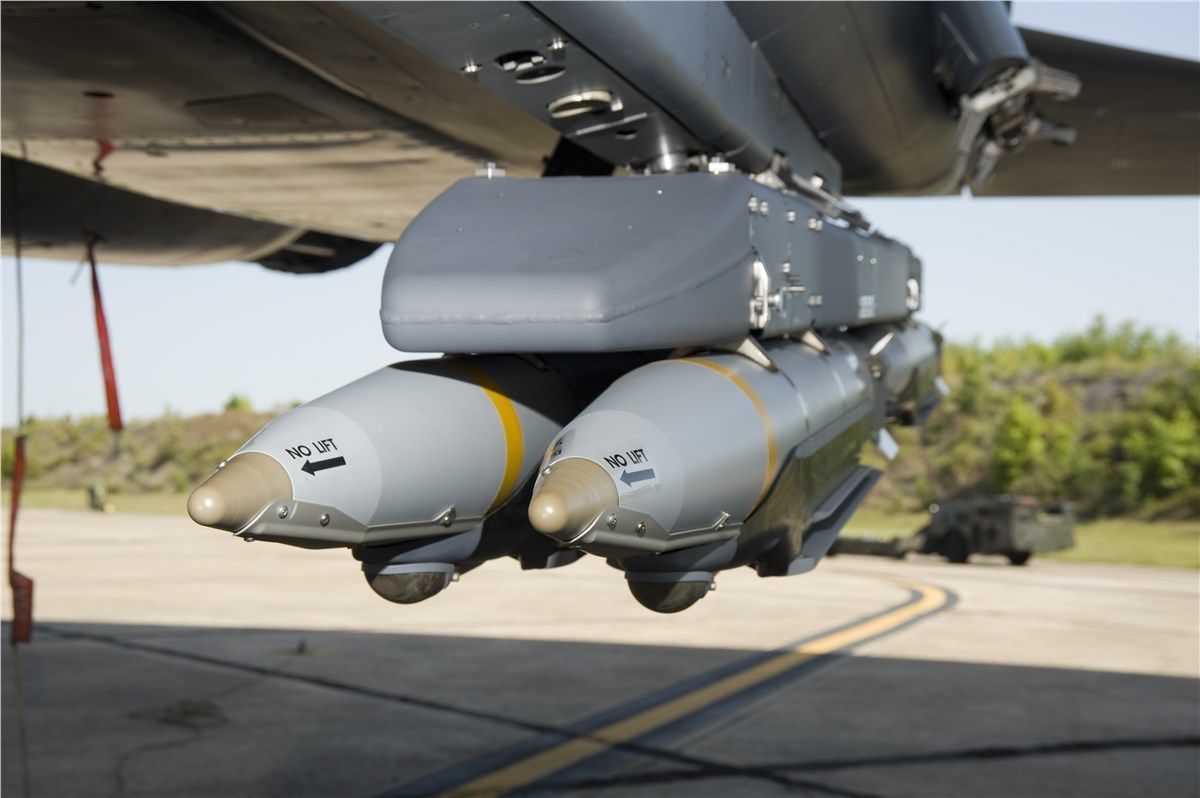
The program was intended to increase the number of independently guided weapons available to one aircraft without requiring a corresponding increase in weapons stations. Four GBU-39/B bombs can be mounted on one BRU-61/A smart carriage. This arrangement permits an aircraft to engage several aimpoints during one sortie while retaining other stations for fuel tanks, sensors or defensive weapons.
Design
Airframe and glide system
The GBU-39/B is an unpowered, air-delivered glide bomb in the 250-pound class. Its narrow cylindrical body carries a hardened nose, warhead, guidance section, folding wing assembly and tail-control section. The joined tandem wings deploy after release and provide the lift required for a standoff glide. Four movable tail surfaces control the weapon during flight.
The compact folded configuration was designed for carriage in internal weapons bays as well as on external hardpoints. The BRU-61/A carriage holds as many as four weapons on one MIL-STD-1760-compatible station. A technical visual guide published by the Open Source Munitions Portal identifies the nosecone, warhead, Diamond Back wing assembly, fuze well and tail-actuation section as characteristic components.
Guidance and targeting
The baseline GBU-39/B uses an inertial navigation system aided by GPS. Target coordinates are loaded before release, either during mission preparation or by the aircrew in flight. After separation, the bomb navigates autonomously to the programmed impact point. Unlike weapons assembled from a conventional bomb and an attached guidance kit, the GBU-39/B body and guidance system are integrated during production.
The baseline weapon is intended for fixed and stationary targets. It does not have the tri-mode seeker used by the later GBU-53/B Small Diameter Bomb II and should not be confused with that separate design. GPS and inertial guidance permit all-weather, day-or-night employment, although performance can depend on release conditions, navigation data and the electronic-warfare environment.
Warhead and fuze
The standard GBU-39/B contains approximately 16–16.8 kg (36–37 lb) of AFX-757 insensitive high explosive in a penetrating blast-fragmentation warhead. Its hardened steel nose is credited with penetrating more than 0.91 m (3 ft) of steel-reinforced concrete. The electronic safe-and-arm fuze supports selectable functions that include airburst and delayed detonation.
The comparatively small explosive charge was selected to concentrate the effect on the designated target and reduce the affected area compared with larger conventional bombs. Precision and a smaller warhead can reduce risk outside the target area, but they do not eliminate danger to civilians. Weapon effects still depend on the target, fuze setting, surrounding structures and the proximity of people.
Range and carriage
The U.S. Air Force states that the weapon can reach more than 74 km (40 nautical miles). Other published descriptions give distances exceeding 100 km under suitable release conditions. The difference reflects the effect of launch altitude, speed and flight profile on an unpowered glide weapon. The Smithsonian National Air and Space Museum describes how the folding wings and low weight provide a glide range of more than 97 km (60 miles).
Operational history
The GBU-39/B made its combat debut with U.S. Air Force F-15E aircraft in Iraq in October 2006. It was used in Afghanistan in January 2007. The weapon later appeared in operations involving the United States and allied air forces in the Middle East and other regions.
Israel received approval to acquire the weapon in 2008, and GBU-39-series remnants have subsequently been documented in Gaza, Lebanon and Syria. Although the weapon is designed for precise attacks with a relatively small explosive charge, investigations of strikes in densely populated areas have shown that its use can still cause substantial civilian casualties. Identification evidence and the humanitarian limits of precision-guided weapons are discussed in the GBU-39 visual guide.
Ukraine adapted the BRU-61/A carriage for use on MiG-29 fighters and began employing air-launched GBU-39/B bombs during the war with Russia. Photographic evidence has shown the American carriage and bombs installed on the Soviet-designed aircraft.
In August 2026, imagery released from the U.S. Central Command area showed an F-16 apparently carrying eight GBU-39/B bombs on two BRU-61/A carriages. The aircraft retained external fuel tanks, targeting equipment and air-to-air missiles. The configuration demonstrated how two aircraft stations could provide eight independently employable precision weapons while leaving other stations available for endurance, sensors and self-protection.
Production, combat use and export history are also summarized by the GBU-39 reference article and the KÜRE technical overview.
Variants
- GBU-39/B: Baseline SDB I with GPS-aided inertial guidance and a penetrating blast-fragmentation warhead for fixed and stationary targets.
- GBU-39A/B Focused Lethality Munition: Variant using a composite casing and focused-blast warhead to reduce fragmentation outside the immediate blast area. The first production examples were delivered in 2008.
- GBU-39B/B Laser SDB: Development fitted with semi-active laser guidance for engagement of moving or relocated targets. It retained GPS and inertial navigation but was distinct from the tri-mode GBU-53/B SDB II.
Operators
- United States: Lead developer and operator. Initial operational capability was achieved with the U.S. Air Force in 2006.
- Australia: Approved to acquire GBU-39/B weapons and associated support equipment.
- Israel: Operator of the GBU-39/B in combat.
- Italy: Acquired the weapon and arranged licensed production with Boeing and Oto Melara.
- Netherlands: Acquired GBU-39/B weapons through the U.S. Foreign Military Sales program.
- Saudi Arabia: Acquired GBU-39/B weapons through approved U.S. sales.
- Ukraine: Operational user of air-launched GBU-39/B bombs adapted for carriage by MiG-29 fighters.
Specifications (GBU-39/B Small Diameter Bomb I)
General characteristics
- Type: Precision-guided air-delivered glide bomb
- Manufacturer: Boeing
- Country of origin: United States
- Weight class: 250 lb, approximately 113 kg
- Length: Approximately 1.80 m (70.8 in)
- Width: Approximately 190 mm (7.5 in) folded and 1.61 m (5 ft 3.3 in) with wings deployed
- Carriage: Up to four weapons on one BRU-61/A smart carriage
Performance
- Guidance: GPS-aided inertial navigation system
- Targets: Fixed and stationary targets
- Official stated standoff range: More than 74 km (40 nautical miles)
- Flight system: Deployable joined tandem glide wings with tail-fin control
Warhead
- Type: Penetrating blast-fragmentation warhead with hardened steel nose
- Explosive filling: Approximately 16–16.8 kg (36–37 lb) of AFX-757
- Penetration: More than 0.91 m (3 ft) of steel-reinforced concrete
- Fuzing: Electronic safe-and-arm system with selectable airburst and delayed functions
 Argentina
 Armenia
 Australia
 Austria
 Austria-Hungary
 Belgium
 Brazil
 United Kingdom
 Brunei
 Bulgaria
 Canada
 Chile
Chile China
China Colonial America
 Colombia
 Confederate States
 Croatia
 Czech
Czech Denmark
 Egypt
Egypt Finland
 France
 Georgia
 Germany
 German Imperial
 Greece
 Holland
 Hungary
 India
India Indonesia
 Iran
Iran Iraq
Iraq Ireland
 Israel
 Italy
Italy Japan
Japan Japan (1940)
 Jordan
 Kingdom of Italy
 Malaysia
 Mexico
 Myanmar
 Nazi Germany
 Netherlands
 New Zealand
 North Korea
 Norway
 Pakistan
 Peru
Peru Philippines
 Poland
 Portugal
 Prussia
 Romania
 Russia
 Saudi Arabia
 Serbia
 Singapore
 Slovakia
 Slovenia
 South Africa
 South Korea
 Soviet Union
 Spain
Spain Sweden
 Switzerland
 Syria
Syria Taiwan
 Thailand
 Turkey
 UAE
UAE Ukraine
 Vietnam
 Yugoslavia