
History
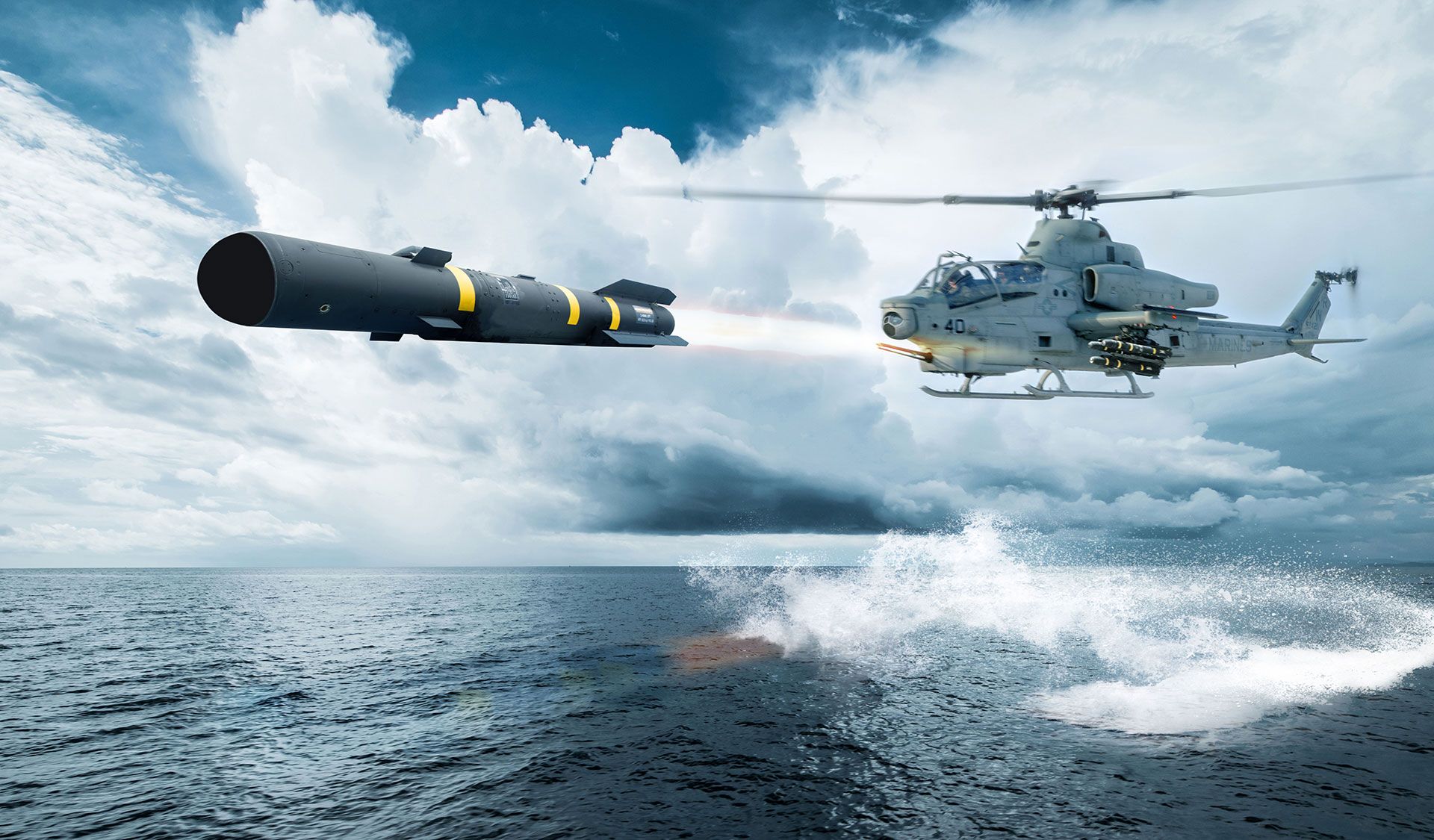
The Lockheed Martin AGM-179 Joint Air-to-Ground Missile (JAGM) is a U.S. precision-guided air-to-surface weapon developed to provide a common missile for attacks against stationary, moving, and relocatable land and maritime targets. It combines semi-active laser guidance with millimeter-wave radar in a dual-mode seeker.
JAGM uses propulsion, warhead, and control components derived from the AGM-114R Hellfire II while introducing a new guidance section. The program was intended to consolidate missions performed by several older air-launched weapons and reduce the logistical burden associated with maintaining different missile types.
Although developed primarily as an air-launched weapon, JAGM has subsequently been demonstrated from surface platforms. In 2026, two missiles were launched from a Saildrone Surveyor unmanned surface vehicle during the U.S. Navy's Rim of the Pacific exercise off Hawaii, marking the first missile launches from a Saildrone platform.
Development
The Joint Air-to-Ground Missile program followed the cancelled AGM-169 Joint Common Missile effort. The U.S. Department of Defense issued a draft request for proposals for JAGM in June 2007. In 2008, Lockheed Martin received a $122 million technology-development contract, while a Raytheon-Boeing team received a separate $125 million contract for competitive risk reduction.
The program faced substantial uncertainty during the following years. In 2011, the U.S. Army and Navy proposed terminating JAGM, but the program survived subsequent budget reductions. In 2012, Lockheed Martin and Raytheon received contracts to extend technology development, including work on the guidance section. The Navy and Marine Corps temporarily ended their investment in the program in 2012 before returning in 2014 as integration with the Marine Corps AH-1Z Viper progressed.
In 2013, the Army continued development with Lockheed Martin rather than awarding Raytheon a contract for the remaining technology-development work. In 2015, Lockheed Martin received an engineering and manufacturing contract to integrate its semi-active laser and millimeter-wave radar seeker with the Hellfire Romeo missile body. The JAGM program subsequently received the AGM-179 designation.
Production and service introduction
Low-rate initial production was approved in 2018, providing the earliest supported production milestone for the AGM-179. By February 2022, approximately 1,000 missiles had been produced under low-rate production.
The AGM-179A achieved initial operational capability with U.S. Marine Corps AH-1Z helicopters in early 2022. JAGM was declared ready for full-rate production later that year. The NAVAIR JAGM program page describes the weapon as a precision-guided munition intended for high-value stationary, moving, and relocatable land and maritime targets.
Extended-range and surface-launch development
Lockheed Martin developed a medium-range version known as JAGM-MR. In November 2022, a flight test demonstrated a range of approximately 16 km, about twice the commonly reported 8 km range of the baseline missile. JAGM-MR adds a third seeker mode using an imaging or near-infrared sensor while retaining the missile's basic dimensions.
Lockheed Martin also developed vertical-launch concepts using the JAGM Quad Launcher. In January 2026, a JAGM was fired vertically from a JAGM Quad Launcher mounted on a Richard Childress Racing Mothership 6x6 ground vehicle. Lockheed Martin described the system as suitable for integration on ground vehicles and surface vessels and presented JAGM vertical launch as a potential precision counter-UAS and multi-domain capability. Details of this work are described in the company's 2026 vertical-launch report.
During the 2026 Rim of the Pacific exercise off Hawaii, a Saildrone Surveyor unmanned surface vehicle launched two Lockheed Martin JAGMs under sponsorship of the U.S. Navy Fleet Experimentation Program. Saildrone described the event as the first missile launches from one of its platforms, demonstrating another surface-launch application for a weapon originally developed as an air-to-ground missile.
Design
JAGM retains substantial commonality with the AGM-114R Hellfire II. According to NAVAIR, it uses the Hellfire II Romeo propulsion, warhead, and control sections combined with a JAGM guidance section. This approach allows the missile to use an established missile architecture while providing a more flexible guidance system.
Guidance
The baseline JAGM uses a dual-mode seeker combining semi-active laser and millimeter-wave radar guidance. The laser channel permits precision engagement of designated targets, while the radar channel supports fire-and-forget operation. The two modes can also be used together to increase targeting flexibility in adverse weather, obscured battlefield conditions, and environments where countermeasures are present.
The JAGM-MR development adds a third imaging or near-infrared seeker mode. This configuration is intended to extend the capabilities of the missile while maintaining commonality with the existing JAGM family.
Warhead and propulsion
JAGM uses a solid rocket motor. NAVAIR describes its multi-purpose warhead as a shaped charge packaged within a fragmenting case. The combination is intended to provide effects against target types including armored and thin-skinned vehicles, maritime patrol craft, structures, bunkers, and field fortifications.
Launch platforms
The baseline missile was designed for aircraft compatible with the Hellfire II family. Confirmed integration cited by NAVAIR includes the U.S. Army AH-64 Apache and U.S. Marine Corps AH-1Z Viper. Other reported integrations and development work have included unmanned aircraft, fixed-wing aircraft, ground launchers, and maritime launch systems.
Surface-launch development has expanded the original air-to-ground concept. Lockheed Martin's JAGM Quad Launcher can fire the missile at angled or vertical orientations, while the 2026 Saildrone demonstration showed JAGM being fired directly from an unmanned surface vessel.
Operational history
The U.S. Marine Corps achieved initial operational capability with JAGM on the AH-1Z Viper in 2022. In June 2024, an AH-1Z operated by the 31st Marine Expeditionary Unit fired a live JAGM in the Indo-Pacific region and struck a moving high-speed towed maritime target.
In 2026, the weapon's demonstrated launch environments broadened further. Lockheed Martin conducted a vertical-launch demonstration from a ground-mobile JAGM Quad Launcher in January, followed later in the year by the two-missile launch from a Saildrone Surveyor during RIMPAC off Hawaii.
International selections
The Netherlands selected JAGM for its AH-64E Apache fleet and requested a foreign military sale of 296 AGM-179A missiles. Poland also selected JAGM in connection with its AH-64E procurement and requested 460 missiles. The United Kingdom selected JAGM for its AH-64E Apache fleet, and a proposed foreign military sale covering up to 3,000 AGM-179A missiles was approved by the U.S. Department of State in 2023. These selections and proposed sales do not by themselves establish that all requested missiles had entered operational service in those countries.
Variants
- AGM-179A JAGM: Baseline operational air-launched version using a dual-mode semi-active laser and millimeter-wave radar seeker.
- JAGM-MR: Lockheed Martin medium-range development tested to approximately 16 km and fitted with a third imaging or near-infrared seeker mode.
- AGM-187 JAGM-F: Fixed-wing JAGM development reported as having undergone testing with the F-15 Eagle and F/A-18 Super Hornet.
Operators
- United States: JAGM achieved initial operational capability with the U.S. Marine Corps in 2022 and is associated with the joint U.S. Army, Navy, and Marine Corps program.
Specifications (AGM-179A JAGM)
General characteristics
- Length: 1.78 m (70 in)
- Weight: approximately 52 kg (115 lb), according to NAVAIR
- Propulsion: solid rocket motor
- Warhead: multi-purpose shaped-charge warhead within a fragmenting case
Performance
- Operational range: approximately 8 km (5 mi) for the baseline missile
Guidance
- Seeker: dual-mode semi-active laser and millimeter-wave radar
- Targeting modes: laser precision targeting, radar fire-and-forget targeting, and combined laser-radar operation
Compatible platforms
- AH-64 Apache: U.S. Army attack helicopter integration identified by NAVAIR
- AH-1Z Viper: U.S. Marine Corps attack helicopter and initial operational platform
Related equipment
- AGM-114R Hellfire II: Provides the propulsion, warhead, and control sections used as the basis for JAGM.
- AGM-169 Joint Common Missile: Earlier joint missile program whose objectives and technology influenced the later JAGM program.
 Argentina
 Armenia
 Australia
 Austria
 Austria-Hungary
 Belgium
 Brazil
 United Kingdom
 Brunei
 Bulgaria
 Canada
 Chile
Chile China
China Colonial America
 Colombia
 Confederate States
 Croatia
 Czech
Czech Denmark
 Egypt
Egypt Finland
 France
 Georgia
 Germany
 German Imperial
 Greece
 Holland
 Hungary
 India
India Indonesia
 Iran
Iran Iraq
Iraq Ireland
 Israel
 Italy
Italy Japan
Japan Japan (1940)
 Jordan
 Kingdom of Italy
 Malaysia
 Mexico
 Myanmar
 Nazi Germany
 Netherlands
 New Zealand
 North Korea
 Norway
 Pakistan
 Peru
Peru Philippines
 Poland
 Portugal
 Prussia
 Romania
 Russia
 Saudi Arabia
 Serbia
 Singapore
 Slovakia
 Slovenia
 South Africa
 South Korea
 Soviet Union
 Spain
Spain Sweden
 Switzerland
 Syria
Syria Taiwan
 Thailand
 Turkey
 UAE
UAE Ukraine
 Vietnam
 Yugoslavia