

History
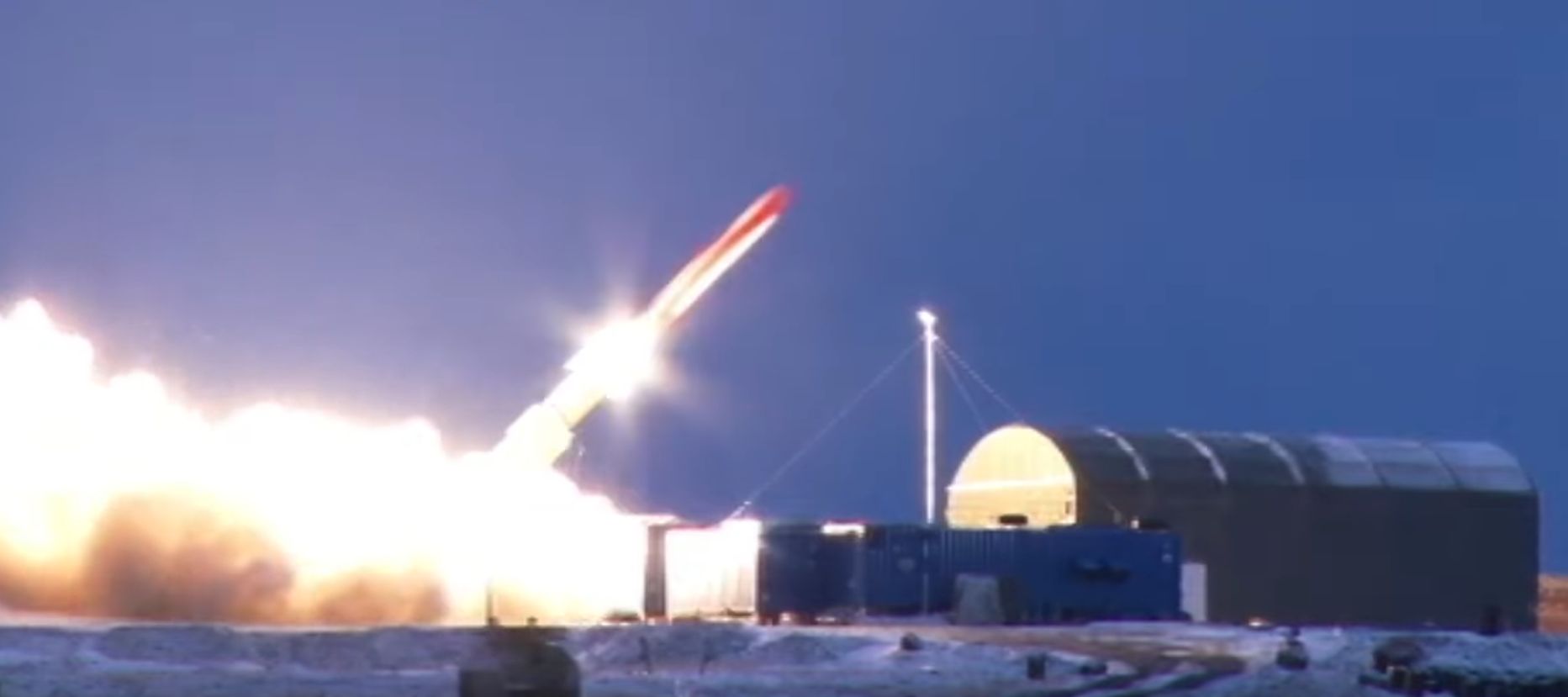
The 9M730 Burevestnik is a Russian nuclear-powered cruise missile developed as a long-range strategic weapon. Russia describes the missile as having effectively unlimited range because its propulsion system uses nuclear energy rather than relying only on conventional onboard fuel.
The program became publicly known in March 2018, although Western intelligence reportedly detected test launches as early as June 2016. The missile remained under development after repeated flight tests, including a Russian-reported long-duration flight in October 2025.
As of August 2026, the Burevestnik had not been fielded for operational service. Activity at Novaya Zemlya in August 2026 indicated that Russia was possibly preparing another flight test.
Development and early testing
According to reporting cited in the available sources, U.S. intelligence detected the first Burevestnik test launches in June 2016. At least 13 known tests were conducted by 2019, with only two described as partially successful. Russia publicly revealed the weapon in March 2018 as part of a group of new strategic systems presented by President Vladimir Putin.
The program has involved testing at sites including Novaya Zemlya and the Nyonoksa missile test area. On 8 August 2019, an explosion associated with an experimental system at Nyonoksa killed five scientists. Arms Control Association reporting identifies the event as an explosion involving a Burevestnik prototype.
Russia later claimed additional successful testing. Putin stated that a final successful test had taken place in 2023, although the claim was not independently verified in the available reporting.
October 2025 long-range test
Russia announced another major test after a flight on 21 October 2025. Chief of the Russian General Staff Gen. Valery Gerasimov said the missile remained airborne for about 15 hours and traveled approximately 14,000 km. He also said it performed prescribed vertical and horizontal maneuvers. These figures were Russian official claims and were not independently verified.
The reported flight was described by Russian officials as demonstrating the missile's ability to maneuver around air and missile defenses. The Norwegian government confirmed that the flight originated from Novaya Zemlya, according to the CSIS analysis.
Despite the test, Russian officials did not describe the missile as operational. Putin said further work was necessary to determine its mode of employment and prepare infrastructure before it could enter combat duty. The Arms Control Association similarly reported that infrastructure and employment concepts still had to be developed.
Possible August 2026 test preparations
In August 2026, activity around Rogachovo airfield on Novaya Zemlya suggested preparations for another Burevestnik test. A second Il-976 airborne command and measurement aircraft reportedly arrived on 22-23 August. Aircraft of this type are used during missile testing to track flight trajectories, receive telemetry, and collect test data.
Other aircraft observed at Rogachovo included an A-50U airborne early warning aircraft, four An-26 transports, an An-74D, and several helicopters. Ships associated with previous Burevestnik test activity were also reported in the Barents and Kara seas. OSINT analysts assessed that the deployment resembled preparations seen during earlier tests, but the available information did not confirm that a new launch had occurred.
Design
The Burevestnik is designed as a low-flying cruise missile powered during sustained flight by a compact nuclear energy system. Its concept is intended to overcome the normal range limitations of conventionally powered cruise missiles, permitting extremely long routes and prolonged low-altitude flight.
Propulsion
The missile is launched with a solid-fuel rocket booster. After launch, the nuclear-powered propulsion system is intended to sustain flight. Available assessments differ on the precise engine arrangement. Two Massachusetts Institute of Technology researchers cited in the source concluded that the missile uses a nuclear-powered ramjet in which atmospheric air is heated by the reactor to produce thrust. Other reporting has described the propulsion system more generally as a nuclear-powered air-breathing engine.
The nuclear propulsion concept theoretically reduces the missile's dependence on conventional fuel and therefore permits very long flight duration. Russia describes its range as effectively unlimited. CSIS notes that nuclear propulsion could allow sustained low-altitude flight over very long distances, although navigation, reliability, and safety remain major challenges.
The proposed propulsion architecture also creates radiological risks. The MIT assessment cited by the source concluded that the system could leave radioactive contamination in its wake. Broader assessments of nuclear-powered cruise missiles have also highlighted the possibility of radioactive release following crashes or propulsion-system failures.
Flight profile
The Burevestnik is intended to fly at low altitude and maneuver around defended areas rather than follow the predictable high-altitude trajectory of a ballistic missile. Low-altitude cruise missiles can remain below the radar horizon for much of their approach, reducing the time available for detection and interception.
Russian officials have emphasized the missile's ability to take indirect routes and bypass air and missile defense systems. The October 2025 test was officially described as including both vertical and horizontal maneuvering. These claims describe the intended and reported test capabilities rather than a demonstrated operational combat record.
Warhead and strategic role
The Burevestnik is described in the available sources as nuclear-capable and intended for strategic long-range strike. Its combination of a nuclear power source, long endurance, low-altitude flight, and route flexibility is intended to complicate interception by missile-defense systems.
Russia has presented the system as a response to advances in missile defense. When publicly unveiling the program in 2018, Putin linked Burevestnik and other new strategic weapons to Russian concerns about U.S. missile-defense development following the United States' withdrawal from the Anti-Ballistic Missile Treaty.
Program status
The 9M730 Burevestnik remained under development after the October 2025 long-range test. Russian leadership instructed the armed forces to continue work on determining how the system would be employed and to prepare the necessary basing infrastructure. CSIS concluded in November 2025 that the missile had not yet been fielded and that substantial work remained before operational deployment.
Satellite analysis has identified possible future Burevestnik infrastructure near a nuclear warhead storage facility in the Vologda region. However, the available evidence does not establish that operational missiles have been deployed there.
The concentration of test-support aircraft and ships around Novaya Zemlya in August 2026 was consistent with preparation for further testing. It did not by itself demonstrate that Burevestnik had entered service.
Specifications (9M730 Burevestnik)
General characteristics
- Type: Nuclear-powered cruise missile.
- Propulsion: Solid-fuel launch booster followed by a nuclear-powered air-breathing propulsion system; a nuclear ramjet configuration has been proposed by researchers.
- Warhead capability: Nuclear-capable.
Performance
- Range: Russia claims effectively unlimited range through nuclear propulsion.
- Reported test distance: Approximately 14,000 km during the Russian-reported flight of 21 October 2025.
- Reported test endurance: Approximately 15 hours during the 21 October 2025 flight.
- Flight profile: Low-altitude cruise flight with horizontal and vertical maneuvering reported during testing.
Related equipment
The Burevestnik concept has historical similarities to the United States' Cold War Project Pluto, which explored a nuclear-powered ramjet for a long-range cruise missile between 1957 and 1964. Project Pluto demonstrated nuclear ramjet technology in ground tests but was canceled without producing an operational missile. The two programs are technologically related in concept but are not identical systems.
 Argentina
 Armenia
 Australia
 Austria
 Austria-Hungary
 Belgium
 Brazil
 United Kingdom
 United States
 Brunei
 Bulgaria
 Canada
 Chile
Chile China
China Colonial America
 Colombia
 Confederate States
 Croatia
 Czech
Czech Denmark
 Egypt
Egypt Finland
 France
 Georgia
 Germany
 German Imperial
 Greece
 Holland
 Hungary
 India
India Indonesia
 Iran
Iran Iraq
Iraq Ireland
 Israel
 Italy
Italy Japan
Japan Japan (1940)
 Jordan
 Kingdom of Italy
 Malaysia
 Mexico
 Myanmar
 Nazi Germany
 Netherlands
 New Zealand
 North Korea
 Norway
 Pakistan
 Peru
Peru Philippines
 Poland
 Portugal
 Prussia
 Romania
 Saudi Arabia
 Serbia
 Singapore
 Slovakia
 Slovenia
 South Africa
 South Korea
 Soviet Union
 Spain
Spain Sweden
 Switzerland
 Syria
Syria Taiwan
 Thailand
 Turkey
 UAE
UAE Ukraine
 Vietnam
 Yugoslavia