History
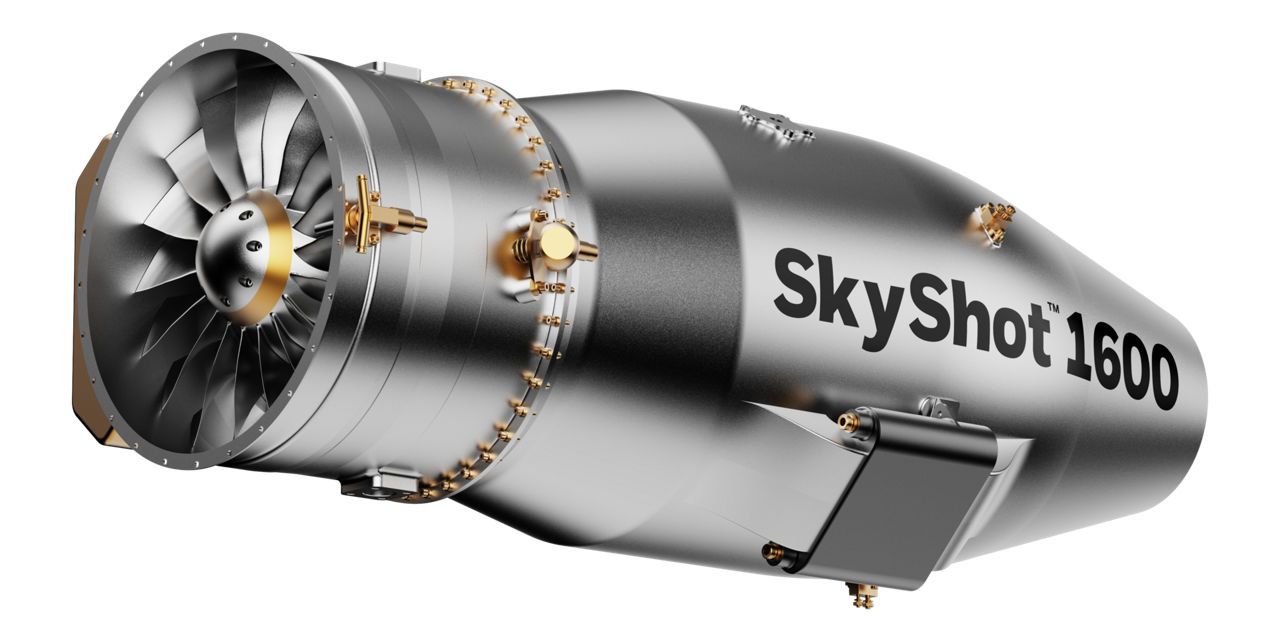
The Honeywell SkyShot 1600 is a small-thrust aircraft propulsion engine developed for autonomous and collaborative combat aircraft. Its architecture is intended to support both turbojet and turbofan configurations across several mission profiles.
In 2026, the U.S. Air Force awarded Honeywell a prototype contract to design an autonomous-aircraft propulsion system based on the SkyShot 1600. The work was conducted in support of the Air Force Propulsion Directorate through the Propulsion Consortium Initiative 2.0.
By September 2026, the SkyShot 1600 had advanced to the Preliminary Design Review stage under the U.S. Air Force Autonomous Collaborative Platform program. Honeywell had also demonstrated the engine core across its full rated thrust range.
Development
The SkyShot 1600 was developed around a flexible propulsion architecture intended for collaborative combat aircraft and other unmanned aircraft. The design can be adapted as either a turbojet or turbofan and covers a thrust range from approximately 3.6 to 12.5 kN (800 to 2,800 lbf). The architecture is also intended to permit scaling to higher thrust levels.
Development requirements include operation at high altitude, performance under elevated G loads, and sufficient propulsion capability for highly maneuverable autonomous aircraft. Honeywell has used digital modeling to accelerate design iterations, evaluate performance, and support integration of the propulsion system with different air vehicles.
The September 2026 Preliminary Design Review was intended to determine whether the engine design was sufficiently mature to proceed into more detailed development. The milestone followed testing of the engine core through its rated thrust range.
Design
The SkyShot 1600 uses a configurable gas-turbine architecture. Depending on the application, it can be arranged as a turbojet or turbofan. This approach allows a common propulsion concept to be adapted for aircraft with different mission, performance, and integration requirements.
Manufacturing
The engine was designed to support a rapid transition from digital models to physical production. A significant proportion of its materials and components can be produced using additive manufacturing or high-volume manufacturing methods. These approaches are intended to provide production flexibility and support scaling as development progresses.
Digital modeling is also used to shorten design cycles and evaluate propulsion-system performance before physical production. The development approach combines these digital methods with manufacturing processes intended for higher production rates.
Program status
As of September 2026, the SkyShot 1600 remained under development. It had received a U.S. Air Force prototype contract and progressed to Preliminary Design Review under the Autonomous Collaborative Platform effort. Its engine core had been demonstrated across the full rated thrust range, but the available information does not establish operational service or production status.
Specifications (SkyShot 1600)
General characteristics
- Type: Small-thrust aircraft gas-turbine engine
- Configurations: Turbojet or turbofan
- Intended applications: Collaborative combat aircraft and other unmanned aircraft
Performance
- Thrust range: Approximately 3.6 to 12.5 kN (800 to 2,800 lbf)
- Operating requirements: High-altitude operation and performance under elevated G loads
 Argentina
 Armenia
 Australia
 Austria
 Austria-Hungary
 Belgium
 Brazil
 United Kingdom
 United States
 Brunei
 Bulgaria
 Canada
 Chile
Chile China
China Colonial America
 Colombia
 Confederate States
 Croatia
 Czech
Czech Denmark
 Egypt
Egypt Finland
 France
 Georgia
 Germany
 German Imperial
 Greece
 Holland
 Hungary
 India
India Indonesia
 Iran
Iran Iraq
Iraq Ireland
 Israel
 Italy
Italy Japan
Japan Japan (1940)
 Jordan
 Kingdom of Italy
 Malaysia
 Mexico
 Myanmar
 Nazi Germany
 Netherlands
 New Zealand
 North Korea
 Norway
 Pakistan
 Peru
Peru Philippines
 Poland
 Portugal
 Prussia
 Romania
 Russia
 Saudi Arabia
 Serbia
 Singapore
 Slovakia
 Slovenia
 South Africa
 South Korea
 Soviet Union
 Spain
Spain Sweden
 Switzerland
 Syria
Syria Taiwan
 Thailand
 Turkey
 UAE
UAE Ukraine
 Vietnam
 Yugoslavia