
History
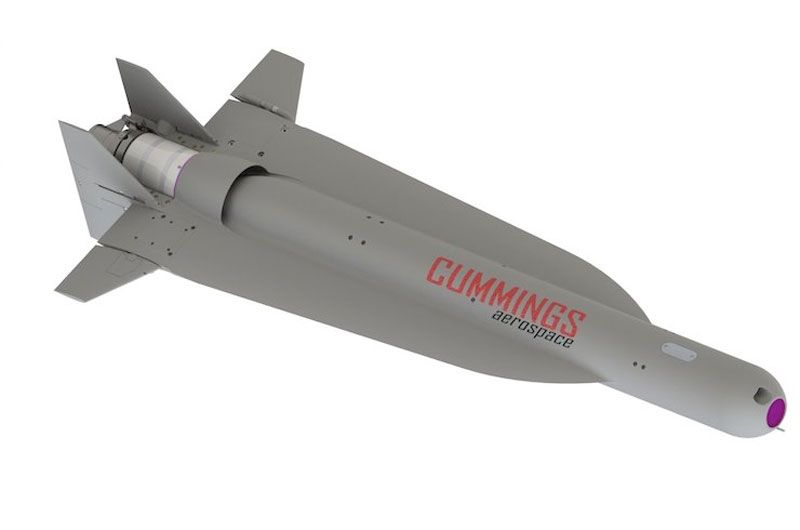
The Hellhound S3 is a compact jet-powered strike uncrewed aerial vehicle developed by Cummings Aerospace, a Native American woman-owned small business headquartered in Huntsville, Alabama, founded in 2009. The airframe is manufactured using additive manufacturing (3D printing) combined with commercial off-the-shelf components, a design approach the company states is intended to simplify and reduce the cost of serial production. The S3 was designed to compete for the U.S. Army's Low Altitude Stalking and Striking Ordnance (LASSO) program.
Cummings Aerospace first showed the Hellhound publicly at SOF Week in 2025, unveiling the turbojet-powered S3 alongside the larger S4 variant. By April 2025, the company reported reaching manufacturing readiness level 7 at its production facility near Redstone Arsenal, Alabama, which it had established in 2021. The company conducted more than a dozen flight tests in the S3's man-portable configuration before the vehicle-mounted test.
On 25 August 2026, Cummings Aerospace conducted the first vehicle-mounted launch of the Hellhound S3 at the Pendleton UAS Range in Oregon. Two S3s, carrying inert payloads, were fired sequentially from a new multi-pack launcher mounted on a Polaris utility vehicle, with a single operator controlling both autonomous missions from one handheld fire control system. This was also the first ripple-fire of the S3 and the first time one operator controlled more than one Hellhound simultaneously. The company announced the results on 12 October 2026 and stated the test met all objectives. The company plans subsequent tests including salvo-fire from the launcher, launching from an uncrewed ground vehicle, and deployment from an uncrewed surface vessel.
Specifications
The Hellhound S3 is a vertically launched, man-portable multi-mission effector. It is turbojet-powered and approximately 90 cm long, weighing about 6 kg (13 lb). In its man-portable configuration, the all-up round, launch canister, and ground control system together weigh less than 11 kg (25 lb), allowing single-soldier deployment. The vehicle can reach speeds of up to 618 km/h (384 mph) and fly more than 60 km. During earlier flight testing, the S3 exceeded 350 km/h at full throttle while covering 20 km using half its fuel.
The S3 features a modular, open-systems architecture with four interchangeable mission modules that can be field-swapped in under two minutes without tools: armor-piercing, blast-fragmentation, electronic warfare, and decoy. Depending on mission requirements, the system can serve as a loitering munition, a precision-guided munition, a one-way attack drone, or a counter-UAS interceptor. The interchangeable twist-and-lock nose section is itself 3D-printed and connects via spring contacts to the airframe electronics. Each nose module weighs 3 kg (7 lb) or less.
The vehicle-mounted configuration uses a multi-pack launcher that holds up to eight S3s and can be mounted on crewed or uncrewed ground vehicles. Cummings Aerospace states a production capacity of more than 100 units per month using commercially available 3D printers and standard components sourced from multiple vendors.
 Argentina
 Armenia
 Australia
 Austria
 Austria-Hungary
 Belgium
 Brazil
 United Kingdom
 Brunei
 Bulgaria
 Canada
 Chile
 China
 Colonial America
 Colombia
 Confederate States
 Croatia
 Czech
 Denmark
 Egypt
 Finland
 France
 Georgia
 Germany
 German Imperial
 Greece
 Holland
 Hungary
 India
 Indonesia
 Iran
 Iraq
 Ireland
 Israel
 Italy
 Japan
 Japan (1940)
 Jordan
 Kingdom of Italy
 Malaysia
 Mexico
 Myanmar
 Nazi Germany
 Netherlands
 New Zealand
 North Korea
 Norway
 Pakistan
 Peru
 Philippines
 Poland
 Portugal
 Prussia
 Romania

 Russia
 Saudi Arabia
 Serbia
 Singapore
 Slovakia
 Slovenia
 South Africa
 South Korea
 Soviet Union
 Spain
 Sweden
 Switzerland
 Syria
 Taiwan
 Thailand
 Turkey
 UAE
 Ukraine
 Vietnam
 Yugoslavia