

History
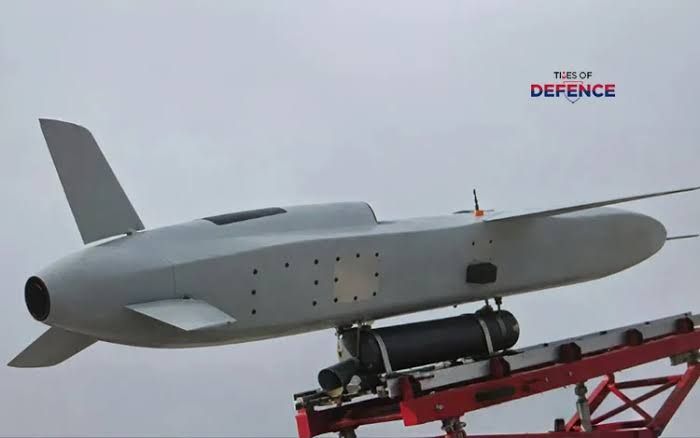
The first photograph of the Filin cruise missile on a ground-based launcher with a solid-fuel booster was published by a Russian propagandist known as PodoLyka. Russia began using the Filin in the war against Ukraine in late summer 2026.
In October 2026, Ukraine's Defense Intelligence (HUR) publicly detailed the missile's components, identifying its manufacturer, propulsion system, guidance equipment, and electronic base.
Specifications
The Filin is a compact cruise missile approximately 3.5 metres in length with a wingspan of 3 metres and a maximum takeoff mass of about 210 kg. It carries a warhead of either 50 or 100 kg, with fragmentation, penetrating, and thermobaric variants reported.
Propulsion is provided by a solid-propellant booster mounted at the lower part of the fuselage for initial launch, after which the missile transitions to its own R500 turbofan engine manufactured by Reynolds LLC. The same engine has previously been identified in the S-71K Kover and S-71M Monokhrom air-launched cruise missiles. The claimed maximum speed is up to 800 km/h, with a range of up to 1,200 km (some assessments give a range of 600 to 1,200 km depending on variant). The missile can fly at altitudes up to 6 km and is also capable of ultra-low-altitude terrain-following flight.
The fuselage is constructed from composite materials, including carbon fibre and fibreglass, with certain components produced using 3D-printing technology. The airframe features a straight wing, tail fins, and an upper-mounted air intake for the turbofan.
Onboard electronics are manufactured by PLAZ LLC, a Russian company also involved in producing the Garpiya, a Russian modification related to the Geran-2 family of unmanned aerial vehicles. Guidance is provided by a Chinese-made inertial navigation system combined with a 16-channel Kometa satellite-navigation module. Ukrainian intelligence analysts identified 35 US-made and 22 Chinese-made components in the missile's electronic base.
Program Status
The Filin is in service with the Russian military as of 2026. Military analyst Rob Lee has reported that more than 1,000 Filin missiles are planned for production by the end of 2026, to be operated by the Rubicon unmanned systems centre and the 50th Unmanned Systems Brigade.
 Argentina
 Armenia
 Australia
 Austria
 Austria-Hungary
 Belgium
 Brazil
 United Kingdom
 United States
 Brunei
 Bulgaria
 Canada
 Chile
 China
 Colonial America
 Colombia
 Confederate States
 Croatia
 Czech
 Denmark
 Egypt
 Finland
 France
 Georgia
 Germany
 German Imperial
 Greece
 Holland
 Hungary
 India
 Indonesia
 Iran
 Iraq
 Ireland
 Israel
 Italy
 Japan
 Japan (1940)
 Jordan
 Kingdom of Italy
 Malaysia
 Mexico
 Myanmar
 Nazi Germany
 Netherlands
 New Zealand
 North Korea
 Norway
 Pakistan
 Peru
 Philippines
 Poland
 Portugal
 Prussia
 Romania
 Saudi Arabia
 Serbia
 Singapore
 Slovakia
 Slovenia
 South Africa
 South Korea
 Soviet Union
 Spain
 Sweden
 Switzerland
 Syria
 Taiwan
 Thailand
 Turkey
 UAE
 Ukraine
 Vietnam
 Yugoslavia