
History
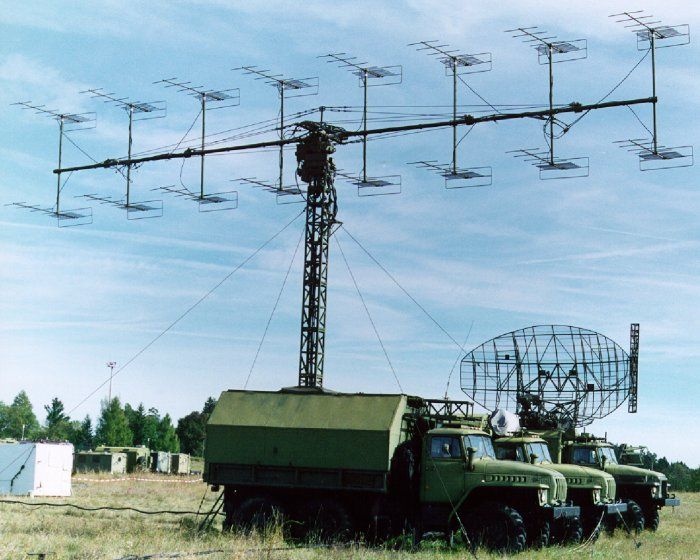
The P-18 Terek, Soviet designation 1RL131 and NATO reporting name “Spoon Rest D,” is a mobile two-dimensional VHF early-warning radar developed in the Soviet Union. It is intended to detect airborne targets, determine their coordinates, and provide surveillance data for air-defense operations.
The radar was developed from the earlier P-12 and entered Soviet service in 1970. Its truck-mounted configuration allowed the station to move between positions, while operation in the metre-wave VHF band provided long-range airspace surveillance.
Although designed during the Cold War, the P-18 remained in service decades later through continued operation and modernization. Russian P-18 stations have also been documented as targets of Ukrainian strikes during the Russia-Ukraine war.
Development
The P-18 was developed by the SKB Design Bureau, a division of State Plant No. 197 named after V. I. Lenin, which had also worked on the preceding P-12 radar. The P-18 incorporated improvements in performance, accuracy, and reliability over the earlier system and was accepted into service in 1970. A later Soviet VHF surveillance radar, the 1L13 Nebo, superseded the P-18 in 1984.
The original radar could operate independently or as part of a command, control, and communications system supplying target information for surface-to-air missile units and aircraft. In 1979 the 1L22 Parol identification-friend-or-foe interrogator entered service and could be used with the P-18 in place of the earlier NRS-12 secondary radar. Technical and historical information on the basic system is summarized in the P-18 radar reference.
Design
Mobility and antenna
The P-18 is a mobile ground-based radar associated with two Ural-4320 truck chassis. Its transport arrangement was intended to allow the station to relocate and establish a new position. During a Ukrainian strike reported in August 2026, the radar was described as capable of changing position in about 45 minutes.
The radar uses one antenna for both transmission and reception. The antenna assembly consists of sixteen Yagi antennas arranged in two groups of eight. It is mounted on the transport vehicle and incorporates mechanisms that allow its height and elevation to be adjusted. Azimuth scanning is mechanical, with the antenna rotating at about 10 revolutions per minute.
Radar equipment
The original P-18 operates in the VHF metre-wave band. It has four preset operating frequencies with automatic frequency control. Moving-target indication is used to suppress passive clutter, while the system also incorporates measures intended to reduce the effects of active jamming. The radar can display information received from another radar with which it is paired.
The original equipment used a coaxial cavity resonator transmitter, a vacuum-tube receiver with transistor-based preamplification, and a duplexer using vacuum-tube and PIN-diode technology. Three indicators were used, including two plan-position indicators and a backup A-scope.
Role
The P-18 is designed for early detection of aircraft and other airborne targets and for determining their coordinates. Surveillance information can then be passed to air-defense elements. Its mobile configuration allows operators to reposition the radar rather than operate permanently from one fixed site.
Operational history
The Soviet Union operated the P-18 from 1970, and the radar was widely exported. After the dissolution of the Soviet Union, examples remained in service with successor states and other countries. Numerous modernization programs have subsequently replaced older electronic components and introduced digital processing while retaining the basic P-18 concept.
The radar has remained relevant during the Russia-Ukraine war. On May 12, 2026, Ukrainian Unmanned Systems Forces reported attacks on several Russian radar positions in occupied Donetsk region, including a station near Zelenyi Yar believed to be a P-18. The strike was reported by Militarnyi.
On July 27, 2026, Ukraine's 15th Brigade was reported to have destroyed a concealed Russian P-18 Terek with an attack drone. According to Defense Express, the radar had been positioned near a tree line and was being used as part of the Russian air-surveillance network.
In August 2026, another Russian P-18 Terek was struck more than 160 km from the line of contact. A Shark-M reconnaissance UAV located the radar before a loitering munition was used against it. Only several hours reportedly passed between detection and the strike, an important factor because the mobile radar could relocate in approximately 45 minutes. A German report in FOCUS online independently described the attack as occurring more than 160 km behind the front and identified the target as a P-18 Terek.
Variants
- P-18M, P-18-1 and P-18-2: Designations applied to different modernization programs depending on manufacturer and national modification. Upgrade packages have included solid-state transmitters and receivers, automatic jammer suppression, and computer-based signal processing and test equipment.
- P-18ML: Lithuanian modernization of the analogue P-18 using commercial components, a modular solid-state transmitter, built-in test equipment, simplified maintenance, and automatic tracking. The type has been reported in Ukrainian service.
- P-18 Malachite: Ukrainian upgraded version based on a KrAZ chassis.
- P-18T: Russian modernization mounted on a KamAZ-43118 chassis.
- ReVEAL: Czech modernization developed by RETIA, incorporating solid-state electronics, digital processing, upgraded identification-friend-or-foe equipment, and repackaging in a standard container.
Operators
- Soviet Union: Original operator from the radar's introduction in 1970. Equipment was later inherited by successor states.
- Russia: P-18 radars and modernized derivatives remain in use; Russian systems have been documented as targets during the Russia-Ukraine war.
- Ukraine: P-18-family radars and modernized versions, including locally upgraded equipment, have been reported in Ukrainian service.
Specifications (P-18)
General characteristics
- Type: Mobile two-dimensional early-warning radar
- Frequency band: VHF
- Scanning: Mechanical azimuth rotation
- Antenna rotation rate: Approximately 10 rpm
- Azimuth coverage: 360 degrees
- Elevation coverage: −5 to +15 degrees
Performance
- Maximum range: 250 km (160 mi)
- Maximum altitude: 35 km (22 mi)
- Range precision: 1 km (0.6 mi)
- Power: 260 kW
Related equipment
- P-12: Earlier Soviet radar from which the P-18 was developed.
- 1L13 Nebo: Later Soviet VHF surveillance radar that superseded the P-18 in 1984.
 Argentina
 Armenia
 Australia
 Austria
 Austria-Hungary
 Belgium
 Brazil
 United Kingdom
 United States
 Brunei
 Bulgaria
 Canada
 Chile
Chile China
China Colonial America
 Colombia
 Confederate States
 Croatia
 Czech
Czech Denmark
 Egypt
Egypt Finland
 France
 Georgia
 Germany
 German Imperial
 Greece
 Holland
 Hungary
 India
India Indonesia
 Iran
Iran Iraq
Iraq Ireland
 Israel
 Italy
Italy Japan
Japan Japan (1940)
 Jordan
 Kingdom of Italy
 Malaysia
 Mexico
 Myanmar
 Nazi Germany
 Netherlands
 New Zealand
 North Korea
 Norway
 Pakistan
 Peru
Peru Philippines
 Poland
 Portugal
 Prussia
 Romania
 Russia
 Saudi Arabia
 Serbia
 Singapore
 Slovakia
 Slovenia
 South Africa
 South Korea
 Spain
Spain Sweden
 Switzerland
 Syria
Syria Taiwan
 Thailand
 Turkey
 UAE
UAE Ukraine
 Vietnam
 Yugoslavia