
History
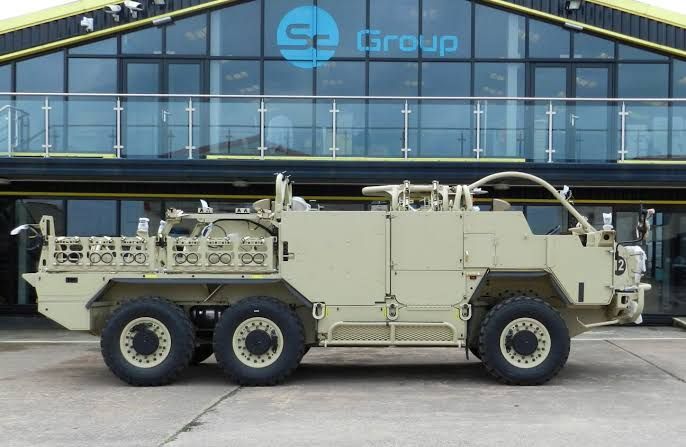
The Supacat HMT Extenda is a British high-mobility military vehicle developed for special operations forces. Its defining feature is a modular third axle that allows the platform to be configured as either a 4×4 or 6×6 vehicle according to mission requirements.
The Extenda belongs to Supacat's High Mobility Transporter family and combines a modular vehicle structure with variable-height air suspension, substantial payload capacity and provisions for weapons, communications, surveillance and protection systems. The platform has been selected by several armed forces for special operations roles.
In September 2026, Supacat announced that production had started on 18 HMT Extenda vehicles for the Czech Republic. The vehicles are intended for the Czech Army's 601st Special Forces Group, with deliveries scheduled to begin in 2027 and continue throughout that year.
Development and early orders
The Extenda was developed specifically for special forces requirements. Its modular design allows operators to add or remove a self-contained third axle and convert the vehicle between 4×4 and 6×6 configurations. An HMT Extenda was publicly displayed at DSEI in 2015, providing the earliest physical milestone explicitly supported by the available material.
In May 2015, Supacat received a £23 million contract from the Norwegian Defence Logistics Organisation for HMT Extenda vehicles and through-life support. The first production vehicle under that programme was scheduled for delivery in late 2016, with deliveries expected to continue between 2017 and 2019. Details of the Norwegian programme were reported by Army Technology.
Australia also selected a vehicle derived from the HMT Extenda. The Australian Defence Materiel Organisation placed a contract for 89 Special Operations Vehicles – Commando under the JP2097 Phase 1B REDFIN programme. The Australian SOV-Cdo was described as a derivative of the HMT Extenda Mk2.
Supacat unveiled the newer Extenda Mk2 version in 2019. According to Supacat, the Mk2 introduced an enhanced suspension system that permitted a 1,500 kg increase in gross vehicle weight and expanded the principal crew seating capacity from four to six.
Czech procurement
The Czech selection followed a feasibility study conducted in 2020–2021 that assessed 14 vehicle types from nine manufacturers. Requirements included high cross-country mobility, sufficient payload for multi-day independent operations, modularity and compatibility with air transport. The HMT Extenda was selected to replace aging Land Rover Defender 110 special operations vehicles.
The Czech Ministry of Defence confirmed the acquisition of 18 British-made vehicles in September 2025. Supacat and Czech partner LPP signed the supply contract in October 2025. The programme separates vehicle supply from Czech integration work, with the Military Technical Institute responsible for technical evaluation and the integration of required mission systems.
Pre-production work for the Czech 6×6 HMT Extenda began in June 2026. Full production subsequently started at Supacat's manufacturing facility at Dunkeswell in Devon. ADS Advance reported that deliveries are planned to begin in 2027 and continue throughout that year.
Open-source reporting describes the Czech configuration as the HMT 600 in 6×6 form, selected for its greater payload. Army Recognition also describes the Czech order as the first export of an Extenda Mk3 variant. The supplied Supacat and ADS Advance material identifies the Czech vehicles as 6×6 HMT Extenda platforms but does not independently confirm the Mk3 designation.
Design
Convertible chassis
The central feature of the HMT Extenda is its convertible chassis. A modular, self-contained third axle unit can be fitted or removed to change the platform between 4×4 and 6×6 layouts. Supacat states that this conversion can be completed in a military workshop using standard tools and lifting equipment.
The modular approach extends beyond the axle system. Different mission modules, protection packages and equipment installations can be fitted according to operational requirements. Published descriptions list provisions for weapons, communications equipment, intelligence, surveillance, target acquisition and reconnaissance systems, and force-protection equipment.
Suspension and mobility
The vehicle uses the HMT variable-height independent air suspension system. Adjustable ride height supports cross-country mobility and allows the vehicle to alter ground clearance according to terrain and transport requirements.
Published information for the 6×6 configuration gives a maximum road speed of 120 km/h and a fording depth of 1 m. Supacat states that the Extenda Mk2 can operate on gradients of 60% and side slopes of 32 degrees. Published road-range figures vary by configuration and source, from approximately 800 km to 1,000 km.
Protection and mission equipment
The Extenda can be supplied with optional mine-blast and ballistic protection. Additional equipment listed for the platform includes run-flat tyres, locking differentials, a self-recovery winch, weapon mounts, remote weapon stations, smoke grenade launchers and infrared lighting.
The Czech vehicles are planned to receive locally integrated weapons, communications, electronics, protection and other mission equipment. Open reporting mentions heavy machine guns and 40 mm automatic grenade launchers among the planned weapon categories, but the final configuration of individual Czech vehicles has not been publicly detailed.
Transportability
Air transportability was an important element of the Czech selection process. Open reporting states that the 6×6 platform can be transported by rail and sea and can be carried as an underslung load beneath a CH-47 Chinook helicopter. It can also fit inside larger transport aircraft such as the Embraer C-390.
Variants
- HMT Extenda 4×4: Shorter configuration created by removing the modular third axle. Published data gives a gross vehicle weight of 7,600 kg and payload of 2,100 kg.
- HMT Extenda 6×6: Extended configuration using the modular third axle. Published data gives a gross vehicle weight of up to 10,500 kg and payload of approximately 3,900 kg.
- HMT Extenda Mk2: Updated version unveiled in 2019 with enhanced suspension, increased permitted gross weight and seating for up to six in the main crew positions.
- SOV-Cdo: Australian Special Operations Vehicle – Commando derived from the HMT Extenda Mk2 for the JP2097 Phase 1B REDFIN programme.
- Czech 6×6 HMT Extenda: Configuration ordered for the Czech Army's 601st Special Forces Group. Army Recognition describes the order as an Extenda Mk3 export, although that designation is not independently confirmed by the supplied manufacturer-related material.
Operators
- Australia: Ordered 89 Special Operations Vehicles – Commando derived from the HMT Extenda Mk2.
- Norway: Ordered HMT Extenda vehicles under a £23 million contract signed in 2015.
- Czech Republic: Ordered 18 6×6 HMT Extenda vehicles for the Czech Army's 601st Special Forces Group. Production started in 2026 and deliveries are scheduled throughout 2027.
Specifications (HMT Extenda 6×6)
General characteristics
- Configuration: 6×6
- Length: approximately 7.04–7.07 m
- Width: 2.05 m
- Gross vehicle weight: up to 10,500 kg
- Payload: approximately 3,900 kg
- Transport weight: 6,600 kg
- Ground clearance: up to 485 mm
- Fuel capacity: approximately 200 litres
Powerplant
- Engine: diesel engine
- Published engine displacement: 4.25 litres
- Published power output: 180 hp
- Transmission: 5 forward gears
Performance
- Maximum road speed: 120 km/h
- Maximum published road range: approximately 800 km for the documented 6×6 configuration; Supacat publishes up to 1,000 km for the newer Extenda Mk2
- Fording depth: 1 m
- Gradient: 60%
Mission equipment
- Protection: Optional mine-blast and ballistic protection kits
- Weapons: Configurable weapon mounts and remote weapon stations depending on customer requirements
- Other equipment: Communications, ISTAR and force-protection systems can be integrated according to mission requirements
 Argentina
 Armenia
 Australia
 Austria
 Austria-Hungary
 Belgium
 Brazil
 United States
 Brunei
 Bulgaria
 Canada
 Chile
Chile China
China Colonial America
 Colombia
 Confederate States
 Croatia
 Czech
Czech Denmark
 Egypt
Egypt Finland
 France
 Georgia
 Germany
 German Imperial
 Greece
 Holland
 Hungary
 India
India Indonesia
 Iran
Iran Iraq
Iraq Ireland
 Israel
 Italy
Italy Japan
Japan Japan (1940)
 Jordan
 Kingdom of Italy
 Malaysia
 Mexico
 Myanmar
 Nazi Germany
 Netherlands
 New Zealand
 North Korea
 Norway
 Pakistan
 Peru
Peru Philippines
 Poland
 Portugal
 Prussia
 Romania
 Russia
 Saudi Arabia
 Serbia
 Singapore
 Slovakia
 Slovenia
 South Africa
 South Korea
 Soviet Union
 Spain
Spain Sweden
 Switzerland
 Syria
Syria Taiwan
 Thailand
 Turkey
 UAE
UAE Ukraine
 Vietnam
 Yugoslavia