

History
The Almaz-Antey RM-48U is a Russian single-stage solid-fuel ballistic strike missile assembled using components derived from several surface-to-air missiles associated with the S-300 and S-400 families. Ukrainian Defense Intelligence states that Russia developed the weapon by restoring and modifying decommissioned anti-aircraft guided missiles and target missiles for attacks on ground targets.
The missile follows a ballistic trajectory, has a reported range of up to 400 km, and reaches speeds of Mach 4 to Mach 6. It carries a 199 kg high-explosive fragmentation warhead and can use autonomous inertial and satellite navigation. The supplied sources describe both radio-command-guided and satellite-guided configurations.
The first supported physical milestone in the supplied material is production during 2025, when Ukrainian intelligence reported that more than 200 RM-48U missiles were produced. For 2026, Russian authorities reportedly planned production of more than 480 missiles, representing more than twice the previous annual output.
Development and production
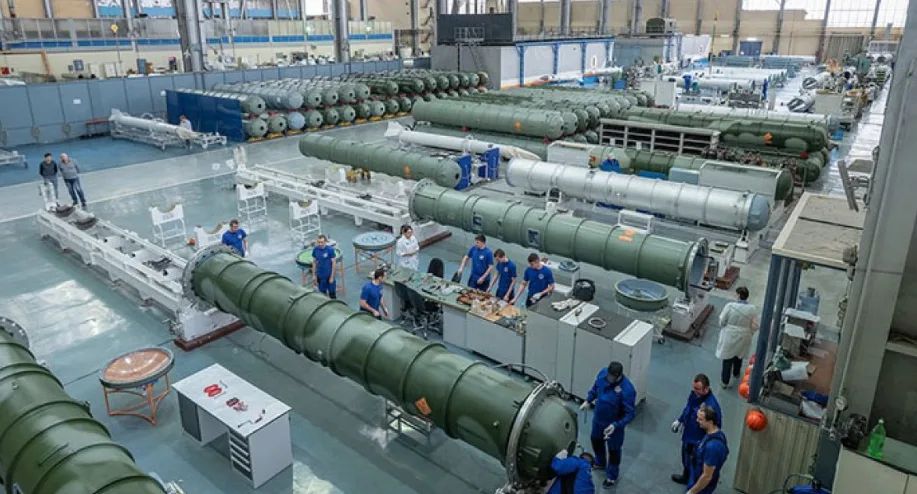
According to Ukrainian intelligence reporting cited by Militarnyi, the RM-48U is a specialized conversion of missiles from the 48N6 family originally developed for air-defense missions. The weapon is intended for use with S-300PM and S-400 systems when attacking ground targets.
Ukraine's Defense Intelligence reported in September 2026 that the RM-48U combines components from several existing missile types. Its solid-propellant motor is derived from the 48N6DM surface-to-air missile used with the S-400. The tail section originates from the export 48N6E2 missile used with the S-300 PMU1/2 and S-400, while the instrument section incorporates elements associated with the 9M96 and 48N6E2 missiles. These details were also reported by RBC-Ukraine, UNITED24 Media, and Oboronka.
Ukrainian intelligence linked at least 63 Russian enterprises to the RM-48U production network. The supplied source identifies Almaz-Antey as the principal developer and manufacturer. VNIIР-Progress is reported to manufacture the Kometa-R12 satellite-navigation system. NPO Poisk is associated with the 9E134 safety and arming mechanism installed in the warhead. Kombinat Kamensky reportedly supplies the 87B6 solid-propellant motor charge, while the Sverdlov Plant produces components for the motor and warhead, including 87B6 and 28A6 charges.
Production increase in 2026
In June 2026, Militarnyi, citing an official response from Ukraine's Defense Intelligence, reported that Russia planned to manufacture more than 480 RM-48U missiles during 2026. The same report stated that more than 200 had been produced during 2025.
On September 10, 2026, Ukraine's Defense Intelligence publicly released additional information about the missile's construction, electronic components, guidance equipment, production network, and an interactive model. Independent reports based on that disclosure included UkrMedia News, RBC-Ukraine, UNITED24 Media, and Oboronka.
Design
Airframe and propulsion
The RM-48U has a single-stage configuration and uses a solid-fuel rocket motor derived from the 48N6DM surface-to-air missile. Its tail section is based on the 48N6E2 export missile. Ukrainian intelligence describes the missile as following a ballistic trajectory at approximately Mach 4 to Mach 6.
Guidance
The autonomous configuration uses a strapdown inertial navigation system together with satellite navigation based on Kometa-R12 receivers. The supplied source identifies a Swiss-branded u-blox M10050-KB GNSS module as part of the Kometa-R12 system.
Ukrainian intelligence also describes a radio-command-guided RM-48U configuration. It reported the creation of separate Russian units for the two guidance arrangements: a Special Tactical Missile Group using radio-command guidance and a Special Operational Missile Group using satellite-guided missiles. The radio-command configuration is limited by the radio horizon and by the capabilities of the S-400 illumination and guidance radar, while the autonomous satellite-guided configuration can operate without continuous command guidance from that radar.
Warhead
The RM-48U carries a 199 kg high-explosive fragmentation warhead. Ukrainian intelligence identifies it as the 28B6A warhead and reports that it contains preformed cube-shaped fragmentation elements. The supplied material also identifies a 9E134 safety and arming mechanism associated with the warhead.
Electronic components
Ukrainian intelligence reported identifying 117 foreign electronic components in the RM-48U. Of these, 95 were associated with United States brands, four with Taiwan, three with Switzerland, two each with Germany, the Netherlands, Japan, and South Korea, and one with France.
Reported components include a Xilinx Zynq XC7Z010 processor and FPGA, Micron memory, analog-to-digital and digital-to-analog converters from Analog Devices and Texas Instruments, transceivers, operational amplifiers, voltage regulators, and other electronics. A laser diode produced by France's 3SP Technologies was also identified. The component findings and their reported national distribution were independently summarized by UkrMedia News and UNITED24 Media.
Operational history
The RM-48U has been reported in Russian attacks on Ukraine. Militarnyi published an image described as fragments of a downed RM-48U from the night of January 20, 2026. The same publication reported that some of the ballistic missiles launched during a major Russian strike on June 2, 2026 were identified as RM-48U missiles.
According to Ukrainian intelligence, Russia employs converted anti-aircraft missiles against ground targets at tactical and operational depths. Satellite-guided RM-48U missiles are reportedly used more frequently than the radio-command configuration because the latter depends on the coverage and performance of the S-400 radar system.
Variants
- RM-48U radio-command configuration: Configuration guided through radio commands and associated by Ukrainian intelligence with the Special Tactical Missile Group. Its effective employment is constrained by the radio horizon and the S-400 illumination and guidance radar.
- RM-48U satellite-guided configuration: Autonomous configuration combining strapdown inertial navigation with satellite navigation using Kometa-R12 receivers. Ukrainian intelligence associates it with the Special Operational Missile Group.
Operators
- Russia: Reported operational user of the RM-48U for strikes against ground targets in Ukraine.
Specifications (RM-48U)
General characteristics
- Configuration: Single-stage ballistic missile
- Propulsion: Solid-fuel rocket motor derived from the 48N6DM surface-to-air missile
- Warhead: 199 kg high-explosive fragmentation warhead with preformed cube-shaped fragments
- Guidance: Radio-command guidance or autonomous strapdown inertial navigation with Kometa-R12 satellite navigation, depending on configuration
Performance
- Maximum reported range: Up to 400 km
- Speed: Mach 4 to Mach 6
Related equipment
- 48N6DM: S-400 surface-to-air missile whose solid-fuel motor is used as the basis for the RM-48U propulsion system.
- 48N6E2: Export surface-to-air missile associated with the S-300 PMU1/2 and S-400; its tail section and some instrument-compartment elements are used in the RM-48U.
- 9M96: Surface-to-air missile family whose components are reported in the RM-48U instrument compartment.
 Argentina
 Armenia
 Australia
 Austria
 Austria-Hungary
 Belgium
 Brazil
 United Kingdom
 United States
 Brunei
 Bulgaria
 Canada
 Chile
Chile China
China Colonial America
 Colombia
 Confederate States
 Croatia
 Czech
Czech Denmark
 Egypt
Egypt Finland
 France
 Georgia
 Germany
 German Imperial
 Greece
 Holland
 Hungary
 India
India Indonesia
 Iran
Iran Iraq
Iraq Ireland
 Israel
 Italy
Italy Japan
Japan Japan (1940)
 Jordan
 Kingdom of Italy
 Malaysia
 Mexico
 Myanmar
 Nazi Germany
 Netherlands
 New Zealand
 North Korea
 Norway
 Pakistan
 Peru
Peru Philippines
 Poland
 Portugal
 Prussia
 Romania
 Saudi Arabia
 Serbia
 Singapore
 Slovakia
 Slovenia
 South Africa
 South Korea
 Soviet Union
 Spain
Spain Sweden
 Switzerland
 Syria
Syria Taiwan
 Thailand
 Turkey
 UAE
UAE Ukraine
 Vietnam
 Yugoslavia