
History
The DF-15A is a Chinese road-mobile, solid-fuel short-range ballistic missile derived from the DF-15 family, also associated with the Western CSS-6 designation. The family was developed in China by the China Academy of Launch Technology, commonly abbreviated CALT, for mobile ground-based ballistic missile operations.
According to CSIS Missile Threat, development of the original DF-15 began in 1984. Design work on its M-9 export version followed in 1985, the missile was publicly displayed in Beijing in 1986, production was approved in 1987, and the first flight test took place in June 1988. The first DF-15 brigade entered Chinese service in August 1991. The DF-15A was subsequently developed as one of several improved members of the family, together with the DF-15B and DF-15C.
China is the only confirmed operator of the DF-15 family in the supplied sources. In September 2026, debris carrying markings identified by open-source analysts as belonging to a DF-15A was found in Yemen. Claims that the missile had been launched by Saudi Arabia remain unconfirmed, and neither Saudi authorities nor the Houthis had publicly established responsibility for the incident in the available reporting.
Development
The DF-15 family was designed around a road-mobile launcher and a solid-propellant missile, allowing the system to be transported without the lengthy liquid-fuel preparation associated with older ballistic missiles. The baseline DF-15 was developed during the 1980s, and later variants introduced changes intended to improve range, guidance and terminal accuracy.
The exact year in which the DF-15A prototype was completed or the variant first entered service is not stated in the supplied sources. Open-source descriptions identify it as an improved DF-15 derivative and place it within the operational CSS-6 family that followed the original missile's development and early deployment.
Design
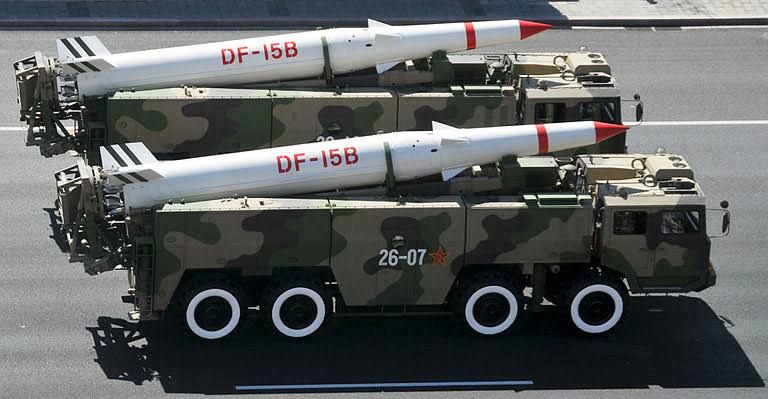
The DF-15A is a road-mobile, single-stage ballistic missile using solid propellant. It is launched from a transporter-erector-launcher, allowing the missile unit to move between firing positions. The mobile configuration is intended to reduce dependence on fixed launch infrastructure and permit relocation after launch.
Open-source descriptions attribute improved guidance features to the DF-15A compared with the original DF-15. These include inertial guidance supplemented by satellite-navigation updates and terminal guidance. Some descriptions also identify control surfaces on the missile and reentry vehicle as part of the improved configuration. Exact guidance architecture and performance remain only partially documented in public sources.
The DF-15 family is generally associated with payloads of approximately 500 to 750 kg. Some open-source assessments place the DF-15A payload near 600 kg. The available sources describe conventional payload options across the family, but they do not establish a complete DF-15A-specific warhead inventory.
Published range figures for the DF-15A are inconsistent. Army Recognition describes the DF-15A as having a range of about 600 km, while other open-source descriptions give estimates reaching approximately 900 km. CSIS lists the wider DF-15 family with a maximum range of 600 to 900 km. The exact range of a particular DF-15A configuration should therefore be treated as uncertain.
Reported 2026 Yemen incident
In September 2026, photographs and videos from Raghwan district in Yemen's Marib Governorate showed a large missile section with markings identified by open-source analysts as DF-15A. Some analysts, including Babak Taghvaee and the OSINTWarfare account cited by SOFX, claimed that the missile had been operated by the Royal Saudi Strategic Missile Force and used against Houthi forces.
The attribution has not been independently confirmed. Other reports initially described the debris as belonging to a missile launched by Houthi forces, and another assessment cited by SOFX suggested an Iranian-origin missile with possible foreign technical influence. Army Recognition reported that no publicly available serial number, verified launch position, official statement or other independent evidence tied the missile to a specific Saudi unit.
Saudi Arabia has not publicly acknowledged operating the DF-15 family. The country is, however, a confirmed operator of Chinese DF-3A ballistic missiles acquired in the late 1980s, while separate reports have alleged a later acquisition of DF-21 missiles. Those earlier relationships provide context for the Saudi attribution but do not confirm Saudi possession or use of the DF-15A.
Operators
- China: China is the only confirmed operator of the DF-15 family in the supplied sources. The DF-15A is documented as a Chinese-developed member of this missile family.
Specifications (DF-15A)
General characteristics
- Type: Short-range ballistic missile.
- Basing: Road-mobile transporter-erector-launcher.
- Propulsion: Single-stage solid-propellant rocket motor.
- Length: Approximately 10 m according to CSIS data for the DF-15A.
- Estimated payload: About 600 kg in some open-source assessments; published family-wide figures range from approximately 500 to 750 kg.
Performance
- Estimated range: Approximately 600 to 900 km across available open-source assessments; published figures for the DF-15A differ.
- Guidance: Inertial guidance with navigation updates and terminal guidance described in open sources.
- Estimated accuracy: Some open-source descriptions cite approximately 30 to 45 m circular error probable for the DF-15A, but the exact figure is not independently confirmed in the supplied evidence.
Related equipment
- DF-15: Original member of the CSS-6 family from which the DF-15A was developed.
- DF-15B: Later improved member of the DF-15 family described in open sources as having additional terminal-guidance and maneuvering features.
- DF-15C: DF-15 family variant associated with a penetrator-type warhead for hardened targets.
 Argentina
 Armenia
 Australia
 Austria
 Austria-Hungary
 Belgium
 Brazil
 United Kingdom
 United States
 Brunei
 Bulgaria
 Canada
 Chile
Chile Colonial America
 Colombia
 Confederate States
 Croatia
 Czech
Czech Denmark
 Egypt
Egypt Finland
 France
 Georgia
 Germany
 German Imperial
 Greece
 Holland
 Hungary
 India
India Indonesia
 Iran
Iran Iraq
Iraq Ireland
 Israel
 Italy
Italy Japan
Japan Japan (1940)
 Jordan
 Kingdom of Italy
 Malaysia
 Mexico
 Myanmar
 Nazi Germany
 Netherlands
 New Zealand
 North Korea
 Norway
 Pakistan
 Peru
Peru Philippines
 Poland
 Portugal
 Prussia
 Romania
 Russia
 Saudi Arabia
 Serbia
 Singapore
 Slovakia
 Slovenia
 South Africa
 South Korea
 Soviet Union
 Spain
Spain Sweden
 Switzerland
 Syria
Syria Taiwan
 Thailand
 Turkey
 UAE
UAE Ukraine
 Vietnam
 Yugoslavia