
History
The THeMIS, or Tracked Hybrid Modular Infantry System, is a tracked unmanned ground vehicle developed by Milrem Robotics in Estonia for military support missions. Its modular architecture allows the same vehicle platform to carry logistics, reconnaissance, combat, engineering, casualty evacuation, electronic-warfare and other mission equipment.
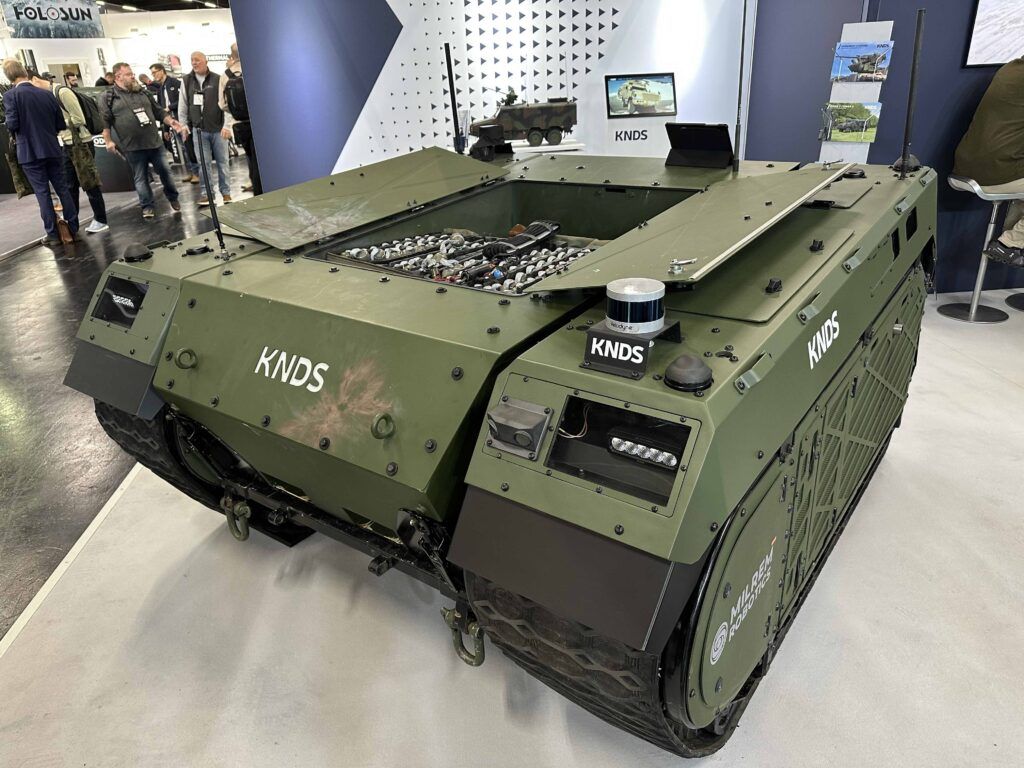
KNDS has used the THeMIS platform as the basis for interchangeable mission modules, including counter-drone and minefield-breaching configurations. The vehicle consists of two tracked side modules separated by a central payload bay, allowing mission equipment to be installed between the tracks.
In 2026, a KNDS mission module carrying TYTAN Technologies TI-03 Hyperion interceptors demonstrated the THeMIS as a mobile counter-UAS launcher. The configuration separates the unmanned effector carrier from radar and command elements, allowing interceptors to move with supported ground formations.
Development and service
By September 2020, Estonia and the Netherlands had announced a joint acquisition of seven THeMIS unmanned ground vehicles after both armies had tested the system.
In September 2022, THeMIS vehicles configured for casualty evacuation and supply transportation were delivered to Ukraine. In November 2022, the German Ministry of Defence, through Krauss-Maffei Wegmann, contracted for another 14 THeMIS unmanned ground vehicles for Ukraine.
By 2026, KNDS was presenting additional mission configurations based on the THeMIS platform. At Enforce Tac 2026, a THeMIS equipped with the H-POMBS minefield-breaching module was shown for remote clearance of anti-personnel mines and battlefield obstacles. The module carried two H-POMBS systems, each intended to clear a lane approximately 54 m long.
At DVD 2026, THeMIS was shown with a KNDS mission module carrying several TI-03 Hyperion counter-UAS interceptors. The integration was intended to create a mobile launcher capable of accompanying manoeuvre forces while keeping personnel physically separated from the effector vehicle.
Design
Platform architecture
THeMIS uses two tracked side modules with a central bay for mission payloads. This arrangement allows the vehicle to function as a modular tool carrier rather than a platform limited to one permanent role. KNDS mission modules can use the bay for reconnaissance, logistics, casualty evacuation, route clearance, electronic warfare, counter-UAS missions and other effectors.
Mission modules can weigh up to 650 kg. The described KNDS modular system allows modules to be exchanged in about ten minutes with a crane or forklift. The interface also supplies electrical and electronic connections between the vehicle and installed equipment.
The platform supports remote operation and autonomous-navigation functions. Its modular architecture allows sensors and mission equipment to be changed for different tasks while keeping personnel away from locations exposed to direct fire, explosive hazards or unmanned-aircraft threats.
Counter-UAS configuration
The 2026 counter-UAS configuration uses the central payload bay to carry multiple TI-03 Hyperion interceptors. THeMIS functions as the mobile effector carrier while radar, command-and-control equipment and other parts of the air-defence network can remain on separate platforms.
Separating sensors from the launcher allows the unmanned vehicle to reposition independently, disperse with other launchers or move closer to an expected threat axis. Target information can be supplied from another element of the network, making the vehicle a mobile node within a wider counter-UAS architecture rather than a complete standalone air-defence system.
The TI-03 Hyperion interceptor uses a rocket booster for initial acceleration before transitioning to an electrically powered terminal phase. It receives data from a ground radar and then continues the engagement autonomously. An AI-assisted thermal camera supports terminal detection and tracking, while the navigation system is designed for operation without GNSS. The demonstrated concept retains a human in the loop during the engagement sequence.
The interceptor carries a fragmentation warhead and is intended for NATO Class II drones. Its stated maximum speed exceeds 500 km/h, with a range of 30 km and a ceiling of 5,000 m. Total interceptor weight is 7.5 kg, including a 0.9 kg payload.
Minefield-breaching configuration
The H-POMBS configuration shown in 2026 transforms THeMIS into a remotely operated minefield-breaching carrier. The module integrates two H-POMBS explosive line-charge systems and allows the vehicle to approach an obstacle while its operators remain at standoff distance.
Each H-POMBS system is specified to create a lane approximately 54 m long and about 0.5 m wide, although actual clearing width depends on mine type, soil and environmental conditions. The vehicle control interface is used to align the system in pitch and roll, while hatch operation and the firing sequence can be controlled remotely.
Preparation is stated as about five minutes for one system or ten minutes for both shots. The module is protected against small-calibre fire and can be supplemented with equipment such as a laser warning system and smoke grenade launchers.
Program status
THeMIS has progressed beyond experimental demonstrations and has been acquired, tested or delivered for military use. The platform has also continued to receive new mission modules, including engineering and counter-UAS configurations demonstrated in 2026.
The TI-03 Hyperion integration demonstrates a distributed counter-drone concept in which THeMIS carries interceptors but does not require the detection radar and command post to be mounted on the same vehicle. Multiple unmanned launchers could therefore be positioned around a formation and receive targeting information from a shared sensor network.
The effectiveness of such a distributed arrangement depends on external sensors, command-and-control communications, available interceptors and the ability to maintain network links in a contested electromagnetic environment.
Variants
- THeMIS Transport — Logistics configuration intended for supply transport and last-mile resupply of frontline units.
- THeMIS Combat — Combat configuration capable of carrying remotely controlled weapon systems, including machine guns, grenade launchers, autocannons and anti-tank missile systems.
- THeMIS ISR — Intelligence, surveillance and reconnaissance configuration using multiple sensors for situational awareness, reconnaissance and battle-damage assessment.
- THeMIS H-POMBS — 2026 engineering configuration carrying two H-POMBS minefield-breaching systems for remotely creating lanes through anti-personnel minefields and obstacles.
- THeMIS TI-03 Hyperion — 2026 KNDS counter-UAS configuration carrying TYTAN TI-03 Hyperion interceptors as a mobile effector node within a distributed air-defence network.
Specifications (THeMIS with KNDS TI-03 Hyperion mission module)
Platform and mission module
- Configuration: Tracked unmanned ground vehicle with two side track modules and a central mission bay
- Mission-module capacity: Up to 650 kg
- Module replacement time: About 10 minutes using a crane or forklift
- Counter-UAS role: Mobile carrier and launcher for multiple TI-03 Hyperion interceptors
Integrated TI-03 Hyperion interceptor
- Intended target class: NATO Class II unmanned aircraft
- Maximum speed: More than 500 km/h
- Range: 30 km
- Ceiling: 5,000 m
- Total weight: 7.5 kg
- Payload: 0.9 kg
- Warhead: Fragmentation
- Propulsion: Rocket booster followed by electrically powered terminal flight
- Terminal sensor: AI-assisted thermal camera
- Navigation: Designed for operation in a GNSS-denied environment
- Engagement architecture: Ground-radar cueing followed by autonomous engagement, with a human retained in the engagement loop
 Argentina
 Armenia
 Australia
 Austria
 Austria-Hungary
 Belgium
 Brazil
 United Kingdom
 United States
 Brunei
 Bulgaria
 Canada
 Chile
Chile China
China Colonial America
 Colombia
 Confederate States
 Croatia
 Czech
Czech Denmark
 Egypt
Egypt Finland
 France
 Georgia
 Germany
 German Imperial
 Greece
 Holland
 Hungary
 India
India Indonesia
 Iran
Iran Iraq
Iraq Ireland
 Israel
 Italy
Italy Japan
Japan Japan (1940)
 Jordan
 Kingdom of Italy
 Malaysia
 Mexico
 Myanmar
 Nazi Germany
 Netherlands
 New Zealand
 North Korea
 Norway
 Pakistan
 Peru
Peru Philippines
 Poland
 Portugal
 Prussia
 Romania
 Russia
 Saudi Arabia
 Serbia
 Singapore
 Slovakia
 Slovenia
 South Africa
 South Korea
 Soviet Union
 Spain
Spain Sweden
 Switzerland
 Syria
Syria Taiwan
 Thailand
 Turkey
 UAE
UAE Ukraine
 Vietnam
 Yugoslavia