
History
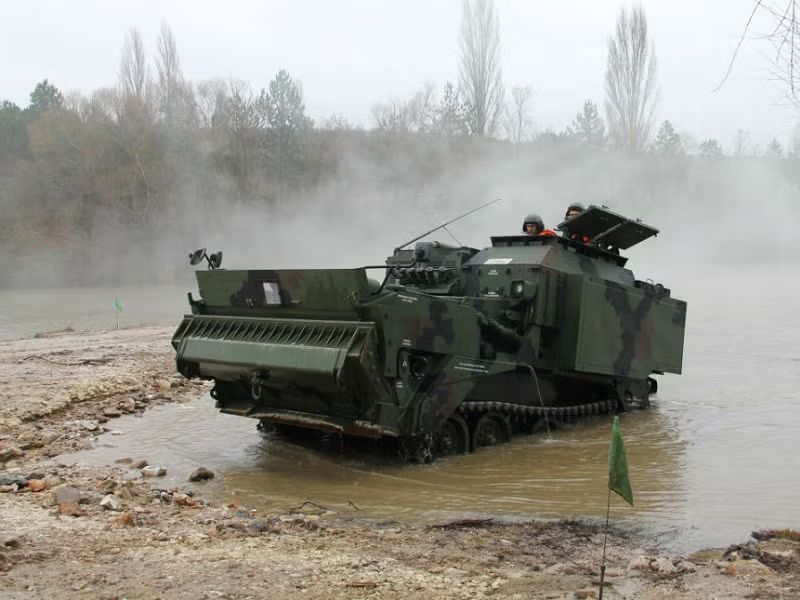
The FNSS Kunduz is a Turkish tracked amphibious combat engineering vehicle designed to combine protected mobility with earthmoving capability. It supports combat-engineering tasks including obstacle clearance, excavation, grading, hauling, route preparation, river-crossing support, survivability work, and disaster-response operations.
The vehicle uses a front dozer blade and ballast system for engineering work while retaining the ability to swim using twin water jets. A two-person crew operates the vehicle from an armoured hull equipped with day and night observation systems, CBRN protection, air-conditioning, and a recovery winch.
Kunduz was developed by FNSS for the Turkish Armed Forces and later selected by the Philippines. Six vehicles entered Philippine Army service with the 525th Combat Engineer Battalion in September 2026.
Development
Turkey's Ministry of National Defence signed a contract with FNSS on 10 March 2009 for development of an armoured amphibious combat earthmover. Development began on 15 June 2009, with the programme initially providing for production of twelve vehicles. The first Kunduz was delivered to the Turkish Armed Forces on 11 January 2013.
The vehicle was developed to move earth, clear terrain obstacles, cut steep slopes, and prepare or reinforce stream banks to assist the movement and crossing of combat vehicles. Its amphibious configuration allows it to cross water obstacles without a separate transporter.
Philippine procurement
FNSS received a contract in 2020 to supply an undisclosed number of Kunduz vehicles to the Armed Forces of the Philippines. Six Kunduz combat engineering vehicles were handed over to the Philippine Army's 525th Combat Engineer Battalion on 23 September 2026 at Fort Bonifacio in Metro Manila. The vehicles were inducted alongside other combat-engineering equipment.
Design
Kunduz has a tracked armoured layout with a dozer blade at the front, a ballast system in the central section, and the power pack at the rear. The crew compartment accommodates two personnel, an operator and an attendant, with access through roof-mounted hatches.
The hull is constructed from aluminium to support amphibious operation while providing ballistic protection. The specified protection level is not publicly disclosed, although the vehicle is designed to resist ballistic threats, shell fragments, and mine effects. Six smoke grenade launchers provide an additional survivability measure.
Engineering equipment
The front blade and ballast system allow Kunduz to perform bulldozing, rough grading, excavation, hauling, scraping, obstacle-clearing, slope-cutting, and bank-preparation tasks. Ballast can be added when greater weight is required for earthmoving work and discharged when it is no longer needed. The hydraulic suspension can raise or lower the front of the vehicle to position the blade or ballast equipment against the ground.
A recovery winch with a rated pulling capacity of 15,000 kg is fitted. The vehicle can therefore provide recovery assistance in addition to its principal earthmoving duties.
Crew systems and protection
Kunduz is equipped with a daylight camera, night-vision equipment, a multifunction display, air-conditioning, and CBRN protection. The engine compartment incorporates a fire-suppression system, and portable fire extinguishers are also carried.
Powerplant and mobility
The vehicle is powered by a Cat diesel engine connected to an Allison fully automatic transmission. It has a maximum road speed of 45 km/h and a maximum road range of 400 km. The running gear has four road wheels on each side and a rear sprocket.
Kunduz can climb a 60 percent gradient, traverse a 30 percent side slope, cross a vertical obstacle up to 0.4 m high, and negotiate a trench up to 1.5 m wide.
Amphibious capability
Two pump jets propel Kunduz in water. The system provides manoeuvrability during amphibious movement and permits turning in flowing water. Maximum water speed is 8.6 km/h. The ballast system can be emptied before water crossings to reduce weight and restored for engineering work after reaching land.
Operational history
The Turkish Armed Forces became the first operator after receiving the initial vehicle in January 2013. Kunduz was developed to accompany other combat vehicles and conduct engineering work without requiring a separate carrier for normal movement between operating areas.
The Philippine Army became another operator in 2026. Six Kunduz vehicles were formally handed over to the 525th Combat Engineer Battalion on 23 September and inducted for combat-engineering duties.
Operators
- Turkey: Kunduz was developed for the Turkish Armed Forces, which received the first vehicle in January 2013.
- Philippines: The Armed Forces of the Philippines ordered Kunduz vehicles under a 2020 contract. Six vehicles were handed over to the Philippine Army's 525th Combat Engineer Battalion in September 2026.
Specifications (Kunduz)
General characteristics
- Crew: 2
- Combat weight: 19,500 kg
- Length: 6.2 m
- Width: 3.3 m
- Height: 3.2 m
- Hull: Aluminium armoured construction
- Engine: Cat diesel engine
- Transmission: Allison fully automatic transmission
- Suspension: Hydraulic
- Recovery winch capacity: 15,000 kg
Performance
- Maximum road speed: 45 km/h
- Maximum water speed: 8.6 km/h
- Road range: 400 km
- Gradient: 60 percent
- Side slope: 30 percent
- Vertical obstacle: 0.4 m
- Trench: 1.5 m
Engineering and protection equipment
- Earthmoving equipment: Front dozer blade and ballast system
- Water propulsion: Two pump jets
- Observation: Daylight camera and night-vision equipment
- Crew protection: Ballistic and mine protection to undisclosed levels, with CBRN protection
- Smoke equipment: Six smoke grenade launchers
- Fire protection: Engine-compartment fire-suppression system and portable extinguishers
 Argentina
 Armenia
 Australia
 Austria
 Austria-Hungary
 Belgium
 Brazil
 United Kingdom
 United States
 Brunei
 Bulgaria
 Canada
 Chile
Chile China
China Colonial America
 Colombia
 Confederate States
 Croatia
 Czech
Czech Denmark
 Egypt
Egypt Finland
 France
 Georgia
 Germany
 German Imperial
 Greece
 Holland
 Hungary
 India
India Indonesia
 Iran
Iran Iraq
Iraq Ireland
 Israel
 Italy
Italy Japan
Japan Japan (1940)
 Jordan
 Kingdom of Italy
 Malaysia
 Mexico
 Myanmar
 Nazi Germany
 Netherlands
 New Zealand
 North Korea
 Norway
 Pakistan
 Peru
Peru Philippines
 Poland
 Portugal
 Prussia
 Romania
 Russia
 Saudi Arabia
 Serbia
 Singapore
 Slovakia
 Slovenia
 South Africa
 South Korea
 Soviet Union
 Spain
Spain Sweden
 Switzerland
 Syria
Syria Taiwan
 Thailand
 UAE
UAE Ukraine
 Vietnam
 Yugoslavia