
History
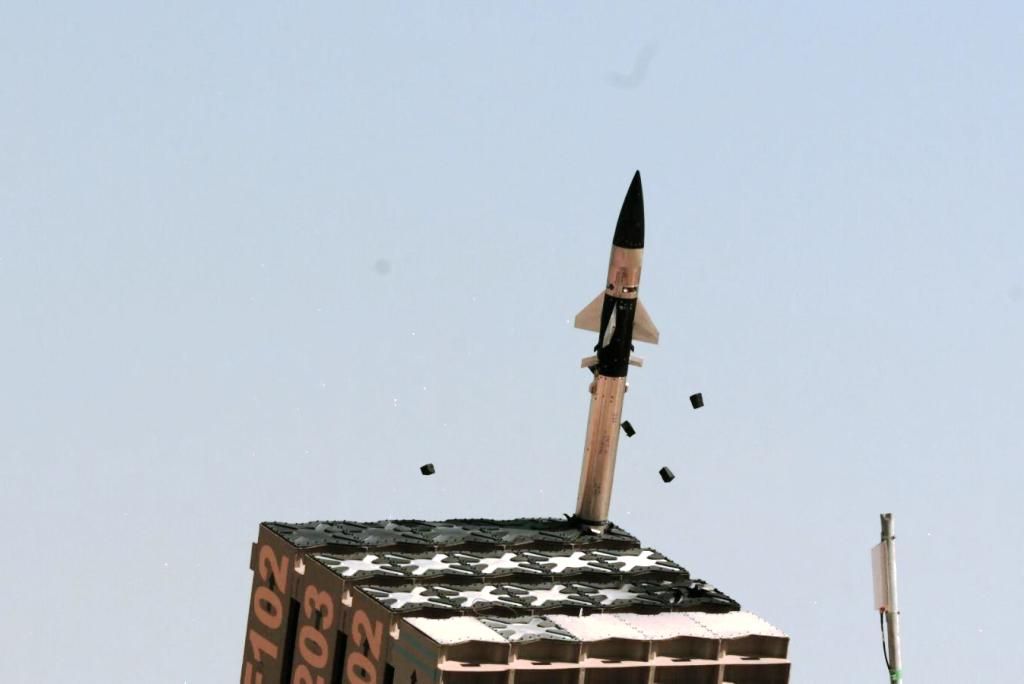
The Tamir interceptor was developed under the leadership of the Israel Missile Defense Organization (IMDO) with Rafael as prime contractor. It entered service in 2011 as the interceptor for Iron Dome, the lowest tier of Israel's missile defense architecture, designed to counter short-range rockets, artillery shells, and mortars. Over 15 years of service, Iron Dome has recorded more than 10,000 operational interceptions, including during recent regional conflicts.
U.S. involvement in Tamir production grew over time. In March 2014, Israel signed a co-production agreement with the United States, allowing U.S. manufacture of system components. By 2016, around 55 percent of Iron Dome's components were produced in the United States, a share that later rose to roughly 75 percent. In August 2020, Rafael and Raytheon formed the R2S joint venture to produce complete interceptors on U.S. soil, building on more than a decade of parts-level workshare under U.S. funding for the system.
R2S broke ground on its facility in East Camden, Arkansas, in February 2024 and opened it in November 2025, after raising its planned investment from $33 million to about $63 million and expanding the expected workforce from 30 to as many as 60. At opening, R2S was awarded a $1.25 billion direct commercial sales contract to supply Israel with Tamir missiles, missile kits, and test equipment. The Camden plant is the first site outside Israel to manufacture complete Tamir interceptors.
In October 2026, R2S delivered the first Tamir interceptor built and assembled entirely in the United States to IMDO at a ceremony at the plant, attended by officials from both nations. The facility is also set to produce SkyHunter, the U.S. variant of Tamir selected for the U.S. Marine Corps' Medium-Range Intercept Capability program.
Specifications
The Tamir interceptor is approximately 3 m long and 160 mm in diameter, with a launch mass of about 90 kg. It uses a command datalink and an onboard active radar seeker for terminal guidance and carries a high-explosive blast-fragmentation warhead with a proximity fuze. Initial production cost was estimated at $100,000 per unit; later estimates place it at roughly $40,000 to $50,000. The Iron Dome system, which employs Tamir launchers holding up to 20 interceptors each, can engage targets at ranges of up to 70 km.
Variants
SkyHunter is the U.S. variant of the Tamir interceptor, selected for the U.S. Marine Corps' Medium-Range Intercept Capability program to defend against cruise missiles, aircraft, rockets, artillery, and mortars.
 Argentina
 Armenia
 Australia
 Austria
 Austria-Hungary
 Belgium
 Brazil
 United Kingdom
 United States
 Brunei
 Bulgaria
 Canada
 Chile
Chile China
China Colonial America
 Colombia
 Confederate States
 Croatia
 Czech
Czech Denmark
 Egypt
Egypt Finland
 France
 Georgia
 Germany
 German Imperial
 Greece
 Holland
 Hungary
 India
India Indonesia
 Iran
Iran Iraq
Iraq Ireland
 Italy
Italy Japan
Japan Japan (1940)
 Jordan
 Kingdom of Italy
 Malaysia
 Mexico
 Myanmar
 Nazi Germany
 Netherlands
 New Zealand
 North Korea
 Norway
 Pakistan
 Peru
Peru Philippines
 Poland
 Portugal
 Prussia
 Romania
 Russia
 Saudi Arabia
 Serbia
 Singapore
 Slovakia
 Slovenia
 South Africa
 South Korea
 Soviet Union
 Spain
Spain Sweden
 Switzerland
 Syria
Syria Taiwan
 Thailand
 Turkey
 UAE
UAE Ukraine
 Vietnam
 Yugoslavia