

History
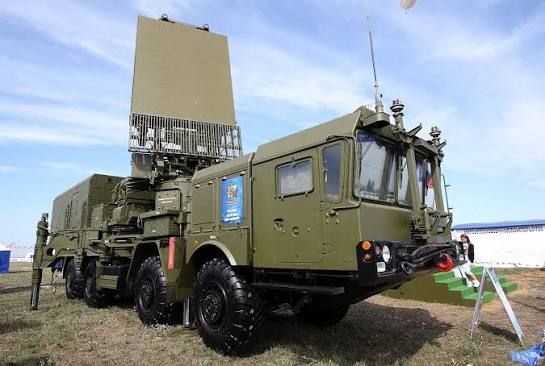
The 96L6 all-altitude detection radar (NATO reporting name: Cheese Board) was developed by the Almaz-Antey concern with serial production at the Lianozovo Electromechanical Plant (NPO LEMZ). Initial tests were conducted on 10 August 1995 at the Kapustin Yar firing range. The radar was unveiled at the MAKS-97 air show in August 1997 as a new element of the S-300PMU2 (Favorit) system, and a model was displayed at the IDEX-97 exhibition. The first public display of the production 96L6E variant took place at the MAKS-2001 air show. State tests of the 96L6E were successfully completed in 2005, and initial operational capability was reached on 28 April 2007. The radar was commissioned into service with the Russian aerospace defence forces by order of the Minister of Defense in 2008. A newer variant, the 96L6-TsP, achieved initial operational capability in 2023.
During the Russian invasion of Ukraine, a 96L6 belonging to an S-400 battery was located by a Ukrainian reconnaissance drone while in the process of redeployment and was subsequently struck by two kamikaze drones that hit the antenna area. The strikes did not destroy the radar but are expected to require extensive and costly repair.
Specifications
The 96L6 is a C-band phased-array surveillance radar designed for detection and tracking of air targets at all altitudes. It provides three-coordinate target information (azimuth, elevation, range) and transmits target designations to command posts and missile launchers over radio or fibre-optic links. The radar recognises four classes of targets — aircraft, helicopters, unmanned aerial vehicles, and missiles — and is capable of distinguishing between aircraft, cruise missiles, ballistic missiles, and UAVs.
The maximum detection range is 300 km with a minimum of 5 km. The radar can simultaneously track up to 100 targets. In all-altitude detection mode the viewing area covers 360° in azimuth and 0° to 20° in elevation, with target Doppler velocities between ±30 and ±1,200 m/s and a refresh rate of 6 s in the lower elevation zone (0–1.5°) and 12 s in the upper zone (1.5–20°). In sector-search mode the azimuth sector extends up to 120° and the Doppler range to ±2,800 m/s, with a sector overview time of up to 8 s. Time to establish a target trail and issue a coordinate update for an aerodynamic target is 12 s at elevations below 1.5° and 21 s above that threshold. The number of false targets over a 30-minute operating period is limited to 3–5.
The radar is available in two transport configurations. In the single-unit version the antenna and electronics are mounted on a MAZ-7930 (8×8) truck chassis. In the two-unit version the antenna post and equipment post are separate road-train units that can be separated by up to 100 m. The antenna assembly can alternatively be mounted on a 40V6M tower for improved low-altitude and rough-terrain coverage, with a tower installation time of approximately 2 hours.
Time to operational readiness from march is 5 minutes for the single-unit version and 30 minutes for the two-unit version; from a pre-deployed standby position readiness is achieved in no more than 40 seconds. The radar supports continuous operation without time limitation. Service life is at least 20 years with a total operational life of 25,000–30,000 hours including overhauls; the interval to the first major overhaul is at least 10 years. The operating temperature range is ±50 °C, the allowable wind speed is up to 30 m/s, and the maximum operating altitude is 3,000 m. The crew complement is up to 3 personnel. The radar interfaces with Baikal-1E, Senezh-M1E, Osnova-1E, and Field-E command and control systems.
Variants
- 96L6E — the original production variant, available in single-unit and two-unit transport configurations. Used in S-300PMU1, S-300PMU2, and S-400 air-defence systems.
- 96L6-TsP — a newer variant with active status.
Operators
The 96L6 is in service with Russia's aerospace defence forces as part of S-300PMU1, S-300PMU2, and S-400 air-defence systems.
 Argentina
 Armenia
 Australia
 Austria
 Austria-Hungary
 Belgium
 Brazil
 United Kingdom
 United States
 Brunei
 Bulgaria
 Canada
 Chile
Chile China
China Colonial America
 Colombia
 Confederate States
 Croatia
 Czech
Czech Denmark
 Egypt
Egypt Finland
 France
 Georgia
 Germany
 German Imperial
 Greece
 Holland
 Hungary
 India
India Indonesia
 Iran
Iran Iraq
Iraq Ireland
 Israel
 Italy
Italy Japan
Japan Japan (1940)
 Jordan
 Kingdom of Italy
 Malaysia
 Mexico
 Myanmar
 Nazi Germany
 Netherlands
 New Zealand
 North Korea
 Norway
 Pakistan
 Peru
Peru Philippines
 Poland
 Portugal
 Prussia
 Romania
 Saudi Arabia
 Serbia
 Singapore
 Slovakia
 Slovenia
 South Africa
 South Korea
 Soviet Union
 Spain
Spain Sweden
 Switzerland
 Syria
Syria Taiwan
 Thailand
 Turkey
 UAE
UAE Ukraine
 Vietnam
 Yugoslavia