
History
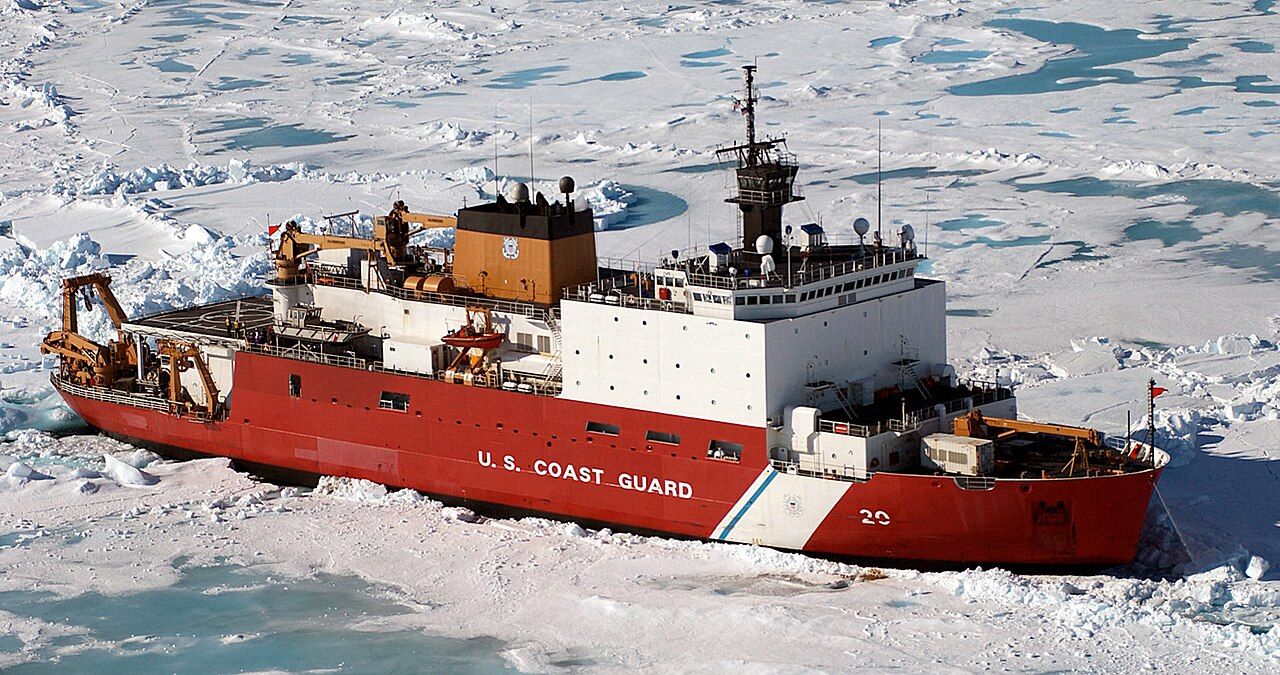
USCGC Healy (WAGB-20) is a United States Coast Guard medium polar icebreaker designed primarily for Arctic scientific research. The ship combines icebreaking capability with laboratories, oceanographic equipment, aviation facilities, and accommodation for scientific personnel.
Avondale Industries built Healy in New Orleans with technical assistance from the Finnish Kværner Masa-Yards Arctic Technology Centre. The Finnish organization contributed expertise in icebreaker hull development and propulsion-line engineering.
Healy entered service near the end of the twentieth century and has since supported scientific expeditions, polar logistics, search and rescue, ship escort, environmental protection, and law-enforcement missions. Repeated propulsion and electrical casualties in 2020, 2024, and 2026 have also demonstrated the maintenance challenges associated with the aging vessel.
Construction and commissioning
Healy was named for Captain Michael A. Healy of the United States Revenue Cutter Service. The Coast Guard provides additional information about the namesake on its Healy history page.
The keel was laid on 16 September 1996, and the ship was launched on 15 November 1997. Healy was commissioned on 10 November 1999. After leaving New Orleans in January 2000, the ship conducted sea trials near Puerto Rico and in Baffin Bay. It then reached Seattle by way of the Northwest Passage and was placed in active commission on 21 August 2000.
Design
Healy has a diesel-electric propulsion system. Four Sulzer 12ZAV40S diesel engines provide electrical power, while two 11.2 MW propulsion motors drive separate shafts. A 2,200 hp bow thruster supports maneuvering, dynamic positioning, and station keeping during scientific work.
The hull is designed to break ice 1.4 m thick continuously at 3 knots. The ship can also penetrate ice up to approximately 3 m thick by backing and ramming. Its specified minimum operating temperature is −46 degrees Celsius.
The vessel provides more than 390 m² of scientific laboratory space. Permanent facilities include main, wet, biochemistry, electronics, and meteorological laboratories. Healy can also carry eight ISO containers configured as additional laboratories or workspaces.
Scientific handling equipment includes oceanographic winches, two A-frames, and several cranes. The starboard crane on the aft working deck is rated for 14 tonnes, while the corresponding port crane is rated for 4.5 tonnes. The flight deck can accept Coast Guard helicopter types, and the hangar can accommodate two HH-65 Dolphin helicopters. The ship also carries an Arctic Survey Boat and two rigid-hull inflatable boats. A technical overview and historical material are available from the Universal Ship Cancellation Society exhibit.
Operational history
On 6 September 2001, Healy reached the North Pole during the Arctic East Science Mission with the German icebreaker Polarstern. The ship returned to the pole with the Swedish icebreaker Oden in September 2005.
Healy supported Operation Deep Freeze in Antarctica in 2003. The cutter worked with Polar Sea to escort a freighter and tanker through the ice during the resupply of McMurdo Station.
In January 2012, Healy escorted the tanker Renda through more than 560 km of difficult pack ice to deliver fuel to Nome, Alaska. In September 2015, the cutter became the first United States surface vessel to reach the North Pole without another ship accompanying it. Healy reached the pole for a fourth time in September 2022 while supporting the international Synoptic Arctic Survey.
The vessel has conducted extensive biological, geological, oceanographic, and climate research. Its equipment has supported seabed mapping, water and ice sampling, ecological studies, autonomous vehicle trials, oil-response experiments, and satellite-communication testing. A broader chronology is available in the USCGC Healy reference overview.
Engineering casualties
On 18 August 2020, an electrical fire disabled the propulsion motor connected to the starboard shaft. The Arctic mission was cancelled, and Healy returned to Seattle. During repairs, the hull was opened and the damaged 106-tonne motor was replaced with a spare. The cutter returned to service in 2021.
Another electrical fire occurred in July 2024 and affected a transformer associated with the propulsion system. The crew and contractors restored power to the affected propulsion motor, but the ship returned to Seattle and cancelled its remaining Arctic missions. Repairs restored Healy to service in 2025.
Early in 2026, Healy underwent an $18.3 million overhaul at the Swan Island shipyard in Portland, Oregon. Work included propulsion shafts, bearings, seals, rudders, the bow thruster, sonar, and supporting infrastructure.
On 13 July 2026, the ship lost propulsion during sea trials off Washington following what the Coast Guard described as a significant engineering casualty. Healy was towed without further incident, and no injuries were reported. The Coast Guard opened an investigation and said major repairs would be required, but it did not initially disclose the cause, full extent of the damage, or a repair schedule. Contemporary accounts were published by The Maritime Executive and Sixty Degrees North.
Operator
- United States Coast Guard: Healy is homeported in Seattle, Washington, and is classified by the service as a medium icebreaker.
Specifications (USCGC Healy WAGB-20)
General characteristics
- Type: Medium polar icebreaker and research vessel
- Displacement: 16,257 tonnes
- Length: 128 m
- Beam: 25 m
- Draft: 8.92 m
- Installed power: Four Sulzer 12ZAV40S diesel engines, 34,560 kW combined
- Propulsion: Diesel-electric system, two shafts with one 11.2 MW motor per shaft
- Bow thruster: 2,200 hp
- Ship complement: 19 officers, 12 chief petty officers, and 54 enlisted personnel
- Scientific personnel: Accommodation for up to 51 scientists
Performance
- Maximum speed: 17 knots
- Cruising speed: 14 knots
- Continuous icebreaking: 3 knots through ice 1.4 m thick
- Maximum ice penetration: Approximately 3 m by backing and ramming
- Minimum operating temperature: −46 degrees Celsius
Scientific and aviation facilities
- Permanent laboratories: Five
- Laboratory area: More than 390 m²
- Container capacity: Eight ISO laboratory or workspace containers
- Aircraft facilities: Flight deck and hangar with space for two HH-65 Dolphin helicopters
- Boats: One 12 m Arctic Survey Boat and two 7.9 m rigid-hull inflatable boats
 Argentina
 Armenia
 Australia
 Austria
 Austria-Hungary
 Belgium
 Brazil
 United Kingdom
 Brunei
 Bulgaria
 Canada
 Chile
Chile China
China Colonial America
 Colombia
 Confederate States
 Croatia
 Czech
Czech Denmark
 Egypt
Egypt Finland
 France
 Georgia
 Germany
 German Imperial
 Greece
 Holland
 Hungary
 India
India Indonesia
 Iran
Iran Iraq
Iraq Ireland
 Israel
 Italy
Italy Japan
Japan Japan (1940)
 Jordan
 Kingdom of Italy
 Malaysia
 Mexico
 Myanmar
 Nazi Germany
 Netherlands
 New Zealand
 North Korea
 Norway
 Pakistan
 Peru
Peru Philippines
 Poland
 Portugal
 Prussia
 Romania
 Russia
 Saudi Arabia
 Serbia
 Singapore
 Slovakia
 Slovenia
 South Africa
 South Korea
 Soviet Union
 Spain
Spain Sweden
 Switzerland
 Syria
Syria Taiwan
 Thailand
 Turkey
 UAE
UAE Ukraine
 Vietnam
 Yugoslavia