
History
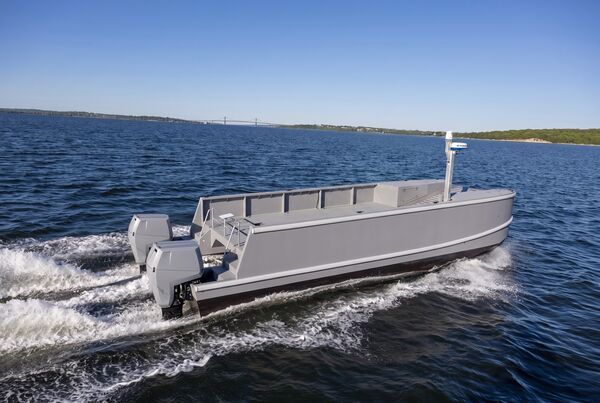
The Tactical Composites Small High-Speed Amphibious Role-Variant Craft (SHARC) is an autonomous catamaran developed for the U.S. Marine Corps as a littoral logistics and payload-delivery vessel. The first prototype was delivered to the Marine Corps in 2026 after initial sea trials earlier that year.
SHARC was developed through a Small Business Innovation Research program in response to a Marine Corps requirement supporting Expeditionary Advanced Base Operations and Littoral Operations in a Contested Environment. The program received about USD 1.9 million in funding.
The vessel combines a road-transportable catamaran hull, high payload capacity, autonomous navigation architecture, and an automated bow ramp intended to move equipment directly onto beaches or into the water where conventional port infrastructure is unavailable.
Development and prototype
An earlier Small High-Speed Amphibious Role Variant Craft design effort described by Art Anderson Associates examined a catamaran landing-craft configuration, modular mission packages, bow-to-stern loading, and the ability to transport autonomous, remotely operated, and crewed vehicles and systems. The work included Phase I concept development and additional technical design intended to reduce risk before Phase II.
The prototype associated with Tactical Composites was designed by Mode 3 Design. Waterfront Composite Solutions provided engineering services, while Cay Electronics Inc. and DQ Yachts Inc. contributed electronics work. Safe Harbor Front Street built the vessel in Maine.
The prototype was launched for initial sea trials in April 2026. Tactical Composites announced in August 2026 that the first SHARC prototype had been delivered to the U.S. Marine Corps. A detailed account published by WorkBoat reported that additional sea trials, autonomy validation, payload testing, and operational demonstrations were planned for summer and fall 2026.
Additional SHARC vessels were reported to be on order for delivery in 2027 and 2028. Tactical Composites was also developing a larger variant and examining possible commercial applications.
This Small High-Speed Amphibious Role-Variant Craft should not be confused with the separate Boeing and Liquid Robotics SHARC, whose name expands to Sensor-Hosting Remote Autonomous Craft and refers to a wave-powered unmanned sensor platform.
Design
Hull and cargo arrangement
SHARC is a catamaran measuring 11.5 m (37.75 ft) long, with a beam of 4.1 m (13.45 ft) and a draft of 0.75 m (2.41 ft). Tactical Composites stated that its dimensions were selected to permit road transport on standard equipment. The prototype can be moved on a low-boy trailer, although its beam requires a wide-load permit.
The hull is constructed from vacuum-infused fibre-reinforced plastic. The reported construction uses fire-retardant vinyl ester resin and a foam core. Carbon fibre reinforces the deck. The cargo area incorporates several tie-down arrangements and alloy rail protection intended for tracked equipment.
An automated bow ramp allows cargo and vehicles to be deployed directly onto a beach or into the water. The ramp is designed to support the vessel's full payload during cantilevered loading. Maximum payload is reported as 6.35 tonnes (14,000 lb).
Propulsion and performance
Propulsion is provided by two 300 hp OXE diesel outboard engines. The vessel has a reported cruising speed of 20 knots and a maximum loaded speed of 25 knots in Sea State 3 conditions. Its stated range exceeds 1,000 nautical miles.
Autonomy and sensors
Robosys Autonomous Marine Solutions developed the autonomy system. SHARC uses an open autonomy architecture intended to accommodate cameras, radar, GPS, sonar, and other sensors. This modular approach is intended to allow the vessel's sensing and mission equipment to be adapted as operational requirements change.
Mission equipment
Proposed military roles include autonomous delivery of food, water, fuel, munitions, unmanned ground vehicles, and other equipment to shorelines where harbour access is unavailable or compromised. Other envisioned roles include casualty evacuation, launch and recovery of autonomous underwater vehicles and uncrewed aircraft, and coordinated operations with other unmanned systems. These are described as intended or possible mission profiles rather than confirmed operational employment.
Program status
The U.S. Marine Corps received the first prototype in 2026. Further testing was planned to include sea trials, autonomy validation, payload testing, and operational demonstrations. The available sources do not establish that SHARC has entered regular operational service.
Additional vessels were reported as ordered for delivery in 2027 and 2028. Tactical Composites was targeting an approximate production cost of USD 1 million per vessel and planned to work with U.S. shipyards on future manufacturing.
Variants
- SHARC prototype: The 11.5 m autonomous catamaran delivered to the U.S. Marine Corps in 2026.
- Larger SHARC variant: A larger version reported as being under development by Tactical Composites; no designation or technical specifications were provided.
Operators
- United States Marine Corps: Received the first SHARC prototype in 2026 for continued testing, autonomy validation, payload trials, and operational demonstrations.
Specifications (SHARC prototype)
General characteristics
- Type: Autonomous catamaran surface vessel
- Length: 11.5 m (37.75 ft)
- Beam: 4.1 m (13.45 ft)
- Draft: 0.75 m (2.41 ft)
- Maximum payload: 6.35 tonnes (14,000 lb)
- Hull: Vacuum-infused fibre-reinforced plastic with foam-core construction
- Deck reinforcement: Carbon fibre
- Powerplant: 2 × OXE diesel outboard engines, 300 hp each
Performance
- Cruising speed: 20 knots
- Maximum loaded speed: 25 knots in Sea State 3 conditions
- Range: More than 1,000 nautical miles
Mission systems
- Autonomy architecture: Open architecture developed to accommodate multiple sensor types
- Supported sensor types: Cameras, radar, GPS, sonar, and other mission sensors
- Cargo deployment: Automated bow ramp for beach or water delivery
 Argentina
 Armenia
 Australia
 Austria
 Austria-Hungary
 Belgium
 Brazil
 United Kingdom
 Brunei
 Bulgaria
 Canada
 Chile
Chile China
China Colonial America
 Colombia
 Confederate States
 Croatia
 Czech
Czech Denmark
 Egypt
Egypt Finland
 France
 Georgia
 Germany
 German Imperial
 Greece
 Holland
 Hungary
 India
India Indonesia
 Iran
Iran Iraq
Iraq Ireland
 Israel
 Italy
Italy Japan
Japan Japan (1940)
 Jordan
 Kingdom of Italy
 Malaysia
 Mexico
 Myanmar
 Nazi Germany
 Netherlands
 New Zealand
 North Korea
 Norway
 Pakistan
 Peru
Peru Philippines
 Poland
 Portugal
 Prussia
 Romania
 Russia
 Saudi Arabia
 Serbia
 Singapore
 Slovakia
 Slovenia
 South Africa
 South Korea
 Soviet Union
 Spain
Spain Sweden
 Switzerland
 Syria
Syria Taiwan
 Thailand
 Turkey
 UAE
UAE Ukraine
 Vietnam
 Yugoslavia