
History
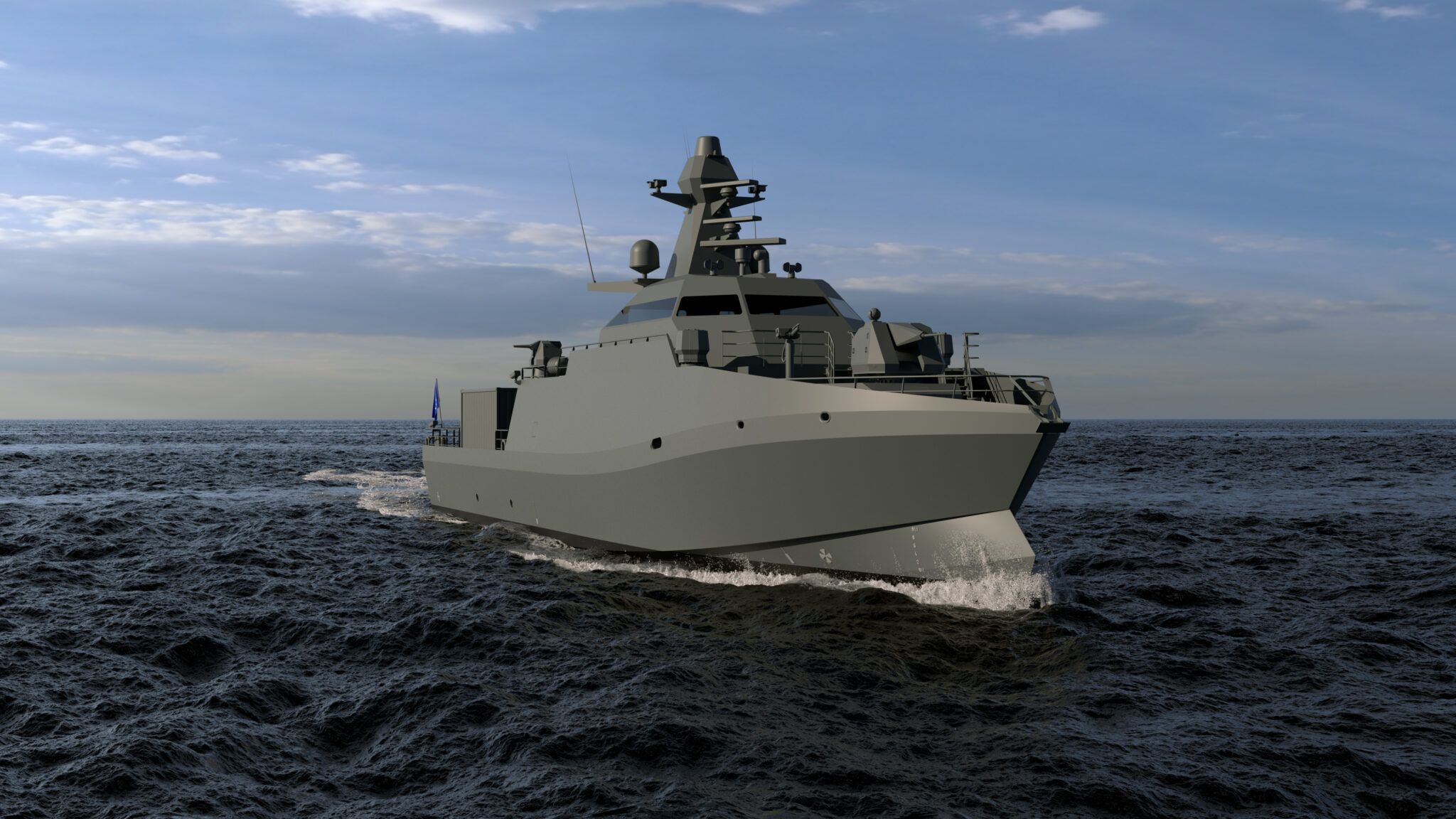
Euroguard is a EUR 95 million (USD 106.3 million) European Defence Fund programme to develop a modular semi-autonomous surface vessel (MSASV) for multiple naval and maritime security missions. Coordinated by the Estonian shipbuilder Baltic Workboats (BWB), the programme brings together 28 organisations from ten European countries: Belgium, Denmark, Estonia, France, Italy, the Netherlands, Norway, Poland, Spain, and Sweden. Funding consists of EUR 65 million from the European Commission and EUR 30 million from participating countries and industry. The project is related to the PESCO initiative on the Medium Size Semi-Autonomous Surface Vehicle (M-SASV).
The project was launched at the end of 2023 and formally kicked off in January 2024 in Estonia. The prototype hull was laid down on 27 May 2025 at BWB's shipyard in Nasva, Saaremaa. On 21 May 2026, the project held its Critical Design Review alongside the prototype hull presentation and a virtual system demonstration, bringing together consortium partners and representatives of participating member states. By July 2026 the hull of the 45-metre prototype had been completed and BWB moved the platform from design into production. The full test platform is scheduled for completion in 2027, with sea trials and validation to be conducted in cooperation with the Estonian Navy.
On 25 September 2026, BWB chief financial officer and programme co-ordinator Ahto Pärl stated that the production Euroguard is expected to be larger and structurally different from the demonstrator, confirming that the production design will diverge from the demonstrator configuration.
Specifications (Demonstrator)
The Euroguard demonstrator is a 45 m modular semi-autonomous surface vessel with an all-aluminium hull. Key parameters as stated by Baltic Workboats:
- Length: 45 m
- Beam: 9.4 m
- Draught (maximum): 3.0 m
- Speed: minimum 20 knots; an approximate maximum of 25 knots has also been cited
- Range: minimum 2,000 nautical miles
- Endurance: 10 days at sea
- Displacement: Baltic Workboats lists maximum displacement as 335 tonnes; a separate account describes 335 tonnes as empty displacement with full load reaching 500 tonnes
- Payload: up to 100 tonnes
- Propulsion: hybrid
Crew accommodation is for up to 20 personnel, with a standard crew of 10 and a lean-manning configuration of six.
Production Design Expectations
BWB expects prospective customers to favour a production vessel more than 60 m long, compared with the demonstrator's 45 m, creating additional room for payload, future sensors, weapons, and mission systems. The production hull is expected to use a steel and aluminium construction rather than the demonstrator's all-aluminium hull; steel would add structural weight and affect the share of displacement available for payload while offering greater toughness and abrasion resistance. These changes are anticipated to make the production vessel more than a scaled-up demonstrator, increasing demands on the design, construction model, and infrastructure while the programme aims to retain its intended affordability and versatility.
Capabilities
The modular architecture enables rapid reconfiguration for different operational tasks. The vessel is designed to accommodate interchangeable mission modules supporting:
- Naval mine countermeasure (NMCM) operations
- Maritime surveillance and situational awareness (ISR)
- Anti-surface warfare (ASuW)
- Anti-submarine warfare (ASW)
- Seabed monitoring and critical infrastructure protection (SBW)
- Search and rescue
- Unmanned systems deployment and control
- Environmental monitoring and maritime safety operations
Core autonomy and remote-control capabilities include autonomous navigation and route planning, obstacle and threat detection, collision avoidance, sensor fusion and situational awareness, secure communications, cyber-secure system architecture, and human-machine teaming functionalities.
 Argentina
 Armenia
 Australia
 Austria
 Austria-Hungary
 Belgium
 Brazil
 United Kingdom
 United States
 Brunei
 Bulgaria
 Canada
 Chile
 China
 Colonial America
 Colombia
 Confederate States
 Croatia
 Czech
 Denmark
 Egypt
 Finland
 France
 Georgia
 Germany
 German Imperial
 Greece
 Holland
 Hungary
 India
 Indonesia
 Iran
 Iraq
 Ireland
 Israel
 Italy
 Japan
 Japan (1940)
 Jordan
 Kingdom of Italy
 Malaysia
 Mexico
 Myanmar
 Nazi Germany
 Netherlands
 New Zealand
 North Korea
 Norway
 Pakistan
 Peru
 Philippines
 Poland
 Portugal
 Prussia
 Romania

 Russia
 Saudi Arabia
 Serbia
 Singapore
 Slovakia
 Slovenia
 South Africa
 South Korea
 Soviet Union
 Spain
 Sweden
 Switzerland
 Syria
 Taiwan
 Thailand
 Turkey
 UAE
 Ukraine
 Vietnam
 Yugoslavia