
History
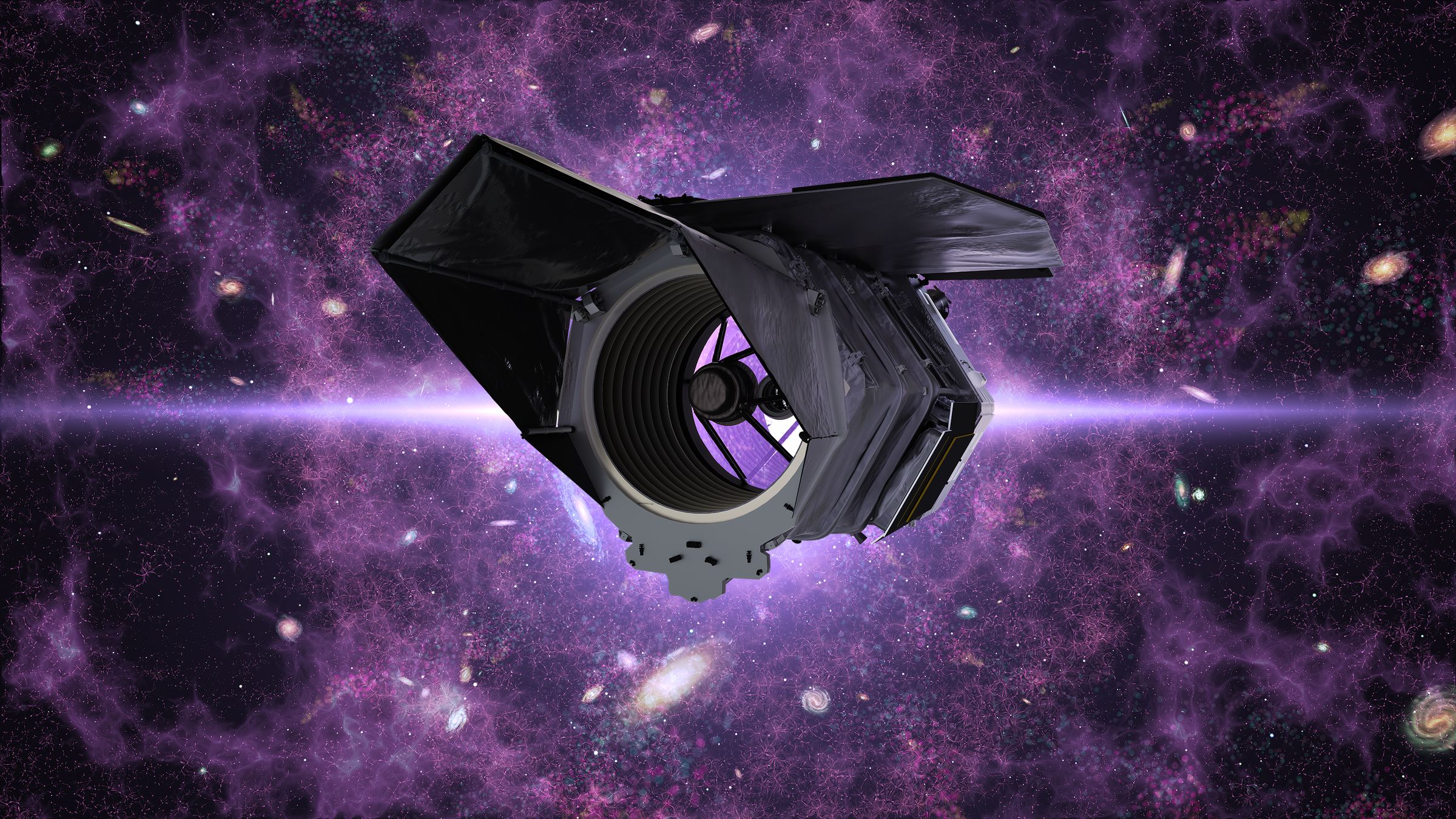
The Nancy Grace Roman Space Telescope is a NASA space observatory designed for wide-field visible and infrared astronomy. Its principal research areas include dark energy, galaxy evolution, exoplanets, and general astrophysics.
Roman combines a 2.4 m primary mirror with a field of view substantially wider than that of the Hubble Space Telescope. Its two instruments are the Wide Field Instrument and the Coronagraph Instrument.
NASA completed construction of the observatory in November 2025. Launch aboard a SpaceX Falcon Heavy from Kennedy Space Center is scheduled for 30 August 2026, followed by deployment into an orbit around the Sun–Earth L2 point.
Development
The mission originated from concepts developed for the Joint Dark Energy Mission and the Wide-Field Infrared Survey Telescope, commonly abbreviated WFIRST. The 2010 United States astronomy decadal survey identified a wide-field infrared survey mission as its highest-priority large space project for the decade.
Early WFIRST studies examined unobstructed telescopes with apertures between 1.1 and 1.3 m. The design changed after the United States National Reconnaissance Office offered NASA two unused 2.4 m telescope assemblies in 2012. NASA developed the resulting WFIRST-AFTA concept around one of these assemblies, which provided an aperture comparable to Hubble but a shorter focal length and much wider field of view.
NASA formally established WFIRST as a project in February 2016. The agency selected a quasi-halo orbit around the second Sun–Earth Lagrange point rather than a geosynchronous orbit. L2 provides a stable thermal environment and favorable observing conditions.
NASA approved the mission for implementation in March 2020. On 20 May 2020, it renamed the observatory in honor of Nancy Grace Roman, NASA's first chief of astronomy and an influential advocate for space-based astronomy.
NASA selected SpaceX's Falcon Heavy as the launch vehicle in July 2022. The Wide Field Instrument was completed in 2024, and both scientific instruments were integrated with the telescope assembly in December of that year. Construction of the complete observatory was finished on 25 November 2025.
The completed telescope arrived at Kennedy Space Center in June 2026 and subsequently underwent launch processing and fueling. A July 2026 report described the planned late-August launch as approximately nine months ahead of the previous schedule. NASA's current technical mission page lists 30 August 2026 as the scheduled launch date.
Design
Observatory
Roman consists of a spacecraft bus and an integrated scientific payload. The telescope uses a three-mirror anastigmat optical design intended to produce well-corrected images across a wide field. Its primary mirror has a physical diameter of 2.4 m and an effective aperture of 2.36 m. The optical system has an f/7.9 focal ratio for the Wide Field Instrument.
The observatory is designed for operation near the Sun–Earth L2 point. Its permitted solar elongation extends from 54 to 126 degrees, forming a broad instantaneous observing annulus. Approximately 59 percent of the sky is accessible at any given time, while regions at high ecliptic latitude can remain continuously visible.
Roman is designed to transmit between 250 and 500 Mbit/s and generate as much as 11 Tbit of data per day. Supporting ground infrastructure includes NASA, European Space Agency, and Japan Aerospace Exploration Agency stations. The spacecraft was also designed to permit robotic refueling in space.
Wide Field Instrument
The Wide Field Instrument is Roman's principal survey instrument. It is a 300.8-megapixel visible and near-infrared camera covering wavelengths from 0.48 to 2.30 µm. Its focal plane contains eighteen 4096 by 4096-pixel mercury-cadmium-telluride detectors.
The instrument covers 0.28 square degrees in a single exposure with a pixel scale of 0.11 arcseconds. It carries eight imaging filters, a high-dispersion grism, and a lower-dispersion prism. The grism and prism provide slitless spectroscopy across the instrument's wide field. Detailed imaging and spectroscopic characteristics are available in the Roman science sheet.
Coronagraph Instrument
The Coronagraph Instrument is a technology demonstrator for direct imaging and spectroscopy of nearby exoplanets and circumstellar disks. It uses masks, filters, and deformable mirrors to suppress light from a target star. Its planned performance includes post-processed contrast approaching one billion to one across selected visible wavelengths.
The instrument is intended to demonstrate technologies required by future space observatories rather than serve as Roman's primary survey instrument. Its measurements will test high-contrast imaging, wavefront control, photometry, and low-resolution spectroscopy in space.
Scientific objectives
Roman will investigate the expansion history of the universe and the growth of cosmic structure. Its planned surveys will use weak gravitational lensing, distant supernovae, and the large-scale distribution of galaxies to study dark energy and test cosmological models.
The observatory will conduct a microlensing survey toward the central Milky Way. This method can detect planets orbiting far from their stars and free-floating objects that are difficult to find through transit or radial-velocity surveys. The coronagraph will separately examine selected nearby planetary systems.
Other planned research includes galaxy formation, stellar populations, the epoch of reionization, objects in the Solar System, and general observer-selected investigations. Roman data are intended to be publicly available, with scientific operations divided among NASA Goddard Space Flight Center, the Space Telescope Science Institute, and Caltech/IPAC. The Roman mission documentation describes the observing modes and science-operations structure.
Program status
As of August 2026, Roman remains a pre-launch observatory. Launch is scheduled for 30 August 2026 from Launch Complex 39A at Kennedy Space Center aboard a Falcon Heavy. The spacecraft is planned to enter a quasi-halo orbit around Sun–Earth L2.
The nominal scientific mission is approximately five years, with a ten-year operational goal. All launch dates and post-launch capabilities remain planned until the relevant milestones have been completed.
Operator
- NASA: The mission is led by NASA's Goddard Space Flight Center, which is responsible for the project and mission operations. Scientific support, data processing, scheduling, and archiving are shared with Caltech/IPAC and the Space Telescope Science Institute.
Specifications (Nancy Grace Roman Space Telescope)
Mission characteristics
- Type: Wide-field visible and infrared space observatory
- Operator: NASA
- Planned launch: 30 August 2026
- Launch vehicle: SpaceX Falcon Heavy
- Launch site: Kennedy Space Center, Launch Complex 39A
- Destination: Quasi-halo orbit around the Sun–Earth L2 point
- Nominal mission duration: Approximately five years
- Operational goal: Ten years
- Launch mass: Approximately 10,500 kg
- Electrical power: Approximately 4.5 kW
- Downlink rate: 250–500 Mbit/s
- Maximum daily data volume: Approximately 11 Tbit
Telescope
- Optical type: Three-mirror anastigmat
- Primary mirror diameter: 2.4 m
- Effective aperture: 2.36 m
- Central obscuration: 30.3 percent of the entrance-pupil diameter
- Focal ratio: f/7.9 for the Wide Field Instrument
- Primary wavelength coverage: 0.48–2.30 µm
- Mirror operating temperature: Approximately 265 K
Wide Field Instrument
- Detector resolution: 300.8 megapixels
- Detector array: Eighteen 4096 by 4096-pixel HgCdTe detectors
- Field of view: 0.28 square degrees
- Pixel scale: 0.11 arcseconds
- Imaging system: Eight filters
- Spectroscopy: High-dispersion grism and low-dispersion prism
Coronagraph Instrument
- Purpose: High-contrast imaging and low-resolution spectroscopy technology demonstration
- Approximate wavelength coverage: 0.5–0.8 µm in supported observing modes
- Planned post-processed contrast: Up to 10-9
- Minimum stated angular separation: Approximately 0.15 arcseconds for exoplanet observations
 Argentina
 Armenia
 Australia
 Austria
 Austria-Hungary
 Belgium
 Brazil
 United Kingdom
 Brunei
 Bulgaria
 Canada
 Chile
Chile China
China Colonial America
 Colombia
 Confederate States
 Croatia
 Czech
Czech Denmark
 Egypt
Egypt Finland
 France
 Georgia
 Germany
 German Imperial
 Greece
 Holland
 Hungary
 India
India Indonesia
 Iran
Iran Iraq
Iraq Ireland
 Israel
 Italy
Italy Japan
Japan Japan (1940)
 Jordan
 Kingdom of Italy
 Malaysia
 Mexico
 Myanmar
 Nazi Germany
 Netherlands
 New Zealand
 North Korea
 Norway
 Pakistan
 Peru
Peru Philippines
 Poland
 Portugal
 Prussia
 Romania
 Russia
 Saudi Arabia
 Serbia
 Singapore
 Slovakia
 Slovenia
 South Africa
 South Korea
 Soviet Union
 Spain
Spain Sweden
 Switzerland
 Syria
Syria Taiwan
 Thailand
 Turkey
 UAE
UAE Ukraine
 Vietnam
 Yugoslavia