
History
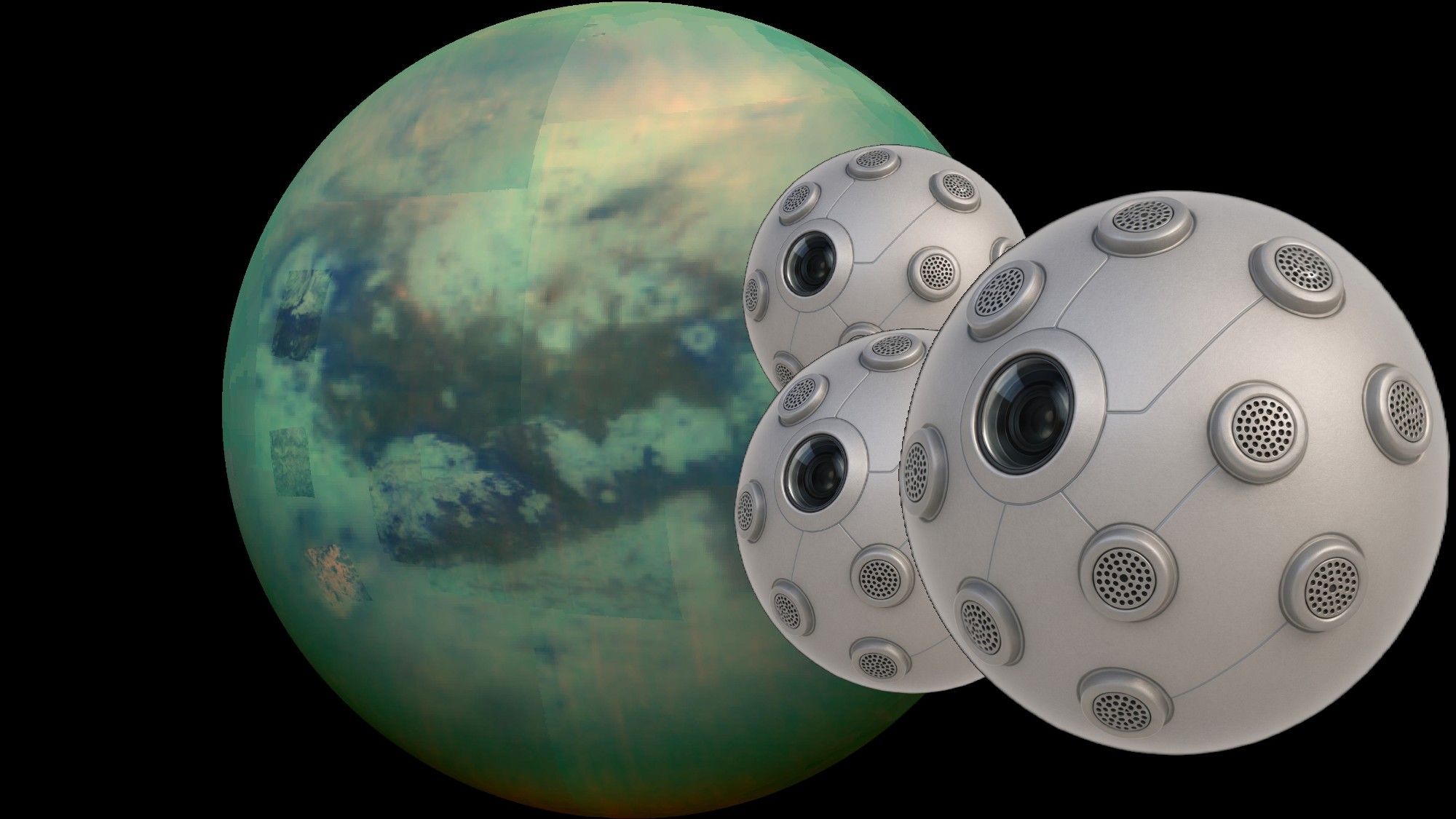
The University of Hawaii SPARK Aerobot is a proposed spherical aerial robot for exploring caves and karst terrain on Titan, Saturn's largest moon. SPARK stands for Solid-state Propulsion for Autonomous Reconnaissance of Karst.
The concept uses lighter-than-air lift and distributed electrohydrodynamic propulsion. Its intended purpose is to enter terrain that would be difficult for conventional rovers while limiting airflow disturbance near scientifically important hydrocarbon deposits.
NASA selected SPARK for early-stage study through the NASA Innovative Advanced Concepts program in 2026. The selection began a nine-month Phase I effort rather than development of an approved flight mission.
Development
Daniel Drew of the University of Hawaii at Manoa leads the project. His collaborators include Ethan Schaler and Jacob Izraelevitz of NASA's Jet Propulsion Laboratory and Michael Malaska of the Blue Marble Space Institute of Science.
Drew's earlier research produced microfabricated, centimeter-scale flying robots powered by atmospheric ion thrusters. This work included demonstrations of microfabricated electrohydrodynamic actuators, an ionocraft taking off and carrying a payload, and an ion-propelled micro-hovercraft.
NASA reportedly included SPARK among 18 concepts supported by the NIAC program in July 2026, with Phase I funding of up to $175,000. The planned work includes feasibility experiments, numerical modeling of electrohydrodynamic propulsion under Titan-like conditions, subsystem trade studies, thermal analysis of the power system, and tethered-power tests of balloon station-keeping. A prototype design may be considered during a later Phase II study, but no prototype completion date has been announced. Further details were reported by Space.com and autoevolution.
Design
Configuration and deployment
SPARK is conceived as a group of small spherical, lighter-than-air vehicles. A larger carrier spacecraft would release the aerobots, allowing them to operate as a swarm inside or around Titan's caves. Published material does not provide confirmed dimensions, mass, payload capacity, or endurance for the individual vehicles.
The spherical layout and distributed propulsion are intended to provide maneuverability and persistence in Titan's near-cryogenic environment. Unlike a surface rover, a flying vehicle would not need to cross lakes, sinkholes, steep surfaces, or other obstacles directly.
Electrohydrodynamic propulsion
Each aerobot would use distributed electrohydrodynamic propulsors, also called atmospheric ion thrusters. These solid-state devices apply a high electric field to ionize atmospheric gas and accelerate it between electrodes. The moving ions transfer momentum to surrounding neutral molecules and produce thrust without rotors or jet engines.
Distributing the thrusters around the vehicle is intended to permit movement in multiple directions. The propulsion system has few moving parts, operates with very little noise, and could produce less downwash than a rotorcraft. Reduced downwash may help prevent disturbance of hydrocarbon layers at scientific investigation sites.
Project calculations reported in 2026 indicated that Titan's low gravity and dense nitrogen-and-methane atmosphere could make atmospheric ion propulsion twice as effective as conventional rotorcraft while requiring 100 times less power. These figures are design estimates that Phase I experiments and modeling are intended to examine; they are not demonstrated SPARK flight performance.
Electrohydrodynamic propulsion remains inefficient for most large terrestrial aircraft because of its low thrust-to-weight ratio. SPARK applies the technology to Titan because the moon's environmental conditions may be more favorable than those on Earth.
Scientific role
The concept is intended to conduct close-range reconnaissance of Titan's karst terrain, including sinkholes and subsurface caves. Titan also has rivers, lakes, and seas containing methane and ethane. These features can obstruct surface vehicles and create targets for atmospheric and geological investigation.
The available sources do not identify a finalized instrument suite. SPARK therefore remains a mobility and propulsion concept rather than a defined scientific spacecraft configuration.
Program status
As of August 2026, SPARK was in NIAC Phase I. The team planned to compare subsystem options, study power requirements, model thermal effects, and test the feasibility of its propulsion method. Phase I was scheduled to last nine months, while a possible Phase II could continue for up to two years.
SPARK has not been selected for an operational mission, and no launch date has been established. Its possible relationship with NASA's Dragonfly mission remains uncertain. Dragonfly was targeted for launch in 2028 in the supplied reports, but the SPARK team did not claim that its aerobots would be ready for inclusion.
Contemporary summaries from NewsBytes and UA.News also describe the project as an early-stage NASA-funded concept rather than an approved Titan mission.
Specifications (SPARK concept)
General characteristics
- Type: Spherical lighter-than-air robotic exploration vehicle concept
- Intended destination: Titan, a moon of Saturn
- Intended operating area: Karst terrain, sinkholes, and caves
- Deployment concept: Multiple aerobots released from a larger carrier spacecraft
- Control concept: Autonomous reconnaissance and multidirectional maneuvering
Propulsion
- Propulsion type: Distributed solid-state electrohydrodynamic atmospheric ion thrusters
- Propulsion medium: Titan's nitrogen-and-methane atmosphere
- Design objective: Maneuvering with minimal downwash near hydrocarbon layers
Development
- Program: NASA Innovative Advanced Concepts Phase I
- Phase I duration: Nine months
- Reported Phase I funding: Up to $175,000
- Status in 2026: Feasibility study and planned experimental validation
Related equipment
SPARK is distinct from earlier Titan aerobot studies based on large propeller-driven airships. A 2006 study described a 14 m buoyant vehicle intended for long-duration global exploration, surface sampling, and atmospheric observations. That earlier configuration provides background for lighter-than-air exploration of Titan but does not represent the spherical SPARK design. Its design and component tests are described in the Titan aerobot research paper.
 Argentina
 Armenia
 Australia
 Austria
 Austria-Hungary
 Belgium
 Brazil
 United Kingdom
 Brunei
 Bulgaria
 Canada
 Chile
Chile China
China Colonial America
 Colombia
 Confederate States
 Croatia
 Czech
Czech Denmark
 Egypt
Egypt Finland
 France
 Georgia
 Germany
 German Imperial
 Greece
 Holland
 Hungary
 India
India Indonesia
 Iran
Iran Iraq
Iraq Ireland
 Israel
 Italy
Italy Japan
Japan Japan (1940)
 Jordan
 Kingdom of Italy
 Malaysia
 Mexico
 Myanmar
 Nazi Germany
 Netherlands
 New Zealand
 North Korea
 Norway
 Pakistan
 Peru
Peru Philippines
 Poland
 Portugal
 Prussia
 Romania
 Russia
 Saudi Arabia
 Serbia
 Singapore
 Slovakia
 Slovenia
 South Africa
 South Korea
 Soviet Union
 Spain
Spain Sweden
 Switzerland
 Syria
Syria Taiwan
 Thailand
 Turkey
 UAE
UAE Ukraine
 Vietnam
 Yugoslavia