
History
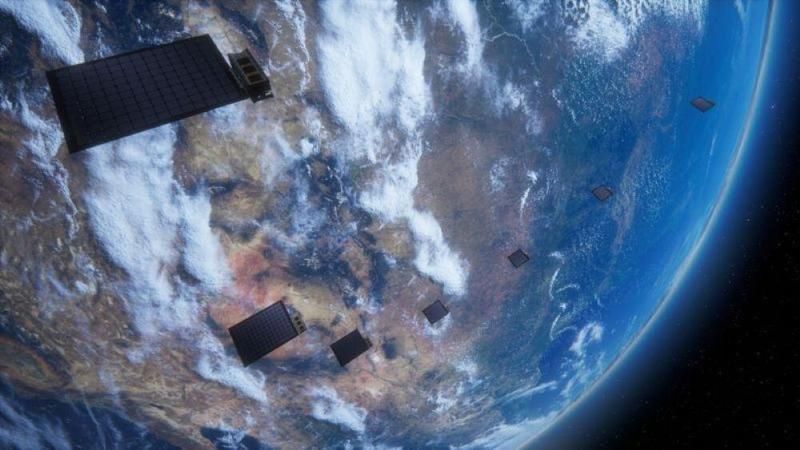
The Space-Based Airborne Moving Target Indicator, or SB-AMTI, is a U.S. Space Force satellite constellation under development for persistent detection and tracking of airborne targets. The program is intended to transfer part of the airborne moving-target-indication mission from vulnerable aircraft to a distributed space-based sensing architecture.
Space Systems Command is pursuing multiple technical solutions rather than a single satellite or sensor design. SpaceX received the initial development award in May 2026, while Rocket Lab, STR, and an undisclosed third company received a second group of awards in August 2026.
The program remains under development. A May 2026 report stated that the first SB-AMTI satellites were expected in 2028, making 2028 a planned milestone rather than an achieved launch date.
Development requirements
The U.S. Air Force has traditionally conducted airborne moving target indication with aircraft carrying large surveillance sensors. According to the Space Force, increasingly capable anti-access and area-denial systems make those aircraft more difficult to employ close to contested areas. SB-AMTI is intended to provide persistent sensing from orbit and reduce coverage gaps that affect aircraft and ground-based radars.
The Space Force has deliberately avoided committing the program to one sensing architecture. Space Systems Command has stated that multiple sensing technologies and different sensing phenomenologies are being evaluated because each can offer advantages under different environmental, geographic, and threat conditions. The service expects a diverse architecture to improve survivability and make the constellation easier to adapt as requirements change.
Initial SpaceX award
In May 2026, Space Systems Command awarded SpaceX the first major SB-AMTI development task order. The primary report and another research source give the value as $4.16 billion, while Breaking Defense reported the value as $4.6 billion. The award covered development of an initial satellite constellation for the program.
A separate May 2026 report described SB-AMTI as a persistent surveillance layer combining orbital sensors, secure communications links, and ground processing to provide rapid tracking information. That report stated that the first satellites were expected in 2028. The total number of satellites, orbital configuration, sensor bands, and deployment schedule have not been publicly disclosed in the available sources.
Second development awards
In August 2026, the Space Force announced three additional agreements with a combined value of $615 million. Rocket Lab and STR were publicly identified, while the third company was withheld for operational-security reasons. The awards were intended to broaden the industrial base, mature competing technical approaches, and prevent the program from becoming dependent on a single solution.
Rocket Lab said its portion of the second award was worth $397 million. According to the company information reported by Breaking Defense, Rocket Lab is to develop, launch, and operate multiple advanced Flatellites equipped with space-based sensors and low-latency, high-bandwidth communications links. The spacecraft are planned to launch on Rocket Lab's Neutron launch vehicle. The publicly available material does not identify the number of Flatellites or provide their mass, dimensions, orbital altitude, or detailed sensor configuration.
Space Systems Command described the broader acquisition strategy as a way to accelerate emerging systems, use commercial technology, demonstrate new SB-AMTI capabilities, and maintain long-term competition. The service also expects the parallel development effort to mature manufacturing capacity for a constellation that could evolve as operational requirements change.
Design
SB-AMTI is being developed as a distributed constellation rather than as a single spacecraft type. Public Space Force statements emphasize multiple sensing technologies, resilience, adaptability, and the ability to employ different technical approaches across the constellation. This means that satellites produced by different contractors may not use identical sensors, buses, or mission architectures.
The core mission is detection and continuous tracking of airborne moving targets from space. The intended architecture addresses limitations of airborne surveillance aircraft, including their exposure to long-range air-defense systems, and limitations of ground sensors caused by terrain and the radar horizon.
Sensors and processing
The Space Force has not publicly disclosed a definitive sensor configuration for SB-AMTI. It has instead stated that different sensing phenomenologies and sensing disciplines are being evaluated. This approach is intended to provide different operational advantages depending on weather, geography, and the threat environment.
Independent technical analysis of space-based AMTI has described formation-flying multistatic radar clusters as one possible method for detecting aircraft from orbit. Such concepts use multiple satellites as a distributed sensor and can exploit several viewing geometries to separate moving targets from ground clutter. However, the available Space Force material does not confirm that this specific multistatic-radar architecture has been selected for the operational SB-AMTI constellation. The concept is therefore relevant technical context rather than a confirmed program configuration. Additional discussion of this approach is available from BlacKnight Space Labs.
Rocket Lab Flatellites
Rocket Lab's disclosed SB-AMTI contribution is based on its Flatellite concept, described as a flat satellite design optimized for deployment in large constellations. The spacecraft are planned to carry space-based sensors and low-latency, high-bandwidth communications links. Rocket Lab is responsible for developing, launching, and operating multiple spacecraft under its award.
The supplied sources do not establish whether Rocket Lab's satellites will use the same sensing method as SpaceX, STR, or the undisclosed contractor. The Space Force has specifically indicated that the purpose of the multi-vendor approach is to investigate fundamentally different ways of accomplishing the airborne moving target indication mission.
Communications and ground segment
A May 2026 description of the program stated that SB-AMTI would combine orbital sensors, secure communications, and advanced ground processing. Such an architecture would allow observations collected in orbit to be transferred for processing and distribution to military users. The available sources do not identify the ground-station network, processing hardware, data standards, or communications frequencies.
Program status
As of August 2026, SB-AMTI was in development and had not been described as operational. SpaceX was developing the initial constellation under the first major award, while Rocket Lab, STR, and an undisclosed contractor were pursuing additional technical solutions under the second group of agreements.
The program's acquisition strategy is designed to preserve competition while allowing the Space Force to compare different sensor technologies and architectures. Space Systems Command has stated that this diversity is important for creating a survivable and adaptable space-based sensing system and for enabling the service to change the constellation as requirements evolve.
A May 2026 report stated that the first SB-AMTI satellites were expected in 2028. No confirmed operational date or full-deployment date is provided by the available sources. An overview of the reported 2028 expectation and SpaceX's initial award is available from AeroMorning.
Specifications (SB-AMTI publicly disclosed configuration)
General characteristics
- Type: Distributed military satellite constellation under development
- Primary mission: Space-based detection and tracking of airborne moving targets
- Program authority: U.S. Space Force, Space Systems Command
- Program office: Space-Based Sensing and Targeting portfolio
- Disclosed developers: SpaceX, Rocket Lab, and STR
- Additional developer: One company not publicly identified for operational-security reasons
- Planned first satellites: 2028 according to a May 2026 report
Rocket Lab configuration
- Spacecraft: Multiple Flatellites
- Mission equipment: Space-based sensors
- Communications: Low-latency, high-bandwidth links
- Launch vehicle: Rocket Lab Neutron, planned
- Contract value: $397 million as reported for Rocket Lab's August 2026 award
Publicly available information does not provide reliable figures for satellite mass, dimensions, electrical power, orbital altitude, inclination, sensor frequency, detection range, constellation size, or service life.
 Argentina
 Armenia
 Australia
 Austria
 Austria-Hungary
 Belgium
 Brazil
 United Kingdom
 Brunei
 Bulgaria
 Canada
 Chile
Chile China
China Colonial America
 Colombia
 Confederate States
 Croatia
 Czech
Czech Denmark
 Egypt
Egypt Finland
 France
 Georgia
 Germany
 German Imperial
 Greece
 Holland
 Hungary
 India
India Indonesia
 Iran
Iran Iraq
Iraq Ireland
 Israel
 Italy
Italy Japan
Japan Japan (1940)
 Jordan
 Kingdom of Italy
 Malaysia
 Mexico
 Myanmar
 Nazi Germany
 Netherlands
 New Zealand
 North Korea
 Norway
 Pakistan
 Peru
Peru Philippines
 Poland
 Portugal
 Prussia
 Romania
 Russia
 Saudi Arabia
 Serbia
 Singapore
 Slovakia
 Slovenia
 South Africa
 South Korea
 Soviet Union
 Spain
Spain Sweden
 Switzerland
 Syria
Syria Taiwan
 Thailand
 Turkey
 UAE
UAE Ukraine
 Vietnam
 Yugoslavia