
History
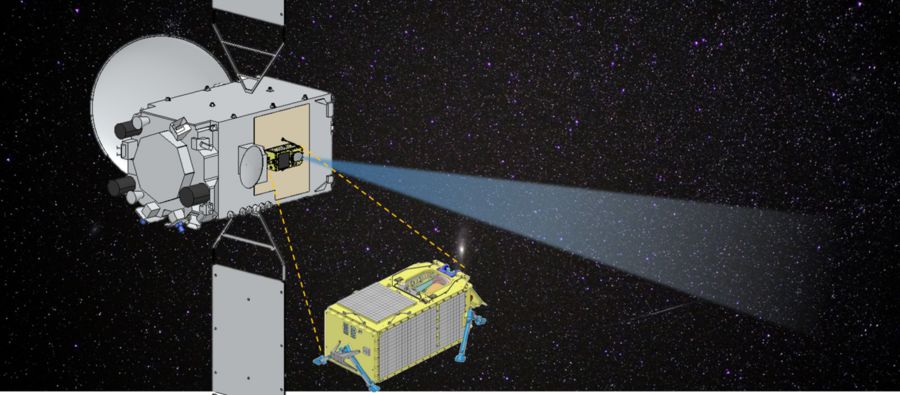
QZS7-HP2 SĀCHI is a United States Space Force optical space-surveillance payload hosted aboard Japan's QZS-7 navigation satellite. MIT Lincoln Laboratory designed and built the sensor for the Quasi-Zenith Satellite System-Hosted Payload program.
The payload observes objects in the geosynchronous-orbit region above the Indo-Pacific. It supplies near-real-time tracking data to the U.S. Space Surveillance Network.
QZS7-HP2 was the second and final payload launched under the bilateral QZSS-HP program. The first payload entered orbit aboard QZS-6 in February 2025.
The program originated in an international agreement concluded by the United States and Japan in December 2020. It established cooperation between the U.S. Space Force and Japan's National Space Policy Secretariat to install American space-domain-awareness sensors on Japanese navigation satellites.
MIT Lincoln Laboratory developed both U.S. payloads in Lexington, Massachusetts. For the QZS-7 installation, American teams worked with the National Space Policy Secretariat and Mitsubishi Electric for approximately two years. The work included integrating and testing the sensor with its Japanese host spacecraft at Mitsubishi Electric's facilities in Kamakura.
The first QZSS-HP sensor launched aboard QZS-6 on 2 February 2025. The second payload was assigned to QZS-7, also known as Michibiki No. 7. Published information identifies this instrument as QZS7-HP2 and as the Situational Awareness Camera Hosted Instrument, or SĀCHI.
QZS-7 and its hosted payload launched from Tanegashima Space Center on 10 August 2026 at 19:23:31 UTC. The Japanese H3-22S launch vehicle placed the satellite into its planned transfer trajectory. The mission completed the two-launch QZSS-HP deployment program, according to the Space Systems Command announcement.
Design
SĀCHI is an optical sensor intended to detect and track objects in and around geosynchronous orbit. This region is approximately 35,800 km (22,200 mi) above Earth. Objects there have orbital periods close to Earth's rotation period, making the region important for communications, navigation, and military spacecraft.
The available sources do not disclose the sensor's mass, aperture, field of view, spectral range, pointing limits, or detection distance. The payload is described as a sovereign U.S. instrument, meaning that the United States retains control of its mission and data while it operates from a Japanese-owned spacecraft.
Host spacecraft
The payload is installed on QZS-7, a Mitsubishi Electric DS2000-based navigation satellite operated as part of Japan's Quasi-Zenith Satellite System. QZS-7 primarily supports positioning, navigation, and timing services over Japan and the surrounding Asia-Pacific region.
QZS-7 operates in a quasi-geostationary orbit with a slight inclination. The hosted sensor uses this location to observe activity across the wider geosynchronous-orbit regime. The navigation satellite and the American surveillance payload perform separate missions.
Data and ground segment
The payload sends tracking information to the U.S. Space Surveillance Network in near real time. Its data is intended to help identify, characterize, and maintain custody of objects in deep space. Maintaining custody means continuing to track an object reliably as it moves through its orbit.
Mission Delta 2 operates the sensor through the Multi-Mission Space Operations Center and Enterprise Command and Control Schriever enclave in Colorado. The ground system connects the hosted instrument with the wider U.S. space-surveillance architecture.
Operational history
Following the August 2026 launch, QZS7-HP2 became the second operationally deployed sensor in the QZSS-HP program. Mission Delta 2 was assigned responsibility for operating both hosted payloads and incorporating their observations into U.S. space-domain-awareness activities.
The sensor's stated mission is to improve understanding of spacecraft and other objects operating in the geosynchronous region above the Indo-Pacific. Public sources have not disclosed individual objects observed by the payload or published measurements of its tracking performance.
Operators
- United States Space Force: Combat Forces Command's Mission Delta 2 operates the payload and distributes its observations through the Space Surveillance Network.
Specifications (QZS7-HP2 SĀCHI)
General characteristics
- Type: Hosted optical space-domain-awareness sensor
- Developer and manufacturer: Massachusetts Institute of Technology Lincoln Laboratory
- Host spacecraft: QZS-7, also known as Michibiki No. 7
- Host satellite manufacturer: Mitsubishi Electric
- Launch date: 10 August 2026
- Launch vehicle: H3-22S
- Launch site: Tanegashima Space Center, Japan
Mission equipment
- Sensor type: Optical surveillance instrument
- Primary mission: Detection and tracking of objects in the geosynchronous-orbit region
- Data delivery: Near-real-time reporting to the U.S. Space Surveillance Network
- Operating organization: U.S. Space Force Mission Delta 2
- Ground system: Multi-Mission Space Operations Center and Enterprise Command and Control Schriever enclave
Related equipment
- QZS-6 hosted payload: The first of the two MIT Lincoln Laboratory space-domain-awareness payloads deployed under the QZSS-HP program. It launched in February 2025.
- QZS-7: The Japanese navigation satellite carrying QZS7-HP2. Detailed spacecraft information is summarized in the available QZS-7 reference.
 Argentina
 Armenia
 Australia
 Austria
 Austria-Hungary
 Belgium
 Brazil
 United Kingdom
 Brunei
 Bulgaria
 Canada
 Chile
Chile China
China Colonial America
 Colombia
 Confederate States
 Croatia
 Czech
Czech Denmark
 Egypt
Egypt Finland
 France
 Georgia
 Germany
 German Imperial
 Greece
 Holland
 Hungary
 India
India Indonesia
 Iran
Iran Iraq
Iraq Ireland
 Israel
 Italy
Italy Japan
Japan Japan (1940)
 Jordan
 Kingdom of Italy
 Malaysia
 Mexico
 Myanmar
 Nazi Germany
 Netherlands
 New Zealand
 North Korea
 Norway
 Pakistan
 Peru
Peru Philippines
 Poland
 Portugal
 Prussia
 Romania
 Russia
 Saudi Arabia
 Serbia
 Singapore
 Slovakia
 Slovenia
 South Africa
 South Korea
 Soviet Union
 Spain
Spain Sweden
 Switzerland
 Syria
Syria Taiwan
 Thailand
 Turkey
 UAE
UAE Ukraine
 Vietnam
 Yugoslavia