
History
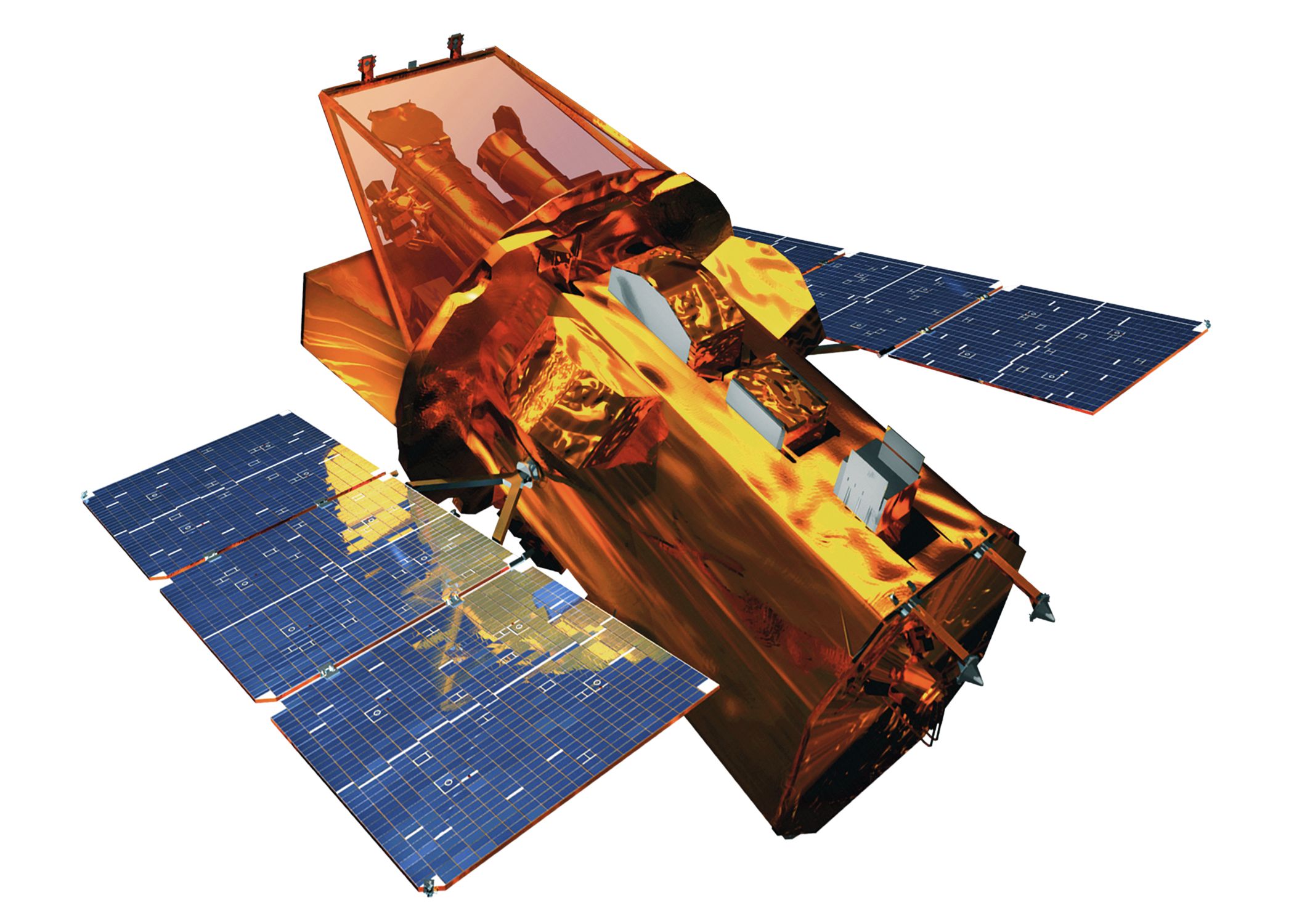
The Neil Gehrels Swift Observatory is a NASA multi-wavelength space observatory developed to detect gamma-ray bursts and rapidly study their afterglows in gamma-ray, X-ray, ultraviolet, and visible light. The mission combines a wide-field burst detector with two narrow-field telescopes and can autonomously turn toward newly detected events within seconds.
Swift was developed through an international collaboration involving the United States, the United Kingdom, and Italy as part of NASA's Medium Explorer program. The spacecraft was launched into low Earth orbit on 20 November 2004 and entered normal science operations in early 2005. Its original two-year mission continued for more than two decades.
By 2026, increased atmospheric drag associated with elevated solar activity had accelerated the decay of Swift's orbit. NASA commissioned a commercial spacecraft to raise the observatory to a higher orbit, but the planned boost was abandoned in August 2026 after the servicing vehicle developed attitude-control problems.
Development and launch
Work on the Swift concept began in the late 1990s. A proposal was submitted in response to NASA's 1998 Medium Explorer opportunity, Swift became a finalist in February 1999, and it was selected for flight later that year. Development included integration and calibration of the Burst Alert Telescope, X-Ray Telescope, and Ultraviolet/Optical Telescope, followed by environmental and thermal-vacuum testing. A detailed development chronology is preserved by the Swift Mission Operations Center.
The spacecraft bus was manufactured by Spectrum Astro. Swift was launched from Cape Canaveral on a Delta II 7320-10C rocket on 20 November 2004. It entered an initial orbit of approximately 585 by 604 km with an inclination of about 20.6 degrees.
During early checkout, the X-Ray Telescope's thermoelectric cooler power supply failed to activate, but testing established that the instrument could operate without the cooler. The Burst Alert Telescope located an apparent gamma-ray burst on 17 December 2004. Swift performed an autonomous slew to a burst after normal slewing capability had been enabled in January 2005. The mission team released the first UVOT image and declared the observatory operational on 1 February 2005.
Renaming
NASA renamed the spacecraft the Neil Gehrels Swift Observatory in January 2018 in honor of Neil Gehrels, the mission's principal investigator, who died in 2017.
Design
Swift was designed around rapid autonomous response to transient astronomical events. Its three co-aligned instruments cover complementary wavelength bands. The Burst Alert Telescope searches a large portion of the sky for gamma-ray bursts. When a burst is detected, the spacecraft calculates an approximate position and can autonomously slew so that the X-Ray Telescope and Ultraviolet/Optical Telescope can begin more precise observations.
The spacecraft can typically repoint toward a newly detected burst within roughly 20 to 75 seconds. Burst coordinates can be transmitted to the ground within about 15 seconds, allowing other observatories to begin follow-up observations. The mission architecture and instrument operation are described in the Swift Technical Handbook and NASA's Swift learning material.
Burst Alert Telescope
The Burst Alert Telescope, or BAT, is a coded-mask gamma-ray and hard X-ray instrument. It uses cadmium zinc telluride detectors and was designed to detect gamma-ray bursts over a wide field of view, estimate their positions, and initiate the spacecraft's rapid-response sequence.
BAT operates over an energy range of 15–150 keV. NASA describes a detector area of approximately 5,200 cm² and a coded-aperture system capable of producing rapid burst positions. The instrument can view a large fraction of the sky at one time and was originally expected to detect around 100 gamma-ray bursts per year.
X-Ray Telescope
The X-Ray Telescope, or XRT, is a Wolter Type I telescope used for imaging, spectroscopy, and monitoring of X-ray afterglows. It covers an energy range of 0.2–10 keV and uses a CCD detector with 600 by 600 pixels. Its field of view is approximately 23.6 by 23.6 arcminutes.
XRT provides a much more precise source location after BAT has supplied the initial burst coordinates. It can also monitor the evolution of an afterglow over periods ranging from hours to weeks, depending on the source.
Ultraviolet/Optical Telescope
The Ultraviolet/Optical Telescope, or UVOT, observes gamma-ray burst afterglows and other targets at ultraviolet and visible wavelengths. It is a modified Ritchey-Chrétien telescope with a 30 cm aperture and an intensified photon-counting CCD.
UVOT covers wavelengths of approximately 170–650 nm and has a field of view of about 17 by 17 arcminutes. It provides photometry, source positions, and low-resolution spectroscopy using filters and grisms.
Operations and communications
The Mission Operations Center at Pennsylvania State University provides spacecraft command and control, science and mission planning, Target of Opportunity handling, and data management. The Italian Space Agency ground station at Malindi, Kenya serves as the primary ground communications facility. Burst alerts are also transmitted rapidly through NASA's Tracking and Data Relay Satellite System for distribution to the astronomical community.
Swift data are released without a proprietary period after processing. This rapid public access supports coordinated observations of short-lived astronomical events by other ground-based and space-based observatories.
Operational history
Swift was originally optimized for gamma-ray burst research, but its rapid pointing capability and broad wavelength coverage also made it useful as a general-purpose observatory for transient astrophysical phenomena. It has been redirected to study supernovae, black-hole activity, fast radio burst sources, gravitational-wave counterparts, stellar flares, and other rapidly changing objects.
Swift detected its 500th gamma-ray burst by 2010 and its 1,000th, GRB 151027B, on 27 October 2015. Among its notable observations were GRB 050509B, an important short-duration burst with an X-ray afterglow; the exceptionally bright GRB 080319B; high-redshift bursts including GRB 090423 and GRB 090429B; and the ultraviolet counterpart associated with the 2017 gravitational-wave event GW170817.
In March 2024, Swift entered safe mode after the failure of the second of its four gyroscopes. A software modification allowing operation with two gyroscopes was developed, uploaded, and tested, and the observatory returned to normal operations in April 2024.
Orbital decay and Swift Boost mission
Swift was launched without a propulsion system intended to maintain its orbital altitude. During the mid-2020s, increased solar activity expanded Earth's upper atmosphere and increased drag on the spacecraft, causing its orbit to decay more rapidly. NASA announced in 2025 that an orbit-raising mission would be attempted.
NASA awarded Katalyst Space Technologies a $30 million contract for the Swift Boost mission. Katalyst developed the LINK robotic servicing spacecraft to rendezvous with Swift, capture the observatory, and raise its orbit. LINK was launched on 3 July 2026 aboard an air-launched Northrop Grumman Pegasus XL rocket.
Approximately three weeks after launch, LINK developed attitude-control problems and began spinning uncontrollably. On 19 August 2026, NASA announced that the planned capture and orbit boost would no longer be attempted. NASA and Katalyst continued evaluating a rendezvous and proximity-operations demonstration that would not include capture of Swift. NASA's decision and the revised mission plan were published in its Swift Boost update.
Without the planned boost, NASA expected Swift's altitude to continue falling and projected atmospheric reentry later in 2026, although an exact date had not been established as of the August announcement. The observatory remained the central target of the rescue effort; LINK was a separate commercial servicing spacecraft rather than part of Swift itself.
Operators
- NASA and Pennsylvania State University: NASA operates Swift as an Explorer mission, with spacecraft commanding and mission operations performed through the Mission Operations Center at Pennsylvania State University. The mission was developed and supported through cooperation with institutions in the United States, United Kingdom, and Italy.
Specifications (Neil Gehrels Swift Observatory)
General characteristics
- Spacecraft: Swift Gamma Ray Burst Explorer, Explorer 84
- Spacecraft bus: LEOStar-3
- Manufacturer: Spectrum Astro
- Launch mass: approximately 1,470 kg
- Dry mass: approximately 613 kg
- Payload mass: approximately 843 kg
- Dimensions: approximately 5.6 × 5.4 m
- Electrical power: approximately 1,040 W
- Launch date: 20 November 2004
- Launch vehicle: Delta II 7320-10C
- Launch site: Cape Canaveral
Orbit and pointing
- Orbit: Low Earth orbit
- Initial altitude: approximately 585 × 604 km
- Inclination: approximately 20.6 degrees
- Initial orbital period: approximately 96.6 minutes
- Pointing: Autonomous rapid repointing after transient detection
- Typical rapid slew: approximately 20–75 seconds after a burst detection
Scientific instruments
- Burst Alert Telescope: Coded-mask gamma-ray and hard X-ray telescope operating at 15–150 keV, with approximately 5,200 cm² detector area.
- X-Ray Telescope: Wolter Type I telescope operating at 0.2–10 keV, with a 600 × 600-pixel CCD and approximately 23.6 × 23.6 arcminute field of view.
- Ultraviolet/Optical Telescope: 30 cm modified Ritchey-Chrétien telescope covering approximately 170–650 nm, with a 2048 × 2048-pixel photon-counting detector and approximately 17 × 17 arcminute field of view.
Related equipment
- LINK: Katalyst Space Technologies robotic servicing spacecraft launched in July 2026 for the attempted Swift orbit-boost mission. The boost was abandoned after LINK developed attitude-control problems.
 Argentina
 Armenia
 Australia
 Austria
 Austria-Hungary
 Belgium
 Brazil
 United Kingdom
 Brunei
 Bulgaria
 Canada
 Chile
Chile China
China Colonial America
 Colombia
 Confederate States
 Croatia
 Czech
Czech Denmark
 Egypt
Egypt Finland
 France
 Georgia
 Germany
 German Imperial
 Greece
 Holland
 Hungary
 India
India Indonesia
 Iran
Iran Iraq
Iraq Ireland
 Israel
 Italy
Italy Japan
Japan Japan (1940)
 Jordan
 Kingdom of Italy
 Malaysia
 Mexico
 Myanmar
 Nazi Germany
 Netherlands
 New Zealand
 North Korea
 Norway
 Pakistan
 Peru
Peru Philippines
 Poland
 Portugal
 Prussia
 Romania
 Russia
 Saudi Arabia
 Serbia
 Singapore
 Slovakia
 Slovenia
 South Africa
 South Korea
 Soviet Union
 Spain
Spain Sweden
 Switzerland
 Syria
Syria Taiwan
 Thailand
 Turkey
 UAE
UAE Ukraine
 Vietnam
 Yugoslavia