
History
Tiangong, officially also described as the China Space Station, is China's modular crewed space station in low Earth orbit. It was developed as the final stage of China's three-step human spaceflight strategy and serves as a long-duration national space laboratory for scientific research, technology experiments and crewed orbital operations.
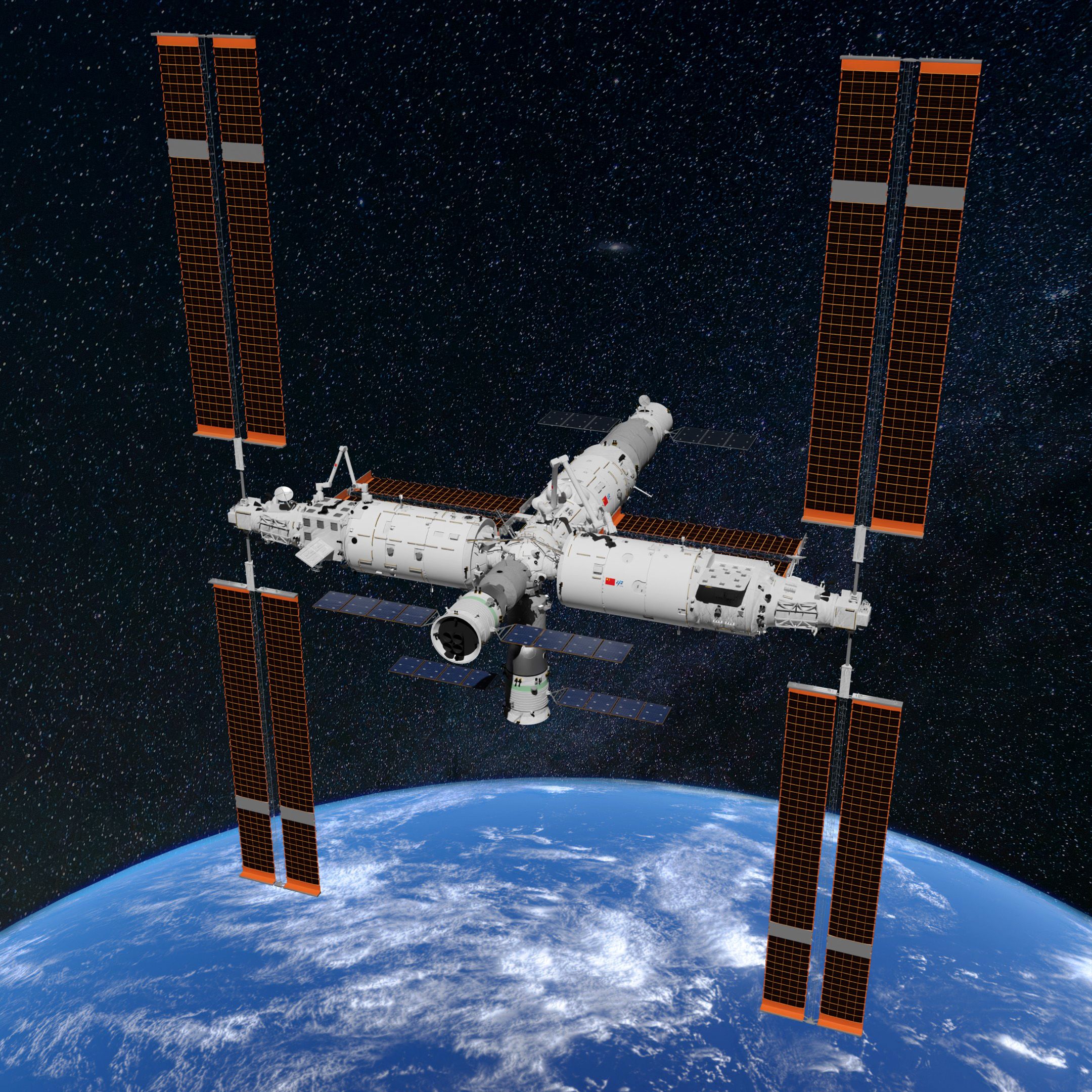
The station's basic configuration consists of the Tianhe core module and the Wentian and Mengtian experiment modules. Tianhe was launched in April 2021, Wentian followed in July 2022, and Mengtian in October 2022. The completed three-module station forms a T-shaped orbital complex.
Tiangong supports long-term habitation by three crewmembers in normal operation and can accommodate up to six during crew rotations. Its design combines regenerative life support, flexible solar arrays, robotic arms, chemical and electric propulsion, standardized experiment facilities and replaceable or upgradeable equipment.
Development and assembly
China's manned space project was approved in 1992 with a three-step development strategy in which construction of a permanent space station was the final objective. The Tiangong space station project itself was formally established in September 2010. Earlier Tiangong-1 and Tiangong-2 space laboratories provided experience with rendezvous, docking, crewed stays, life-support systems and cargo operations before the permanent station was assembled.
The Tianhe core module was launched from Wenchang on 29 April 2021 aboard a Long March-5B launch vehicle, beginning the station's on-orbit construction. Shenzhou 12 became the first crewed mission to visit Tianhe in June 2021. The module was used with Shenzhou crew spacecraft and Tianzhou cargo spacecraft to verify technologies required for later assembly.
Wentian was launched in July 2022 and initially docked with Tianhe's forward docking port. It was later transferred to a lateral berthing port. Mengtian was launched in October 2022, docked initially at the forward port and was subsequently transferred to the opposite lateral position. This produced the station's planned T-shaped three-module configuration. A 2023 technical study states that assembly and the beginning of official station operation were completed through the planned sequence of missions in 2021 and 2022. Further technical details are described in the Tiangong design study.
Published mass figures vary slightly between sources and stages of the program. An earlier CNSA overview described the planned three-module station as about 66 tonnes, while the later design study gives approximately 69 tonnes. A Space.com guide describes the completed station as about 70 tonnes. These values are broadly consistent with differences between design-stage and completed-station reporting.
Design
Tiangong is a third-generation modular station assembled from separately launched spacecraft. Its basic orbital configuration places Tianhe at the center, with Wentian and Mengtian mounted on opposite sides. The experiment modules are positioned in the same plane to reduce obstruction between their large solar arrays.
The station operates in a near-Earth orbit with a design altitude of approximately 340 to 450 km and an inclination of about 41° to 43°. Its planned service life is more than ten years. Shenzhou spacecraft transport crews, while Tianzhou cargo spacecraft deliver propellant, equipment, experiment payloads and other supplies.
Tianhe core module
Tianhe is the station's principal management, control and habitation module. It is 16.6 m long with a maximum diameter of 4.2 m. Its structure includes a node cabin, a life-control cabin and a resource cabin. The node provides forward and radial docking ports, two lateral berthing positions and a hatch that can support extravehicular activity.
The module contains crew sleeping and sanitary areas, work and scientific equipment, station management systems, propulsion equipment and a large robotic arm. Tianhe also provides rendezvous and docking support for visiting spacecraft and can serve as an airlock when required.
Wentian experiment module
Wentian is 17.9 m long with a maximum diameter of 4.2 m. It contains a working cabin, a dedicated airlock cabin and a resource cabin. External experiment platforms, a small robotic arm and two-degree-of-freedom solar arrays are installed on the module.
Wentian provides additional pressurized and external experiment capability. It also serves as a system-level backup for several critical Tianhe functions, including energy management, information management, control and the crewed environment system. The module includes additional crew facilities and can act as an emergency shelter.
Mengtian experiment module
Mengtian is also 17.9 m long and 4.2 m in maximum diameter. It consists of a working cabin, cargo airlock cabin, payload cabin and resource cabin. Deployable platforms support exposed experiments outside the module.
Mengtian is primarily optimized for scientific and technological experiments. Its cargo airlock allows equipment and payloads to be transferred between the pressurized interior and the external environment without requiring every operation to be performed through a crew spacewalk.
Guidance, control and propulsion
Station attitude is controlled principally by control moment gyros, with reaction-control thrusters providing additional capability. Tianhe and Wentian each carry six control moment gyros, allowing the two sets to operate independently or together. The station can use different flight attitudes according to mission requirements and normally minimizes propellant use during long-duration operations.
The modules share control computers, sensors, gyros and thrusters through integrated data buses. Docked Tianzhou cargo spacecraft can also contribute their thrusters to attitude and orbit control. Tianhe contains a propellant refueling system that receives fuel from Tianzhou spacecraft, allowing the station's chemical propulsion resources to be replenished.
Tianhe also carries a Hall-effect electric propulsion system that supplements chemical propulsion for orbit maintenance. The system uses four 80 mN Hall thrusters and xenon propellant. The design study reports that use of electric propulsion significantly reduces orbital decay and can save at least 800 kg of chemical propellant per year.
Electrical power
Tiangong uses large flexible solar arrays with triple-junction gallium-arsenide solar cells and lithium-ion batteries. Tianhe's solar arrays extend about 12.6 m on each side, while the arrays on Wentian and Mengtian extend about 27 m on each side and use two-degree-of-freedom pointing mechanisms.
The station uses a 100 V electrical bus and supports power transfer among modules and docked spacecraft. The published power-supply index is 27 kW, of which approximately 17 kW is available for application payloads. Solar-array sections are designed for maintenance, relocation and replacement in orbit.
Life support and habitation
Tianhe and Wentian include regenerative and nonregenerative life-support systems, while Mengtian carries a simplified nonregenerative system. The regenerative system includes oxygen generation, carbon-dioxide removal, trace-contaminant removal, water processing, urine processing and carbon-dioxide reduction. The system recovers water and reduces dependence on consumables transported from Earth.
The station provides at least 110 cubic metres of crew activity space. Tianhe contains working, sleeping, sanitary, dining, storage, health-care and exercise areas. Wentian adds working, sleeping, sanitary, storage and exercise facilities. Mengtian mainly provides working, exercise and storage space for experiment operations.
Robotic systems
Tianhe carries a seven-degree-of-freedom large robotic arm with an operating radius of 10 m and a maximum load of 25 tonnes. Wentian carries a smaller seven-degree-of-freedom arm with a 5 m radius and a maximum load of 3 tonnes. The arms can operate separately or together, producing a combined reach of about 15 m.
The robotic systems support module relocation, spacewalk assistance, cargo handling, exposed payload operations and capture-related tasks. Both arms can relocate between adapters on the station exterior, extending their working area.
Experiment facilities
Tiangong was designed as a national space laboratory with standardized internal experiment racks and external payload interfaces. The basic station contains 25 experiment cabinets and provides mechanical, thermal, electrical, information and other support interfaces for research equipment.
External experiment platforms and mounting points allow payloads to operate directly in vacuum, radiation and thermal cycling environments. Research fields include aerospace medicine, life sciences, materials science, space physics and advanced spacecraft technology. A separate study of the station's experimental role identifies robotics and autonomous systems, on-orbit assembly and manufacturing, new energy and propulsion, environmental control and life support, and generic spacecraft technologies as major research themes. These capabilities are described in the on-orbit technology study.
Operational history
Shenzhou 12 delivered the first crew to Tianhe in June 2021, when only the core module was present. Subsequent Shenzhou and Tianzhou missions supported construction, station verification, crew rotations, cargo delivery and scientific operations.
After completion of the three-module configuration in 2022, Tiangong entered its regular operational phase. The station normally supports three crewmembers, with temporary six-person occupancy during handovers. The Shenzhou-14 and Shenzhou-15 crews produced the first six-person gathering aboard the completed station during their in-orbit rotation.
Tiangong also supports repeated extravehicular activities for station maintenance, external equipment installation and scientific work. The station can be seen from Earth under suitable lighting conditions as a bright, steadily moving point of light. Its visibility results from sunlight reflected by the station and its solar arrays. A general background description is available in the Tiangong overview.
Operators
- China Manned Space Agency: Operates China's Tiangong space station and the associated crewed station program.
Specifications (Tiangong basic three-module configuration)
General characteristics
- Type: Modular crewed space station
- Configuration: Tianhe core module with Wentian and Mengtian experiment modules in a T-shaped arrangement
- Basic station mass: Approximately 69 tonnes in the 2023 design study
- Normal crew: 3
- Maximum crew during rotation: 6
- Designed service life: More than 10 years
- Crew activity space: At least 110 m³
- Internal experiment cabinets: 25
Orbit
- Orbital regime: Low Earth orbit
- Design altitude: 340-450 km
- Orbital inclination: Approximately 41°-43°
Modules
- Tianhe length: 16.6 m
- Tianhe maximum diameter: 4.2 m
- Wentian length: 17.9 m
- Wentian maximum diameter: 4.2 m
- Mengtian length: 17.9 m
- Mengtian maximum diameter: 4.2 m
Power and propulsion
- Electrical bus: 100 V
- Power-supply index: 27 kW
- Power available to application payloads: Approximately 17 kW
- Tianhe solar-array extension: About 12.6 m per side
- Wentian and Mengtian solar-array extension: About 27 m per side
- Electric propulsion: Four 80 mN Hall-effect thrusters using xenon
- Electric-propulsion power class: 0.5-10 kW
Robotic systems
- Large robotic arm: 7 degrees of freedom, 10 m operating radius, 25-tonne maximum load
- Small robotic arm: 7 degrees of freedom, 5 m operating radius, 3-tonne maximum load
- Combined robotic-arm reach: Approximately 15 m
Related equipment
- Tiangong-1: Earlier Chinese orbital laboratory used to develop rendezvous, docking and crewed orbital operations.
- Tiangong-2: Follow-on orbital laboratory used to develop longer-duration habitation, life-support and cargo-related technologies.
- Shenzhou: Crewed spacecraft used to transport astronauts to and from Tiangong.
- Tianzhou: Cargo spacecraft used to deliver propellant, equipment and supplies to the station.
- Xuntian: Space telescope designed to share a similar orbit and periodically dock with Tiangong for servicing and related support.
 Argentina
 Armenia
 Australia
 Austria
 Austria-Hungary
 Belgium
 Brazil
 United Kingdom
 United States
 Brunei
 Bulgaria
 Canada
 Chile
Chile Colonial America
 Colombia
 Confederate States
 Croatia
 Czech
Czech Denmark
 Egypt
Egypt Finland
 France
 Georgia
 Germany
 German Imperial
 Greece
 Holland
 Hungary
 India
India Indonesia
 Iran
Iran Iraq
Iraq Ireland
 Israel
 Italy
Italy Japan
Japan Japan (1940)
 Jordan
 Kingdom of Italy
 Malaysia
 Mexico
 Myanmar
 Nazi Germany
 Netherlands
 New Zealand
 North Korea
 Norway
 Pakistan
 Peru
Peru Philippines
 Poland
 Portugal
 Prussia
 Romania
 Russia
 Saudi Arabia
 Serbia
 Singapore
 Slovakia
 Slovenia
 South Africa
 South Korea
 Soviet Union
 Spain
Spain Sweden
 Switzerland
 Syria
Syria Taiwan
 Thailand
 Turkey
 UAE
UAE Ukraine
 Vietnam
 Yugoslavia