
History
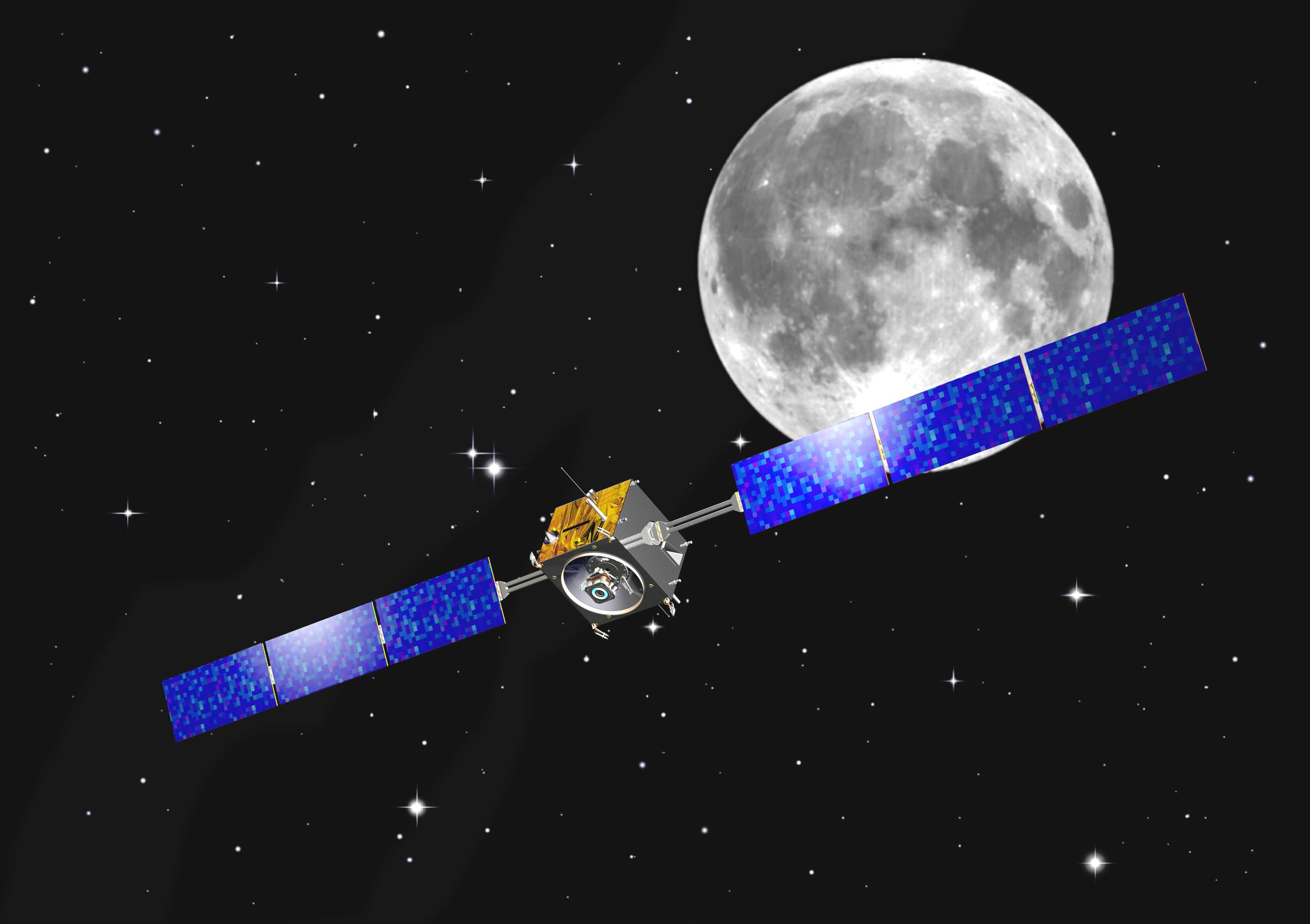
SMART-1 was the European Space Agency's first lunar mission and a small spacecraft designed primarily to demonstrate technologies for future deep-space missions. Its central experiment was solar-electric propulsion, which used a xenon-fed Hall-effect thruster to carry the spacecraft gradually from an Earth transfer orbit to lunar orbit.
The spacecraft also supported a substantial lunar science program. Its instruments imaged the Moon, investigated surface mineralogy and chemical composition, examined the plasma environment, and tested new communications, navigation, spacecraft-autonomy, and miniaturized-instrument technologies.
SMART-1 was launched on 27 September 2003, entered lunar orbit in November 2004, and continued operating around the Moon until a deliberately arranged impact on 3 September 2006. The mission demonstrated that very low continuous electric thrust could be used for interplanetary navigation while simultaneously providing useful planetary-science observations.
Development and objectives
SMART-1 was the first spacecraft in ESA's Small Missions for Advanced Research in Technology program. These missions were intended to provide comparatively small and cost-conscious platforms for testing technologies that could later be applied to larger scientific missions. SMART-1's principal objective was to qualify solar-electric propulsion for deep-space navigation, including the associated flight dynamics, orbit-control methods, and long-duration spacecraft operations.
The Swedish Space Corporation was the prime contractor for the spacecraft platform, with assembly performed by Saab Space in Linköping. The mission was managed for ESA as an international European project. In addition to electric propulsion, SMART-1 tested autonomous spacecraft functions, deep-space communications, miniaturized instruments, and operational concepts intended to reduce the resources required for mission control.
The scientific program focused on lunar morphology, mineralogy, chemical composition, polar regions, possible cold traps, and processes involved in the origin and evolution of the Moon. A contemporary scientific overview described seven hardware experiments conducting ten science and technology investigations. More information on the mission's objectives and flight operations is available from the ESA mission record.
Launch and transfer to the Moon
SMART-1 was launched from Kourou, French Guiana, on 27 September 2003 as an auxiliary payload aboard an Ariane 5. The launcher placed it into a geostationary transfer orbit. From there, the spacecraft did not use a conventional high-thrust chemical burn to depart for the Moon. Instead, it repeatedly operated its solar-electric propulsion system and slowly enlarged its Earth orbit.
This low-thrust trajectory required many months. During the Earth-escape phase, SMART-1 also had to pass repeatedly through the Van Allen radiation belts. Radiation contributed to several early operational problems, including interruptions affecting the spacecraft's computers, star trackers, and electric propulsion system. Software changes and revised ground procedures were used to manage these anomalies.
The spacecraft exploited lunar gravitational perturbations and resonances as its orbit expanded. It passed into the region dominated by the Moon's gravity in November 2004 and reached its first lunar orbit on 15 November. The electric thruster was then used to reduce the size of the orbit progressively. A scientific account of the mission describes a roughly 14-month cruise from launch to lunar capture and the establishment of the lunar science orbit in early 2005. The mission and early scientific results are described in a SMART-1 mission study.
Lunar science phase
SMART-1 eventually operated in a polar elliptical orbit around the Moon, with its closest approaches providing improved spatial resolution for the imaging and spectroscopic instruments. ESA originally planned a nominal lunar science phase of about six months, but the mission was extended. Scientific observations continued through 2005 and most of 2006.
The AMIE camera obtained thousands of images of the lunar surface, including observations of the polar regions. The SIR infrared spectrometer investigated surface minerals, while the D-CIXS X-ray spectrometer and its X-ray Solar Monitor supported measurements of lunar elemental composition. Other experiments studied the spacecraft plasma environment, radio science, telecommunications, and the behavior of electric propulsion.
Mission operations were conducted from ESA's European Space Operations Centre in Darmstadt. SMART-1 used a comparatively small flight-control team and progressively increasing automation. The mission planning and automation system ultimately allowed a large proportion of routine passes to be operated without continuous manual commanding.
Mission extension and impact
The electric propulsion system remained active until September 2005, by which time nearly all usable xenon had been consumed. Mission planning and orbit adjustments extended SMART-1's scientific lifetime beyond the originally expected termination date. When further changes were required to control where and when the spacecraft would strike the Moon, the remaining hydrazine attitude-control system was used for small orbit-raising maneuvers.
SMART-1 was deliberately directed to impact the lunar near side on 3 September 2006. The impact occurred in the region known as the Lake of Excellence and was arranged so that observers on Earth could attempt to record the event. A flash was detected from Earth. The spacecraft struck the surface at about 2 km/s.
Descriptions produced around the end of the mission referred to a grazing impact angle of roughly 5–10 degrees. A later scientific investigation of the impact instead treated the trajectory as an extremely shallow impact of approximately 1 degree. That later study predicted a strongly elongated crater and ejecta pattern using laboratory experiments and scaling models. The research is described in The SMART-1 lunar impact.
The precise impact feature was identified more than a decade later in high-resolution Lunar Reconnaissance Orbiter imagery. The observed site included a gouge approximately 4 m wide and 20 m long, consistent with the unusual consequences expected from the spacecraft's shallow approach to the lunar surface.
Design
Spacecraft structure and attitude control
SMART-1 was a compact three-axis-stabilized spacecraft built around an approximately one-cubic-metre aluminum box structure. Detailed spacecraft data give body dimensions of about 157 cm by 115 cm by 104 cm. With both solar-array wings deployed, the span was approximately 14 m.
The attitude and orbit control architecture incorporated two autonomous star trackers, sun sensors, angular-rate sensors, four reaction wheels arranged in a pyramid configuration, and eight 1 N hydrazine thrusters. The hydrazine system was intended primarily for attitude-control functions such as detumbling and momentum management rather than for the main Earth-to-Moon transfer.
The electric propulsion thruster was mounted on a two-axis gimbal. This mechanism allowed the thrust direction to be adjusted as the spacecraft's center of mass changed while xenon was consumed. Maintaining alignment between the thrust vector and center of mass was particularly important because the ion engine operated for thousands of hours.
Solar-electric propulsion
The main propulsion system was the PPS-1350-G Stationary Plasma Thruster, a Hall-effect electric thruster developed by SNECMA of France with associated power-processing equipment. Xenon stored in a roughly 49–50 litre high-pressure tank served as propellant. The initial xenon load was about 82 kg.
In the thruster, electrons ionized the xenon inside the discharge chamber. Electric and magnetic fields accelerated the resulting ions to produce thrust, while an external cathode supplied electrons to neutralize the outgoing beam. The system generated only about 68–70 millinewtons of nominal thrust, giving the spacecraft an acceleration of approximately 0.2 mm/s². The very small force became effective because it could be applied for long periods.
The thruster's specific impulse was approximately 1,640 seconds, considerably higher than conventional chemical propulsion. During the mission the electric propulsion system accumulated almost 5,000 hours of active firing. SMART-1 demonstrated the use of a Hall-effect thruster as the spacecraft's primary means of propulsion and used electric propulsion both to escape progressively from Earth and to establish and modify its lunar orbit.
Power and onboard systems
Electrical power was supplied by two large solar-array wings using multi-junction solar cells. Published spacecraft descriptions give beginning-of-life output in the approximate 1.8–2.0 kW range, with mission power decreasing as the arrays experienced radiation exposure and normal degradation.
The spacecraft used lithium-ion batteries for periods when solar generation was unavailable. Its onboard control architecture was centered on a 20 MHz ERC-32-class processor and used Controller Area Network buses to connect platform and payload equipment. A hierarchical failure-detection, isolation, and recovery system supported autonomous responses to spacecraft anomalies.
This autonomy was particularly important because the electric propulsion system depended on long-duration firing and because maintaining continuous ground supervision would have increased mission-operating costs. Software modifications introduced during the mission also enabled autonomous recovery from some radiation-induced propulsion interruptions.
Communications and experimental technology
The normal telemetry, tracking, and command system operated in S-band. SMART-1 also carried the KaTE experimental telecommunications package for X-band and Ka-band investigations. KaTE was intended to test high-frequency deep-space links, ranging, tracking, and communications techniques relevant to later planetary missions.
The mission also tested radio-science techniques and onboard autonomous navigation concepts. Ground-system experimentation was part of the technology program as well, with ESA reusing mission-control infrastructure and increasing the degree of automated planning and commanding during the lunar phase.
Scientific payload
The Advanced Moon micro-Imager Experiment, or AMIE, was a compact multispectral camera used for lunar morphology, topography, surface-texture, and polar observations. It used a 1024 by 1024 CCD detector and several fixed spectral filters. From the lowest parts of the lunar orbit, its imaging scale was on the order of tens of metres per pixel.
The SMART-1 Infrared Spectrometer, or SIR, was a miniaturized near-infrared grating spectrometer covering approximately 0.94–2.4 micrometres. It was intended to investigate lunar mineralogy, including spectral signatures associated with minerals such as pyroxene, olivine, and feldspar.
The Demonstration of a Compact Imaging X-ray Spectrometer, D-CIXS, measured fluorescent X-rays from the lunar surface to investigate elemental composition. Its companion X-ray Solar Monitor measured solar X-ray activity so that lunar fluorescence observations could be interpreted against the varying solar illumination.
EPDP, the Electric Propulsion Diagnostic Package, characterized the plasma environment associated with the electric thruster and monitored possible contamination or surface effects. SPEDE measured spacecraft potential, electrons, and the surrounding plasma environment. The RSIS radio-science investigations used precise tracking and attitude information for experiments involving spacecraft dynamics and lunar rotation.
Operational history
SMART-1 was operated by the European Space Agency from its launch in September 2003 until the controlled lunar impact in September 2006. It completed hundreds of Earth orbits while gradually increasing its distance from Earth, then entered lunar orbit in November 2004 and conducted extended lunar observations through the remainder of the mission.
The spacecraft achieved its principal technology objective by demonstrating long-duration solar-electric propulsion for deep-space navigation. Its flight also provided ESA with practical experience in low-thrust trajectory design, autonomous recovery, reduced-size mission-control teams, and highly automated lunar operations.
The lunar science phase produced extensive imagery and spectroscopic measurements of the Moon. The spacecraft continued returning observations until its final orbits, and the planned impact itself became an additional scientific experiment observed from Earth.
Operators
- European Space Agency: Operated SMART-1 from the European Space Operations Centre in Darmstadt from its 2003 launch through the end of the mission on 3 September 2006.
Specifications (SMART-1)
General characteristics
- Type: Lunar science and technology-demonstration spacecraft
- Prime spacecraft contractor: Swedish Space Corporation
- Launch mass: 367 kg in detailed spacecraft data; ESA's operational summary rounds the value to approximately 370 kg
- Payload mass: Approximately 19 kg
- Body dimensions: Approximately 1.57 × 1.15 × 1.04 m
- Deployed solar-array span: Approximately 14 m
- Attitude control: Three-axis stabilized with star trackers, sun sensors, rate sensors, reaction wheels, and eight 1 N hydrazine thrusters
- Launch vehicle: Ariane 5
- Launch date: 27 September 2003
- Lunar capture: 15 November 2004
- End of mission: Controlled lunar impact on 3 September 2006
Propulsion
- Main engine: PPS-1350-G Hall-effect solar-electric thruster
- Main propellant: Xenon
- Xenon capacity: Approximately 82–82.5 kg
- Xenon tank volume: Approximately 49–50 litres
- Nominal thrust: Approximately 68–70 mN
- Specific impulse: Approximately 1,640 seconds
- Spacecraft acceleration under electric thrust: Approximately 0.2 mm/s²
- Electric propulsion operating life during mission: Approximately 4,958 hours of active firing
Communications and payload
- Primary communications: S-band telemetry, tracking, and command system
- Experimental communications: KaTE X-band and Ka-band deep-space communications experiment
- Imaging: AMIE multispectral lunar micro-camera
- Infrared spectroscopy: SIR near-infrared spectrometer
- X-ray spectroscopy: D-CIXS with X-ray Solar Monitor
- Propulsion environment diagnostics: EPDP
- Plasma measurements: SPEDE
- Radio science: RSIS
Related equipment
- Deep Space 1: NASA spacecraft that preceded SMART-1 in demonstrating solar-electric propulsion in deep-space operations.
- BepiColombo: ESA-JAXA Mercury mission whose transfer architecture uses solar-electric xenon propulsion, a technology area for which SMART-1 provided European flight experience.
Source record:
 Argentina
 Armenia
 Australia
 Austria
 Austria-Hungary
 Belgium
 Brazil
 United Kingdom
 United States
 Brunei
 Bulgaria
 Canada
 Chile
Chile China
China Colonial America
 Colombia
 Confederate States
 Croatia
 Czech
Czech Denmark
 Egypt
Egypt Finland
 France
 Georgia
 Germany
 German Imperial
 Greece
 Holland
 Hungary
 India
India Indonesia
 Iran
Iran Iraq
Iraq Ireland
 Israel
 Italy
Italy Japan
Japan Japan (1940)
 Jordan
 Kingdom of Italy
 Malaysia
 Mexico
 Myanmar
 Nazi Germany
 Netherlands
 New Zealand
 North Korea
 Norway
 Pakistan
 Peru
Peru Philippines
 Poland
 Portugal
 Prussia
 Romania
 Russia
 Saudi Arabia
 Serbia
 Singapore
 Slovakia
 Slovenia
 South Africa
 South Korea
 Soviet Union
 Spain
Spain Switzerland
 Syria
Syria Taiwan
 Thailand
 Turkey
 UAE
UAE Ukraine
 Vietnam
 Yugoslavia