
History
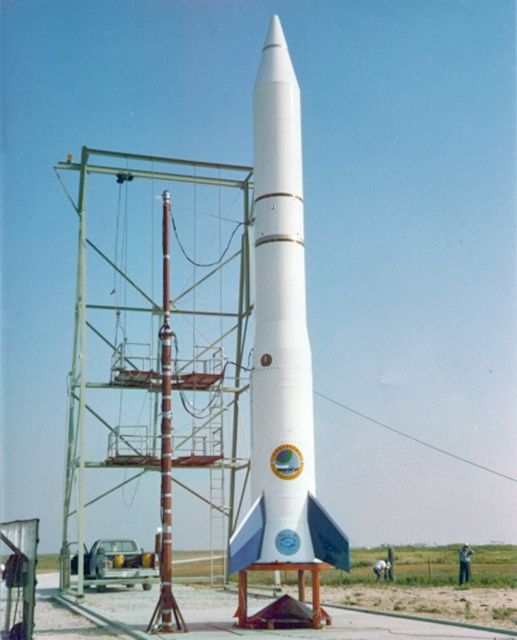
Conestoga 1 was a privately funded suborbital rocket developed by Houston-based Space Services Inc. of America (SSIA). It was launched from a private facility on Matagorda Island, Texas, on September 9, 1982, and became an important early demonstration of privately financed access to space.
The rocket used existing rocket hardware, including a surplus Minuteman missile second stage, and was powered by solid propellant. Its flight was intended primarily to demonstrate that a private company could organize, finance, obtain regulatory approval for, and conduct a space launch.
Conestoga 1 carried no scientific payload. Instead, it carried about 151 liters (40 US gal) of water, which was released near peak altitude to create a visible marker that observers on the ground could follow.
Development
SSIA was led by former Mercury 7 and Apollo-Soyuz astronaut Donald K. Deke Slayton together with businessmen David Hannah Jr. and Charles M. Chafer. The company pursued private launch operations at a time when American spaceflight was dominated by government agencies and no established federal licensing framework existed specifically for private commercial launches.
Before Conestoga 1, SSIA attempted to launch the Percheron rocket from Matagorda Island in 1981, but that vehicle failed on the launch pad. For Conestoga 1, the company adopted a different approach based on proven rocket hardware. The available account describes the vehicle as using a Minuteman missile second stage acquired from NASA and identifies it as a solid-fueled rocket.
Matagorda Island was selected after SSIA had first sought support for a launch from Vandenberg Air Force Base in California. According to the detailed Conestoga 1 history, SSIA intended the mission to demonstrate its ability to assemble the necessary technology, financing, and launch team, show that the federal government would permit a privately financed space launch, and establish Matagorda Island as a viable private launch site.
Construction of both the launch vehicle and its facilities proceeded while SSIA worked through a lengthy federal approval process. The final approval, described as a US Department of State export license, was received only shortly before the launch. Other agencies involved included the Federal Aviation Administration, Federal Communications Commission, NASA, the Department of Defense, and the Bureau of Alcohol, Tobacco, and Firearms.
Launch
Conestoga 1 lifted off from Matagorda Island at 10:12 a.m. on September 9, 1982. The rocket was approximately 11 m (36 ft) long. One account states that the mission lasted about 10.5 minutes.
Published accounts differ on the reported maximum altitude. The SSIA-related Celestis history states that Conestoga 1 reached an apogee of more than 257 km (160 mi), while another supplied account gives approximately 314 km (195 mi). Both figures place the vehicle well above the conventional boundary of space. Celestis also states that the rocket splashed down roughly 966 km (600 mi) downrange in the Gulf of Mexico.
The successful mission demonstrated privately financed launch operations at a time when such activity was highly unusual in the United States. SSIA and its successors have subsequently presented the flight as the beginning of the American commercial space-launch era.
Design
Conestoga 1 was assembled largely from existing rocket components rather than being developed as an entirely new launch vehicle. The principal propulsion element was derived from a surplus LGM-30 Minuteman missile stage. The rocket used solid propellant, simplifying the vehicle compared with systems that required liquid-propellant loading and associated ground equipment.
The vehicle was configured for a suborbital demonstration mission. It did not attempt to place a payload into orbit. The only payload identified for the September 1982 flight was approximately 151 liters (40 US gal) of water. At high altitude, the water was expelled to provide a visible marker for observers tracking the flight.
The wider Conestoga program later explored modular configurations using Minuteman-derived stages and additional boosters. A general overview of the program is available in the Conestoga rocket overview, although Conestoga 1 itself was the specific vehicle flown from Matagorda Island in 1982.
Operational history
Conestoga 1 flew a single successful suborbital mission on September 9, 1982. The launch validated SSIA's ability to conduct a privately financed spaceflight from a privately prepared launch facility and demonstrated that the company could navigate the regulatory environment then governing such activity.
The company later continued work on commercial launch services. A larger Conestoga 1620 with additional strap-on boosters was launched from NASA's Wallops Flight Facility in Virginia in October 1995, but failed 46 seconds after liftoff. The Conestoga program was subsequently discontinued.
The 1982 launch remained historically significant because it preceded the formal establishment of a dedicated US commercial launch regulatory framework. In 1984, the US government designated the Department of Transportation as the lead agency for commercial space transportation, and Congress enacted the Commercial Space Launch Act.
Specifications (Conestoga 1)
General characteristics
- Type: Privately funded suborbital demonstration rocket
- Developer: Space Services Inc. of America
- Length: approximately 11 m (36 ft)
- Propulsion: Solid-propellant rocket stage derived from surplus Minuteman missile hardware
- Payload: approximately 151 liters (40 US gal) of water
Flight performance
- Launch date: September 9, 1982
- Launch site: Private launch facility on Matagorda Island, Texas
- Mission profile: Suborbital
- Flight duration: approximately 10.5 minutes
- Maximum altitude: reported as more than 257 km (160 mi) by the SSIA-related Celestis account and approximately 314 km (195 mi) by another supplied account
- Downrange distance: approximately 966 km (600 mi), according to the Celestis account
Related equipment
- Percheron: Earlier SSIA private rocket attempted from Matagorda Island in 1981; the vehicle failed on the launch pad.
- Conestoga 1620: Later and larger Conestoga configuration using additional strap-on boosters. Its October 1995 launch failed shortly after liftoff.
 Argentina
 Armenia
 Australia
 Austria
 Austria-Hungary
 Belgium
 Brazil
 United Kingdom
 Brunei
 Bulgaria
 Canada
 Chile
Chile China
China Colonial America
 Colombia
 Confederate States
 Croatia
 Czech
Czech Denmark
 Egypt
Egypt Finland
 France
 Georgia
 Germany
 German Imperial
 Greece
 Holland
 Hungary
 India
India Indonesia
 Iran
Iran Iraq
Iraq Ireland
 Israel
 Italy
Italy Japan
Japan Japan (1940)
 Jordan
 Kingdom of Italy
 Malaysia
 Mexico
 Myanmar
 Nazi Germany
 Netherlands
 New Zealand
 North Korea
 Norway
 Pakistan
 Peru
Peru Philippines
 Poland
 Portugal
 Prussia
 Romania
 Russia
 Saudi Arabia
 Serbia
 Singapore
 Slovakia
 Slovenia
 South Africa
 South Korea
 Soviet Union
 Spain
Spain Sweden
 Switzerland
 Syria
Syria Taiwan
 Thailand
 Turkey
 UAE
UAE Ukraine
 Vietnam
 Yugoslavia