
History
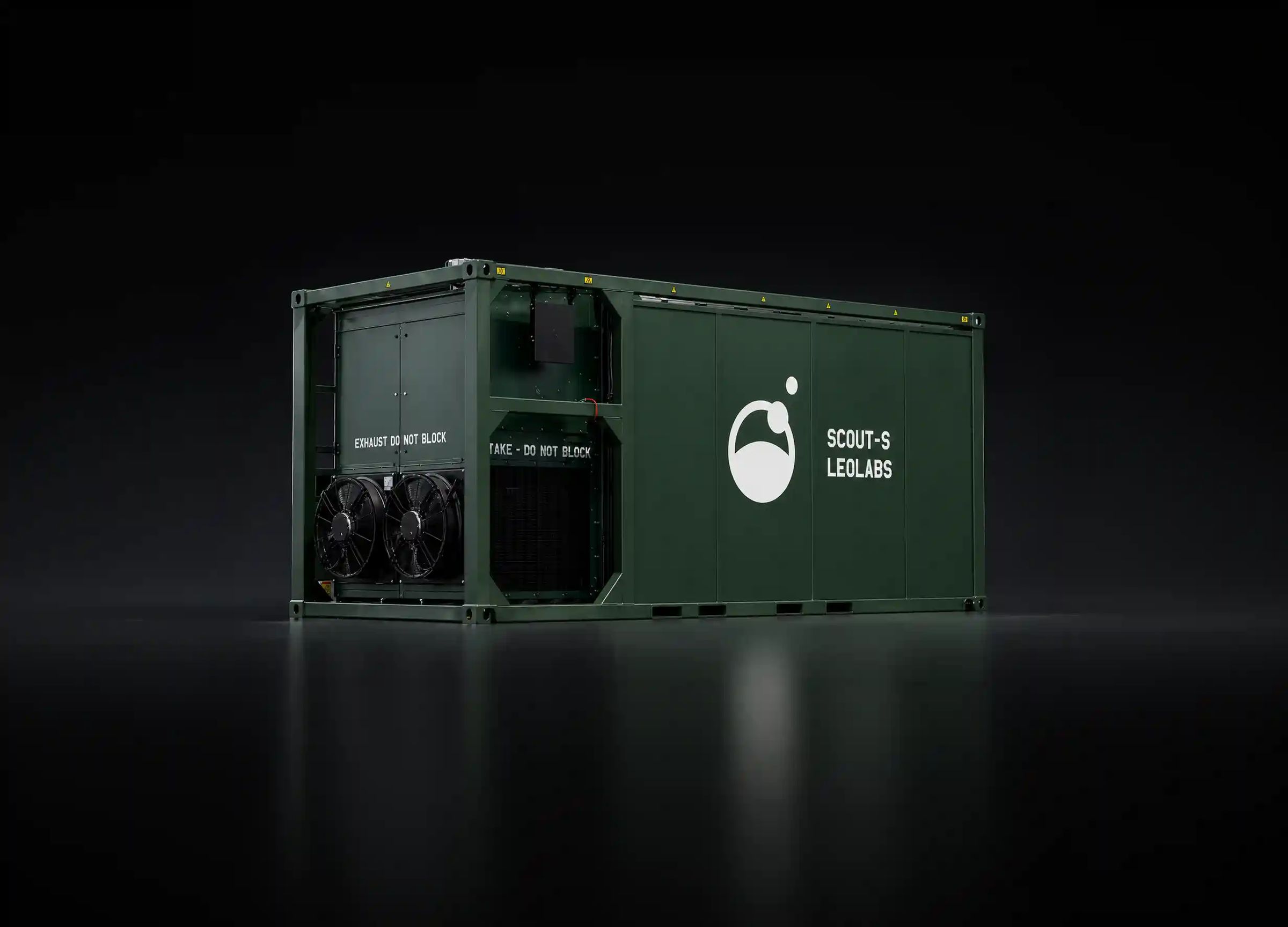
LeoLabs Scout-S is a transportable S-band phased-array radar developed for space domain awareness and persistent tracking of objects in low Earth orbit and very low Earth orbit. The system places its radar equipment in a standard 20-foot ISO container so it can be transported by land, sea, or air and repositioned when required.
Scout-S was developed to complement LeoLabs' fixed global radar network by extending coverage into areas where existing sensors leave observation gaps. Its design emphasizes longer observation windows and persistent custody of maneuvering spacecraft rather than only periodic measurements during brief orbital passes.
The first fielded Scout-S system became operational in the Indo-Pacific in June 2026. LeoLabs reported that it began observing satellites within hours of activation and subsequently participated in experimentation associated with U.S. Indo-Pacific Command's Valiant Shield 2026 exercise.
Development and first deployment
LeoLabs announced the deployment of Scout-S on June 10, 2026. According to the company's deployment announcement, Scout-S represents a transportable three-dimensional search-radar architecture intended to complement fixed-site sensors and provide rapidly deployable coverage for U.S. and allied space operations.
The first operational system, identified in reporting as Scout Hawaii, became operational in June 2026. It was used as a real-world testbed for transportable sensing and was scheduled to participate in Valiant Shield 2026, held later that month. The system remained part of LeoLabs' radar network after the exercise for continued experimentation and testing.
Early operation demonstrated tracking of Chinese intelligence, surveillance and reconnaissance satellites, including Yaogan reconnaissance satellites at altitudes between approximately 800 and 1,000 km. LeoLabs also reported persistent custody of China's spaceplane and detection of an object at an altitude of 230 km.
U.S. Space Force procurement
In August 2026, LeoLabs received a $20.7 million U.S. Space Force contract covering mobile Scout-S radar hardware for space domain awareness. The agreement calls for delivery of a modified Scout-S configuration intended to track satellites, debris and other space objects in low and very low Earth orbit. Reporting on the contract stated that final hardware integration and environmental qualification would precede initial site deliveries and operational calibration scheduled to begin in early 2027. Details were reported by SatNews.
By September 2026, LeoLabs was also offering Scout-S under several ownership and service models. These included commercial access to radar services, contractor-owned and operated systems funded by a government, and government-owned and operated systems. Company officials said discussions were under way with more than a dozen allied countries, although those prospective customers had not been announced as operators.
LeoLabs planned to manufacture Scout-S systems in single-digit quantities during 2027 before expanding production toward dozens of units annually. The company also planned to deploy additional Scout-S radars to fill geographic gaps in its network of 12 larger radar sites.
Design
Scout-S combines three-dimensional scanning, direct radiating array technology and a modular S-band electronic architecture. The radar is designed for uncued search, discovery and continuous tracking of multiple objects in low Earth orbit and very low Earth orbit.
Transportable configuration
The complete radar system is housed in a standard 20-foot ISO container. This containerized configuration permits transportation by land, sea or air and allows the system to be rapidly deployed, repositioned or reconstituted. The compact form is intended to support temporary deployments as well as longer-term operation at locations where fixed radar coverage is limited.
Radar architecture and tracking
Scout-S uses multiple S-band antennas and a direct radiating array architecture. Search-to-track and track-while-scan modes allow the radar to search for objects while maintaining tracks on already detected targets. LeoLabs states that the system can extend an observation window from seconds to several minutes during a single orbital pass.
The longer observation period is intended to improve orbit determination and make maneuvers, proximity operations and payload deployments easier to detect. The first system has been used to maintain repeated or persistent tracks on selected satellites rather than relying exclusively on isolated observations.
LeoLabs CEO Tony Frazier stated that Scout-S can track multiple objects between very low Earth orbit at approximately 180 km altitude and about 1,000 km. Separately, LeoLabs reported an early operational detection at 230 km and tracking of satellites in the 800 to 1,000 km altitude range.
Network integration
Scout-S is designed to operate as part of LeoLabs' broader radar network. Data from the first fielded system contributes to the company's orbital object catalog. LeoLabs intends to use additional mobile systems to reduce intervals during which satellites pass through regions not observed by its fixed radars.
The transportable architecture also allows sensors to be concentrated temporarily in areas where higher observation cadence is required. This supports LeoLabs' stated transition from periodic observations toward persistent custody of selected maneuverable spacecraft.
Program status
As of September 2026, the first Scout-S was operational in the Indo-Pacific and continued to support LeoLabs' global tracking network and experimental activities. A second Scout system was planned for completion by early 2027, with broader production expansion targeted for the middle to latter part of 2027.
The U.S. Space Force had contracted for a modified Scout-S configuration, with initial deliveries and calibration activities planned to begin in early 2027. LeoLabs was also discussing sales and service arrangements with allied governments, but those discussions had not yet established additional confirmed operators in the available reporting.
Scout-S forms part of a broader Scout family of transportable radars. LeoLabs has stated that future Scout systems are planned to expand beyond space surveillance into missile warning, missile tracking and wider multi-domain battlespace-awareness missions. These future capabilities should not be treated as functions of the fielded Scout-S unless separately demonstrated.
Variants
- Scout-S: Baseline transportable S-band space-surveillance radar. The first fielded system became operational in the Indo-Pacific in June 2026.
- Modified Scout-S for the U.S. Space Force: Contracted mobile radar configuration for space domain awareness. Final integration, qualification and initial site deliveries were planned to lead into operational calibration beginning in early 2027.
Specifications (Scout-S fielded baseline)
General characteristics
- Type: Transportable three-dimensional space-surveillance radar
- Radar band: S-band
- Antenna technology: Direct radiating array phased-array architecture
- Housing: Standard 20-foot ISO container
- Transport: Configured for movement by land, sea or air
- Primary surveillance regimes: Low Earth orbit and very low Earth orbit
Tracking performance
- Reported tracking altitude span: Approximately 180 to 1,000 km
- Demonstrated low-altitude detection: 230 km
- Demonstrated high-altitude tracking: Chinese Yaogan satellites between approximately 800 and 1,000 km
- Observation duration: Extended from seconds to several minutes during a single orbital pass
- Tracking modes: Search-to-track and track-while-scan
- Functions: Uncued search, discovery and persistent tracking of space objects
Source file:
 Argentina
 Armenia
 Australia
 Austria
 Austria-Hungary
 Belgium
 Brazil
 United Kingdom
 Brunei
 Bulgaria
 Canada
 Chile
Chile China
China Colonial America
 Colombia
 Confederate States
 Croatia
 Czech
Czech Denmark
 Egypt
Egypt Finland
 France
 Georgia
 Germany
 German Imperial
 Greece
 Holland
 Hungary
 India
India Indonesia
 Iran
Iran Iraq
Iraq Ireland
 Israel
 Italy
Italy Japan
Japan Japan (1940)
 Jordan
 Kingdom of Italy
 Malaysia
 Mexico
 Myanmar
 Nazi Germany
 Netherlands
 New Zealand
 North Korea
 Norway
 Pakistan
 Peru
Peru Philippines
 Poland
 Portugal
 Prussia
 Romania
 Russia
 Saudi Arabia
 Serbia
 Singapore
 Slovakia
 Slovenia
 South Africa
 South Korea
 Soviet Union
 Spain
Spain Sweden
 Switzerland
 Syria
Syria Taiwan
 Thailand
 Turkey
 UAE
UAE Ukraine
 Vietnam
 Yugoslavia