
History
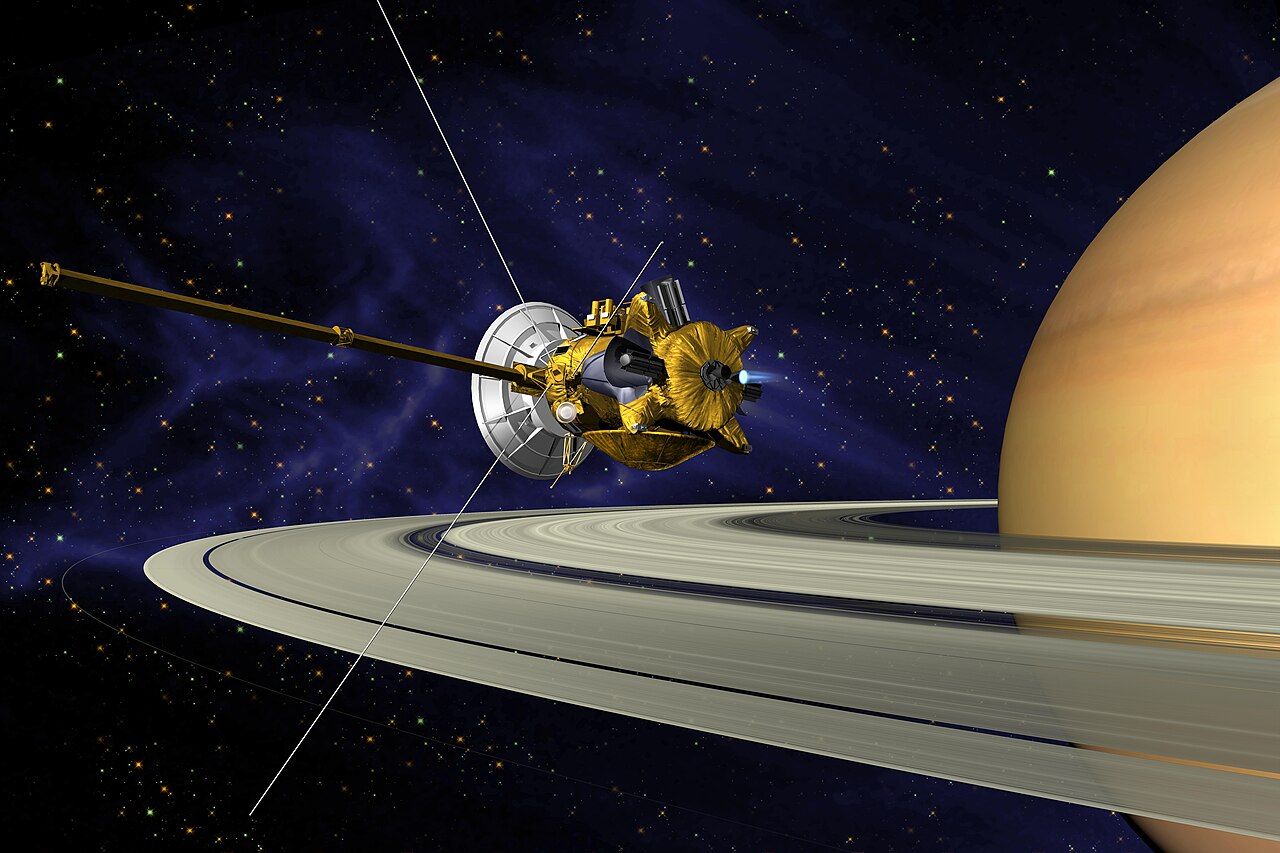
Cassini-Huygens was a joint Flagship-class planetary exploration mission by NASA, the European Space Agency (ESA), and the Italian Space Agency (ASI). The mission was named after Giovanni Domenico Cassini, the Italian astronomer who discovered the Cassini Division in Saturn's rings in 1675, and Christiaan Huygens, the Dutch scientist who discovered Titan in 1655. The program was commonly called Saturn Orbiter Titan Probe (SOTP) during its early development. At the time of its 1997 launch, Cassini-Huygens was the third-largest uncrewed interplanetary spacecraft ever successfully launched; ESA described it as the largest interplanetary spacecraft ever built.
The mission's origins date to 1982, when a working group of the European Science Foundation and the American National Academy of Sciences proposed a paired Saturn orbiter and Titan probe as a possible cooperative mission. In 1983, NASA's Solar System Exploration Committee recommended the concept as a core project, and ESA and NASA conducted a joint study from 1984 to 1985. In late 1988, ESA selected Cassini-Huygens as its next major science mission. The project survived political challenges in the United States in 1992 and 1994, when NASA persuaded Congress that canceling the mission after ESA had already invested in its development would be unwise for international relations.
The spacecraft was launched on 15 October 1997 aboard a Titan IVB/Centaur rocket from Cape Canaveral Air Force Station, Florida. The voyage to Saturn lasted almost seven years and included gravitational-assist flybys of Venus in April 1998 and June 1999, Earth on 18 August 1999 (passing 1,171 km above the planet), the asteroid 2685 Masursky, and Jupiter in December 2000. Cassini entered orbit around Saturn on 1 July 2004, becoming the first probe to orbit the planet.
In December 2004, toward the end of Cassini's third orbit around Saturn, the Huygens probe was separated and began a 22-day cruise to Titan. It reached Titan's surface on 14 January 2005, making it the first spacecraft to land on a world in the outer Solar System. The Huygens probe was designed to enter and brake in Titan's thick atmosphere and parachute a fully instrumented robotic laboratory to the surface; it could withstand temperatures of up to 18,000 °C in front of its heat shield.
Cassini spent 13 years orbiting Saturn. Its primary mission was completed on 30 July 2008, and the mission was subsequently extended through 2017 as the Cassini Equinox and Solstice Missions. During its orbital operations, Cassini discovered a hexagonal jetstream encircling Saturn's north pole, massive hurricane-like vortexes over both poles, and icy plumes of water erupting from the moon Enceladus, revealing clues about that moon's subsurface ocean. In 2010, Cassini observed a giant storm form in Saturn's northern hemisphere that grew to encircle the entire planet through 2011. The spacecraft also revealed Saturn's rings as active, dynamic structures and, through a series of Titan flybys, confirmed that the moon could have liquid hydrocarbon rain, rivers, lakes, and seas.
On 15 September 2017, with fuel running low, NASA deliberately steered Cassini into Saturn's upper atmosphere, where the spacecraft was destroyed. The end-of-mission disposal was chosen to prevent any chance of contaminating Saturn's pristine moons, which might offer habitable environments to stowaway terrestrial microbes.
Specifications
- Launch mass (complete system): 5,712 kg
- Dry mass (orbiter only): 2,125 kg
- Height: 6.7 m
- Width: 4 m
- Electrical power: 885 W at beginning of mission; 633 W at end of nominal mission
- Main propulsion: one prime and one backup R-4D bipropellant rocket engine, 490 N thrust each; total spacecraft delta-v 2,352 m/s
- Attitude control: monopropellant rockets
- Power source: three GPHS-RTG radioisotope thermoelectric generators using approximately 32.7 kg of plutonium dioxide (containing 28.3 kg of pure plutonium-238)
- Launch vehicle: Titan IVB/Centaur (two-stage Titan IV booster, two strap-on solid rocket engines, Centaur upper stage)
- Mission cost: approximately US$3.26 billion (NASA 80%, ESA 15%, ASI 5%); figures from a 2000 press kit do not include inflation or extended-mission costs
 Argentina
 Armenia
 Australia
 Austria
 Austria-Hungary
 Belgium
 Brazil
 United Kingdom
 Brunei
 Bulgaria
 Canada
 Chile
 China
 Colonial America
 Colombia
 Confederate States
 Croatia
 Czech
 Denmark
 Egypt
 Finland
 France
 Georgia
 Germany
 German Imperial
 Greece
 Holland
 Hungary
 India
 Indonesia
 Iran
 Iraq
 Ireland
 Israel
 Italy
 Japan
 Japan (1940)
 Jordan
 Kingdom of Italy
 Malaysia
 Mexico
 Myanmar
 Nazi Germany
 Netherlands
 New Zealand
 North Korea
 Norway
 Pakistan
 Peru
 Philippines
 Poland
 Portugal
 Prussia
 Romania

 Russia
 Saudi Arabia
 Serbia
 Singapore
 Slovakia
 Slovenia
 South Africa
 South Korea
 Soviet Union
 Spain
 Sweden
 Switzerland
 Syria
 Taiwan
 Thailand
 Turkey
 UAE
 Ukraine
 Vietnam
 Yugoslavia