History
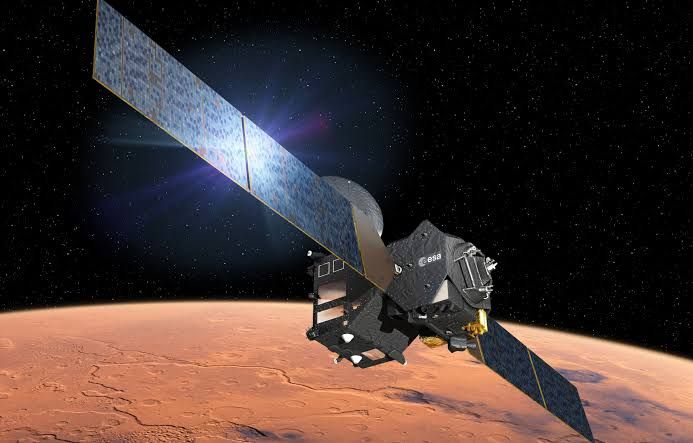
The ExoMars Trace Gas Orbiter (TGO) was launched on 14 March 2016 aboard a Proton-M rocket from Baikonur Cosmodrome, Kazakhstan, as part of the ExoMars 2016 mission, a joint programme of the European Space Agency (ESA) and the Russian Roscosmos agency. Manufactured by Thales Alenia Space, the orbiter carried the Schiaparelli entry, descent and landing (EDL) demonstrator on the journey to Mars.
The TGO and Schiaparelli separated on 16 October 2016, and the orbiter was inserted into an elliptical orbit around Mars on 19 October 2016. Schiaparelli stopped communicating with Earth approximately one minute before its planned landing and crashed on the surface; a premature release of the parachute was identified as the cause. ESA officials described the ExoMars 2016 mission as “96% successful” owing to the lander’s loss.
The TGO has been orbiting Mars since 19 October 2016 and began science observations in April 2018. As of 2026 it has spent a decade studying the Martian atmosphere.
Specifications
The TGO central bus measures 3.2 m × 2 m × 2 m, with solar wings spanning 17.5 m tip-to-tip that generate approximately 2,000 W of power at Mars. Two lithium-ion battery modules provide approximately 5,100 Wh of capacity to cover eclipses. Propulsion is provided by a 424 N bipropellant main engine used for Mars orbit insertion and major manoeuvres.
Launch mass is 4,332 kg including 113.8 kg of science payload and the 577 kg Schiaparelli lander. The orbiter alone has a wet mass of 3,755 kg (a satellite catalogue record gives 3,732 kg). Communication with Earth is handled by a 65 W X-band system with a 2.2-m-diameter high-gain antenna; NASA-provided Electra UHF transceivers support relay communications with Mars surface assets.
The four-instrument science payload (113.8 kg) comprises the Nadir and Occultation for Mars Discovery (NOMAD) spectrometer (Belgium), the Atmospheric Chemistry Suite (ACS) (France and Russia), the Colour and Stereo Surface Imaging System (CaSSIS) 4.5-m/pixel colour stereo camera (Switzerland), and the Fine-Resolution Epithermal Neutron Detector (FREND) (Russia). From its approximately 400-km-altitude science orbit, the instruments detect trace gases such as methane, water vapour, nitrogen oxides and acetylene with an accuracy improved by three orders of magnitude over previous measurements, and map subsurface hydrogen to a depth of one metre.
Program Status
The TGO serves a dual role as a science orbiter and a Mars telecommunications relay. After completing its primary science objectives, it will provide communications support for the ExoMars Rosalind Franklin rover, which is now expected to launch no earlier than 2028 with a Mars landing in 2030. The original ExoMars 2018/2020 timeline was delayed following the Schiaparelli failure and ESA’s severance of its partnership with Russia. The Electra UHF system enables the TGO to relay data from surface rovers and landers and to provide navigation assistance for arriving spacecraft.
 Argentina
 Armenia
 Australia
 Austria
 Austria-Hungary
 Belgium
 Brazil
 United Kingdom
 United States
 Brunei
 Bulgaria
 Canada
 Chile
 China
 Colonial America
 Colombia
 Confederate States
 Croatia
 Czech
 Denmark
 Egypt
 Finland
 France
 Georgia
 Germany
 German Imperial
 Greece
 Holland
 Hungary
 India
 Indonesia
 Iran
 Iraq
 Ireland
 Israel
 Italy
 Japan
 Japan (1940)
 Jordan
 Kingdom of Italy
 Malaysia
 Mexico
 Myanmar
 Nazi Germany
 Netherlands
 New Zealand
 North Korea
 Norway
 Pakistan
 Peru
 Philippines
 Poland
 Portugal
 Prussia
 Romania

 Russia
 Saudi Arabia
 Serbia
 Singapore
 Slovakia
 Slovenia
 South Africa
 South Korea
 Soviet Union
 Spain
 Sweden
 Switzerland
 Syria
 Taiwan
 Thailand
 Turkey
 UAE
 Ukraine
 Vietnam
 Yugoslavia