
History
OSIRIS-REx (Origins, Spectral Interpretation, Resource Identification, Security-Regolith Explorer) was selected by NASA in 2011 as the third planetary science mission in its New Frontiers Program, following Juno and New Horizons. The project cost approximately US$800 million for the spacecraft and an additional US$183.5 million for the Atlas V launch vehicle. It had been rejected twice by NASA before receiving final approval.
The spacecraft launched on September 8, 2016, from Cape Canaveral, Florida, on an Atlas V rocket. After orbiting the Sun for one year, it received a gravity assist from Earth on September 22, 2017, and arrived at asteroid 101955 Bennu in December 2018. Bennu, a 490-metre-diameter carbonaceous near-Earth asteroid, was expected to present a smooth, sandy surface; instead, the spacecraft revealed a loosely bound field of boulders. The mission team spent approximately 505 days in close orbit mapping the surface before selecting a small crater near the north pole, Nightingale, as the sampling site.
On October 20, 2020, OSIRIS-REx touched down on Bennu and fired compressed nitrogen gas into the surface through its Touch-And-Go Sample Acquisition Mechanism. The sampling head sank approximately 51 cm into the regolith, and the collection lid jammed partially open, allowing fragments to escape before the team stowed the sampler inside the return capsule. The spacecraft collected 121.6 grams of material, more than twice the 60-gram mission requirement. It departed Bennu on May 10, 2021, having set a Guinness World Record as the first spacecraft to orbit an object of that size.
The sample return capsule separated on September 24, 2023, and after a 13-minute atmospheric entry at a peak speed of approximately 44,600 km/h (27,700 mph), it landed in the Utah Test and Training Range. A parachute did not deploy as intended, but the capsule landed safely. NASA formally concluded the OSIRIS-REx mission on September 30, 2026, with the completion of the sample analysis phase.
Design
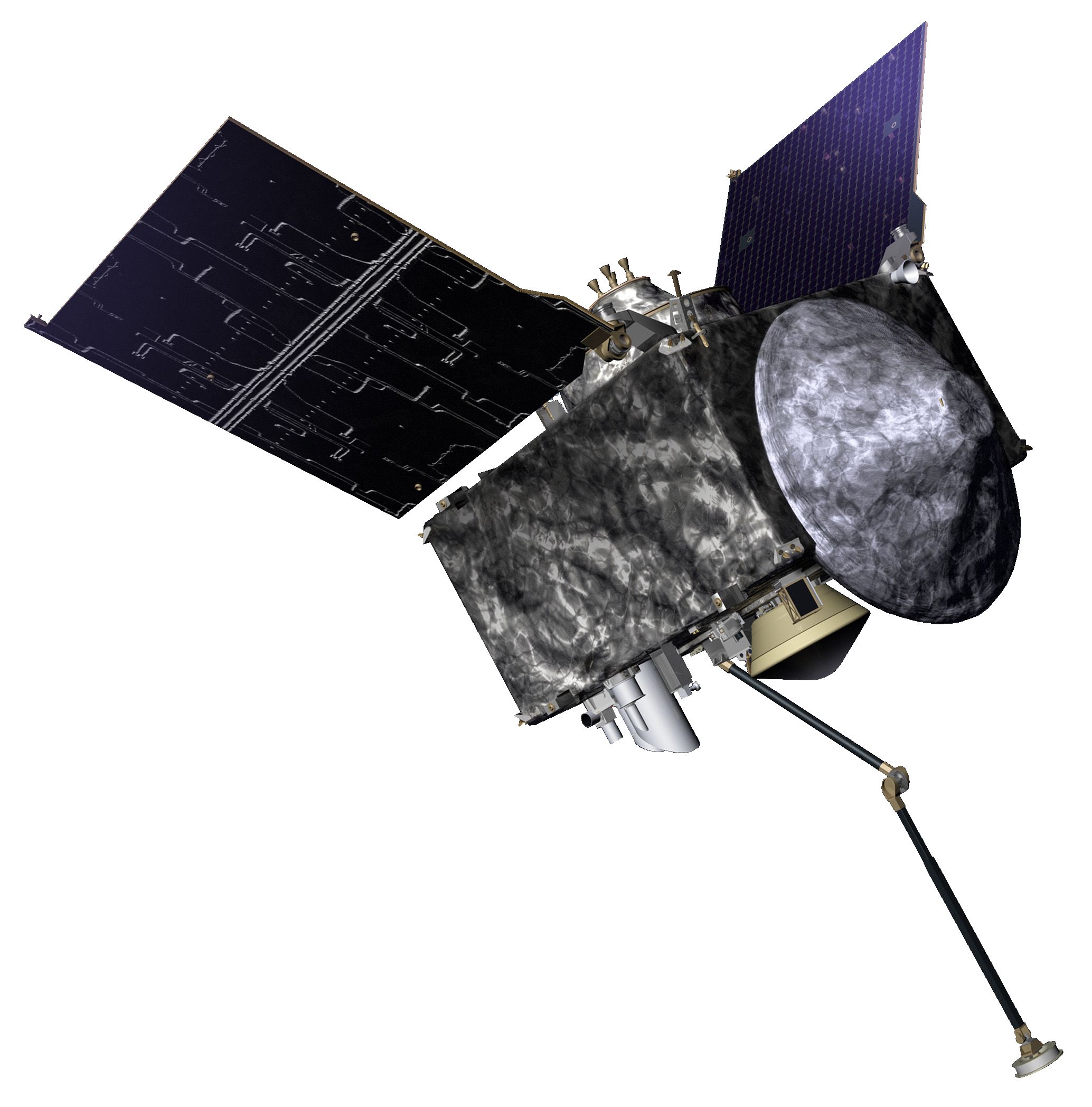
Lockheed Martin Space Systems designed and built the spacecraft at its facility near Denver, drawing structural and subsystem heritage from the Mars Reconnaissance Orbiter, MAVEN, and the Stardust comet sample-return mission. The sample return capsule is a direct heritage of the Stardust capsule.
The Touch-And-Go Sample Acquisition Mechanism (TAGSAM) operates as a reverse vacuum, firing a burst of compressed nitrogen gas to stir up and collect regolith into a ring-shaped canister. The spacecraft's Natural Feature Tracking system enabled autonomous navigation during descent by comparing real-time images of the asteroid's surface against onboard maps. The instrument suite includes visible-light cameras, infrared spectrometers, an X-ray spectrometer, and the OSIRIS-REx Laser Altimeter (OLA), a Canadian-built active-scanning lidar that mapped Bennu from up to 7 km away using 75 watts of power.
Specifications
Body dimensions: 2.4 m × 2.4 m × 3.15 m; overall width 6.2 m with solar arrays deployed. Dry mass 880 kg; wet (fueled) mass 2,110 kg. Two solar arrays generate 1,226 to 3,000 watts depending on distance from the Sun; energy is stored in lithium-ion batteries. The propulsion system is a hydrazine monopropellant system derived from the Mars Reconnaissance Orbiter, carrying 1,230 kg of propellant and helium. TAGSAM length: 3.35 m. Solar array area: 8.5 m² on two-axis gimbals.
Program status
With the mission formally closed on September 30, 2026, the returned sample is preserved at NASA's Johnson Space Center for long-term research. More than 200 scientific papers have been published on the material. Analyses have identified most of the protein amino acids found in terrestrial life, all five nucleobases used by DNA and RNA, and sugars including ribose and glucose. Phosphate minerals in the sample provide evidence that Bennu's parent body experienced significant interaction with liquid water. The Canadian portion of the sample is expected to arrive at the Canadian Space Agency's John H. Chapman Space Centre no earlier than 2027.
The spacecraft itself continues as OSIRIS-APEX (Apophis Explorer), an extended mission to near-Earth asteroid 99942 Apophis, with arrival planned for April 2029. It will orbit Apophis for approximately 18 months, providing first-of-its-kind high-resolution observations of a stony asteroid, a different composition from Bennu's carbonaceous class. The extended mission was confirmed by NASA in April 2022 and is funded at an additional US$200 million.
Operators
NASA's Goddard Space Flight Center manages the mission. The University of Arizona's Lunar and Planetary Laboratory provides principal science operations, with Dante Lauretta serving as Principal Investigator (having taken over in 2011 after the death of the original PI, Michael Drake). Lockheed Martin Space Systems built the spacecraft and operates it from its Mission Support Area. International partners include the Canadian Space Agency (OLA instrument), the Japan Aerospace Exploration Agency (sample exchange agreement), and scientists from France, Germany, the United Kingdom, and Italy.
 Argentina
 Armenia
 Australia
 Austria
 Austria-Hungary
 Belgium
 Brazil
 United Kingdom
 Brunei
 Bulgaria
 Canada
 Chile
 China
 Colonial America
 Colombia
 Confederate States
 Croatia
 Czech
 Denmark
 Egypt
 Finland
 France
 Georgia
 Germany
 German Imperial
 Greece
 Holland
 Hungary
 India
 Indonesia
 Iran
 Iraq
 Ireland
 Israel
 Italy
 Japan
 Japan (1940)
 Jordan
 Kingdom of Italy
 Malaysia
 Mexico
 Myanmar
 Nazi Germany
 Netherlands
 New Zealand
 North Korea
 Norway
 Pakistan
 Peru
 Philippines
 Poland
 Portugal
 Prussia
 Romania

 Russia
 Saudi Arabia
 Serbia
 Singapore
 Slovakia
 Slovenia
 South Africa
 South Korea
 Soviet Union
 Spain
 Sweden
 Switzerland
 Syria
 Taiwan
 Thailand
 Turkey
 UAE
 Ukraine
 Vietnam
 Yugoslavia