
History
The Black Arrow was a British three-stage expendable orbital launch vehicle that originated from Royal Aircraft Establishment (RAE) studies for carrier rockets based on the earlier Black Knight research rocket. The programme was authorised by the British government in the autumn of 1964 under Conservative Aviation Minister Julian Amery, with the RAE's original proposal specifying a vehicle capable of placing a 144 kg payload into low Earth orbit to test systems designed for larger spacecraft. Following a general election, the incoming Labour government placed the project on hold to reduce expenditure; it was subsequently approved for continuation with the test programme reduced from five to three launches and a maiden flight scheduled for 1968.
Initial development was undertaken by the aerospace manufacturer Saunders-Roe, which merged into Westland Aircraft in 1964, making Westland the prime contractor. First and second stage engines were produced by Bristol Siddeley at their factory in Ansty, Warwickshire, test-fired there before being shipped to the Isle of Wight for integration into the rocket, with first-stage engines additionally fired at the High Down test site. Bristol Aerojet produced the third stage in Somerset, while the Explosives Research and Development Establishment manufactured its solid propellant in Waltham Abbey, Essex, and the Rocket Propulsion Establishment at Westcott, Buckinghamshire, was responsible for the third stage's design and integration. Assembly of the first and second stages was carried out at East Cowes on the Isle of Wight.
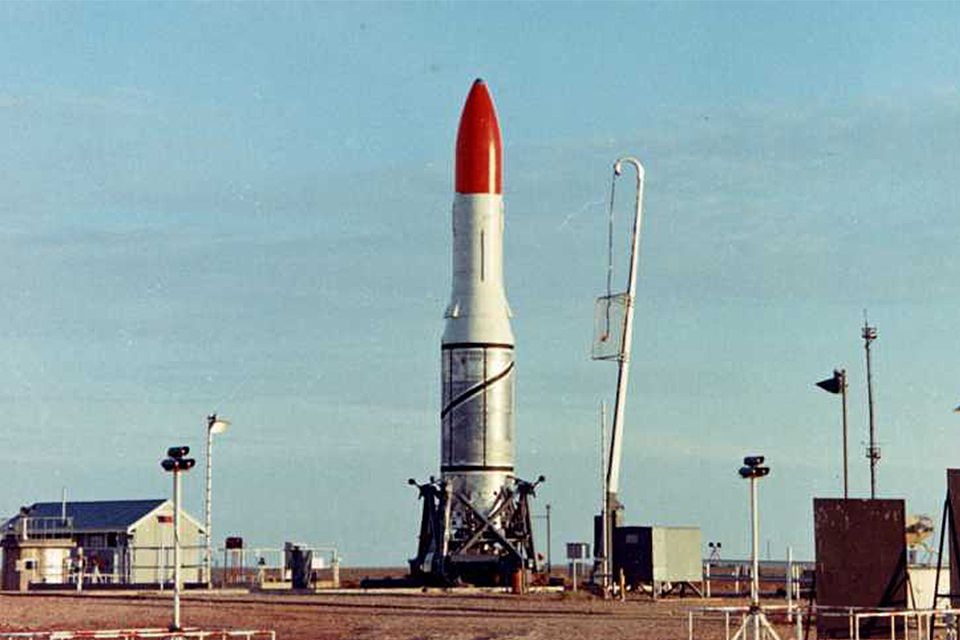
Most of the technology and systems used on Black Arrow had already been developed or flight-proven on the Black Knight rocket or the Blue Steel missile, and the vehicle was designed to reuse as much technology from these earlier programmes as possible to reduce costs and simplify development. Senior staff transferred directly between programmes, including Chief Missile Scientist Roy Dommett, Chief Design Engineer Ray Wheeler, and Deputy Chief Engineer John Underwood. The programme operated under a budget of £3 million per year. The name "Black Arrow" derived from the Ministry of Supply's "Rainbow Codes" policy of assigning colour-and-noun designations to research programmes; the vehicle was also unofficially nicknamed the "Lipstick Rocket" because its bright red payload fairing gave it that appearance.
Five Black Arrow vehicles were built, four of which flew from Launch Area 5B at the RAAF Woomera Range Complex in Australia between 1969 and 1971. The maiden flight (R0) on 28 June 1969 (dated 27 June in one chronology, likely reflecting a timezone convention) failed when an electrical fault caused a pair of first-stage combustion chambers to pivot back and forth; before the vehicle cleared the launch pad it was rolling erratically, and about a minute later it began to disintegrate. After the first-stage engine failed and the rocket fell back to Earth, it was destroyed by range safety. The second launch (R1) on 4 March 1970 was a successful suborbital demonstration flight. The third launch (R2) on 2 September 1970 was the first all-up test and Britain's first attempt to place a satellite into orbit; it failed due to a leak in the second-stage oxidiser pressurisation system that caused early engine cut-off, and the vehicle re-entered over the Gulf of Carpentaria. The fourth launch (R3) on 28 October 1971 successfully placed the 66 kg Prospero satellite into an elliptical low Earth orbit, making the United Kingdom the sixth nation to place a satellite into orbit using an indigenously developed rocket. During the R3 ascent, which took 710 seconds (11.8 minutes) from liftoff to spacecraft separation, the spent upper stage collided with the satellite after separation, breaking one of Prospero's four radio antennas; the spacecraft nevertheless completed its mission and remained operational until 1973.
Minister of State for Trade and Industry Frederick Corfield announced the cancellation of the Black Arrow programme in the House of Commons on 29 July 1971. The Ministry of Defence had calculated that using the American Scout rocket would be cheaper than continuing Black Arrow, and NASA's prior offer to launch British payloads for free was withdrawn following the cancellation decision. Because the R3 vehicle had already been shipped to Woomera, permission was granted for the launch to proceed. The final Black Arrow built (R4) never flew and is preserved at the Science Museum, London, alongside the flight spare of the Prospero satellite. A replica stands in the Rocket Park at Woomera. The first stage of R3 was recovered from the Anna Creek cattle station and returned to the United Kingdom in a preservation initiative led by Skyrora; as of 2024 it is on loan to the Farnborough Air Sciences Trust Museum. As of 2024, the United Kingdom remains the only country to have successfully developed and subsequently abandoned a satellite launch capability.
Specifications
Black Arrow was a three-stage expendable launch vehicle standing 12.87 m (approximately 13 m) tall, with a first-stage diameter of 2 m and a gross mass of 18,130 kg. The first and second stages were fuelled by RP-1 kerosene and high-test peroxide (85% hydrogen peroxide, 15% water); the third stage used a solid propellant motor. The oxidiser tanks were located below the fuel tanks on the first and second stages, following the practice of placing the denser propellant higher to raise the centre of gravity and improve in-flight stability and controllability.
The first stage was powered by a single eight-chamber Gamma 8 engine derived from the Gamma 301 used on Black Knight. The stage measured 6.86 m in length and 1.98 m in diameter, matching the diameter of the French Coralie stage to maintain compatibility with the Blue Streak first stage. First-stage burn time is variously reported as 127, 131, or 142 seconds. Attitude control was provided by thrust vectoring: the eight combustion chambers were arranged in four pairs that could gimbal along one axis, providing roll, pitch, and yaw control when all four pairs were used together.
The second stage measured 2.9 m in length and 1.37 m in diameter and was powered by a two-chamber Gamma 2 engine. Second-stage burn time is variously reported as 113, 116, or 123 seconds. The interstage between the first and second stages contained four Siskin IB separation and ullage motors that separated and ignited seven seconds after first-stage cut-off; the interstage then separated from the second stage six seconds later. The payload fairing separated approximately three minutes after liftoff during the second-stage burn. During the coast phase after second-stage cut-off, the rocket's orientation for third-stage separation was maintained by a reaction control system.
The third stage was a Waxwing solid rocket motor manufactured by the Rocket Propulsion Establishment. It was spin-stabilised, with the stage spun up to 3 Hz (180 rpm) by six Imp rockets near the end of the coast period; it separated five seconds later and ignited after a further ten seconds of coasting. Third-stage burn time is reported as 55 seconds in some references and 28 seconds in others. The guidance system was derived from that of the cancelled BAC TSR-2 bomber.
Payload capacity figures vary by target orbit: 73 kg to a 200 km low Earth orbit, 102 kg to a 500 km orbit, and 135 kg to a 220 km orbit are the values given in the available technical literature. The RAE's original design goal was 144 kg to low Earth orbit. In its standard configuration, Black Arrow was not capable of placing some contemporary satellites into geostationary orbit.
Several unbuilt derivatives were proposed to increase payload capacity, including adding eight Raven solid rocket boosters from the Skylark programme to the first stage, mounting the entire vehicle atop a Blue Streak as an additional first stage, and replacing the Gamma engines with more powerful Larch engines.
 Argentina
 Armenia
 Australia
 Austria
 Austria-Hungary
 Belgium
 Brazil
 United States
 Brunei
 Bulgaria
 Canada
 Chile
 China
 Colonial America
 Colombia
 Confederate States
 Croatia
 Czech
 Denmark
 Egypt
 Finland
 France
 Georgia
 Germany
 German Imperial
 Greece
 Holland
 Hungary
 India
 Indonesia
 Iran
 Iraq
 Ireland
 Israel
 Italy
 Japan
 Japan (1940)
 Jordan
 Kingdom of Italy
 Malaysia
 Mexico
 Myanmar
 Nazi Germany
 Netherlands
 New Zealand
 North Korea
 Norway
 Pakistan
 Peru
 Philippines
 Poland
 Portugal
 Prussia
 Romania

 Russia
 Saudi Arabia
 Serbia
 Singapore
 Slovakia
 Slovenia
 South Africa
 South Korea
 Soviet Union
 Spain
 Sweden
 Switzerland
 Syria
 Taiwan
 Thailand
 Turkey
 UAE
 Ukraine
 Vietnam
 Yugoslavia